

M87, a prominent galaxy in the Virgo cluster, gained fame after the Event Horizon Telescope (EHT) revealed the first image of a black hole in its center.
A subsequent study analyzed data from EHT’s 2018 campaign, reporting a rare gamma-ray flare — marking the first in over a decade — linked to the galaxy’s supermassive black hole. The flare provided valuable insights into emission regions, jet dynamics, and the acceleration of high-energy particles, thanks to a collaboration among leading telescopes and researchers.
M87 and Its Pioneering Observations
M87, also known as Virgo A or NGC 4486, is the brightest galaxy in the Virgo cluster — the largest gravitationally bound structure in the universe. It gained global recognition in April 2019 when the Event Horizon Telescope (EHT) released the first-ever image of the black hole at its center.
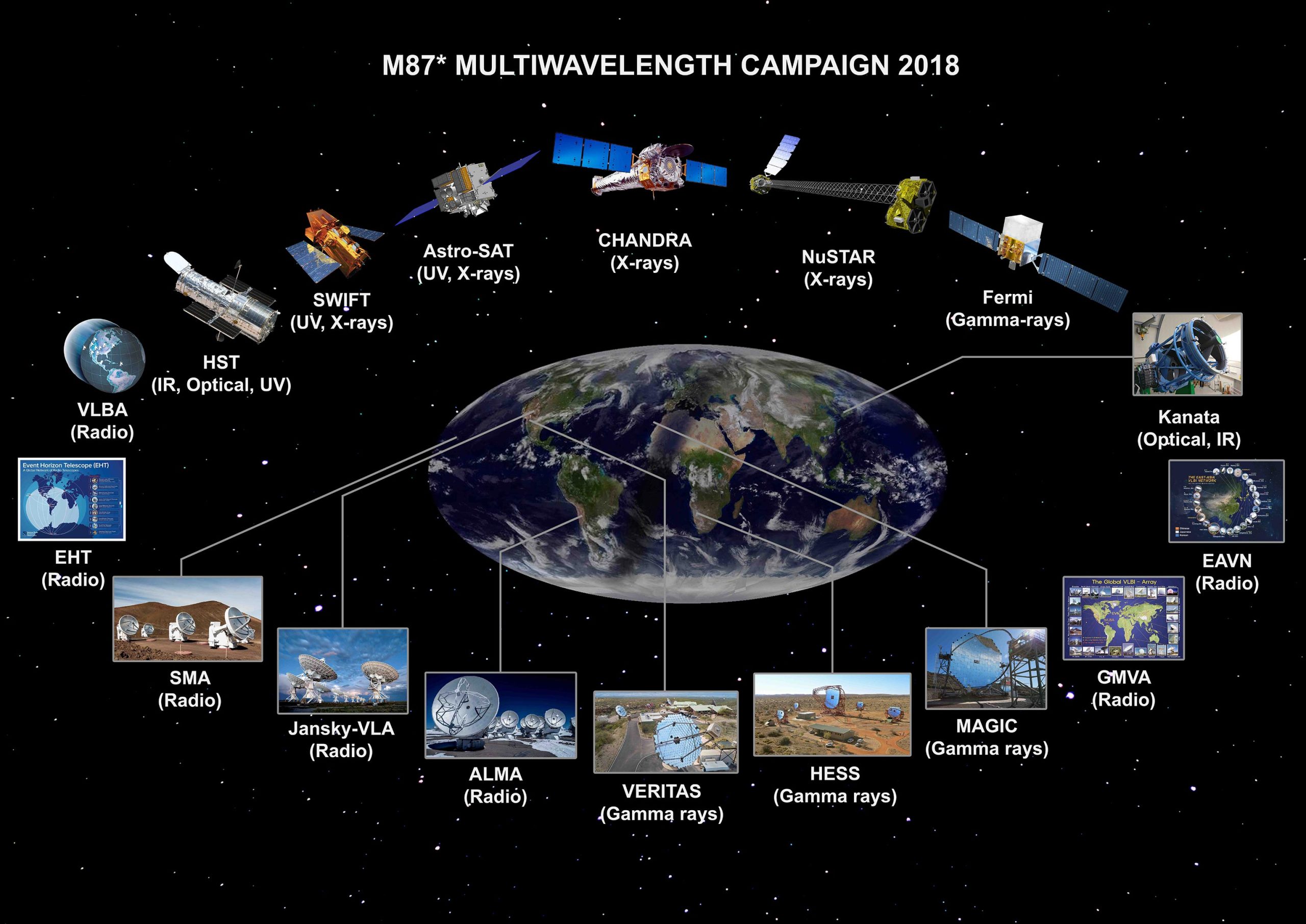
A recent study led by the EHT’s multi-wavelength working group, published in the journal Astronomy & Astrophysics, presents findings from the second EHT observation campaign conducted in April 2018. This campaign involved over 25 telescopes on Earth and in space, making it one of the most comprehensive observational efforts ever undertaken. The researchers reported the first detection of a high-energy gamma-ray flare from M87’s supermassive black hole in more than a decade. The data captured nearly simultaneous observations across the widest range of wavelengths ever recorded for this galaxy.
Groundbreaking Gamma-Ray Flare Detection
“We were lucky to detect a gamma-ray flare from M87 during this Event Horizon Telescope’s multi-wavelength campaign. This marks the first gamma-ray flaring event observed in this source in over a decade, allowing us to precisely constrain the size of the region responsible for the observed gamma-ray emission,” explained Giacomo Principe, one of the paper coordinators, a researcher at the University of Trieste associated with INAF and INFN. The article was published in Astronomy & Astrophysics on December 13.
“Observations — both recent ones with a more sensitive EHT array and those planned for the coming years — will provide invaluable insights and an extraordinary opportunity to study the physics surrounding M87’s supermassive black hole. These efforts promise to shed light on the disk-jet connection and uncover the origins and mechanisms behind the gamma-ray photon emission.”

Relativistic Jet Insights
The relativistic jet examined by the researchers is surprising in its extent, reaching sizes that exceed the black hole’s event horizon by tens of millions of times (7 orders of magnitude) — akin to the difference between the size of a bacterium and the largest known blue whale.
The energetic flare, which lasted approximately three days and suggests an emission region of less than three light-days in size (~170 AU, where 1 Astronomical Unit is the distance from the Sun to Earth), revealed a bright burst of high-energy emission—well above the energies typically detected by radio telescopes from the black hole region.
Unpredictability of Black Hole Flares
“The activity of this supermassive black hole is highly unpredictable – It is hard to forecast when a flare will occur. The contrasting data obtained in 2017 and 2018, representing its quiescent and active phases respectively, provide crucial insights into unraveling the activity cycle of this enigmatic black hole,” says Kazuhiro Hada at Nagoya City University, who led radio observations and analysis of the multi-wavelength campaign.
“The duration of a flare roughly corresponds to the size of the emission region. The rapid variability in gamma rays indicates that the flare region is extremely small, only approximately ten times the size of the central black hole. Interestingly, the sharp variability observed in gamma rays was not detected in other wavelengths. This suggests that the flare region has a complex structure and exhibits different characteristics depending on the wavelength.” explains Daniel Mazin at the Institute for Cosmic Ray Research, The University of Tokyo, a member of the MAGIC telescope team that detected the gamma ray flare.
Advanced Techniques in Multi-Wavelength Astronomy
The second EHT and multi-wavelength campaign in 2018 leveraged more than two dozen high-profile observational facilities, including NASA’s Fermi-LAT, HST, NuSTAR, Chandra, and Swift telescopes, together with the world’s three largest Imaging Atmospheric Cherenkov Telescope arrays (H.E.S.S., MAGIC and VERITAS). These observatories are sensitive to X-ray photons as well as high-energy very-high-energy (VHE) gamma-rays, respectively. During the campaign, the LAT instrument aboard the Fermi space observatory detected an increase in high-energy gamma-ray flux with energies up to billions of times greater than visible light. Chandra and NuSTAR then collected high-quality data in the X-ray band. The East Asian VLBI Network (EAVN) radio observations show an apparent annual change in the jet’s position angle within a few microseconds of arc from the galaxy’s core.
Unraveling Jet Mechanisms Through Observations
“By combining the information about the change in the jet direction, the brightness distribution of the ring observed by the EHT and the gamma-ray activity, we can better understand the mechanisms behind the production of the very-high-energy radiation,” says Motoki Kino at Kogakuin University, a coordinator of the EAVN observations during the campaign.
Data also show a significant variation in the position angle of the asymmetry of the ring (the so-called event horizon of the black hole) and the jet’s position, suggesting a physical relation between these structures on very different scales. The researcher explains: “In the first image obtained during the 2018 observational campaign, it was seen that the emission along the ring was not homogeneous, thus presenting asymmetries (i.e., brighter areas). Subsequent observations conducted in 2018 and related to this paper confirmed the data, highlighting that the asymmetry’s position angle had changed.”
Comparative Models and Future Research Directions
The team also compared the observed broadband multi-wavelength spectra with theoretical emission models. “The flare in 2018 exhibited particularly strong brightening in gamma rays. It is possible that ultra-high-energy particles underwent additional acceleration within the same emission region observed in quiet states, or that new acceleration occurred in a different emission region,” says Tomohisa Kawashima at the Institute for Cosmic Ray Research, who performed a simulation using a supercomputer installed at the National Astronomical Observatory of Japan.
“How and where particles are accelerated in supermassive black hole jets is a longstanding mystery. For the first time, we can combine direct imaging of the near event horizon regions during gamma-ray flares from particle acceleration events and test theories about the flare origins,” says Sera Markoff, a professor at the University of Amsterdam and co-author of the study.
This discovery paves the way for stimulating future research and potential breakthroughs in understanding the universe.
For more on this discovery, see Astronomers Capture Massive Gamma-Ray Flare From M87’s Blazing Black Hole.
Reference: “Broadband multi-wavelength properties of M87 during the 2018 EHT campaign including a very high energy flaring episode” by J. C. Algaba, M. Baloković, S. Chandra, W.-Y. Cheong, Y.-Z. Cui, F. D’Ammando, A. D. Falcone, N. M. Ford, M. Giroletti, C. Goddi, M. A. Gurwell, K. Hada, D. Haggard, S. Jorstad, A. Kaur, T. Kawashima, S. Kerby, J.-Y. Kim, M. Kino, E. V. Kravchenko, S.-S. Lee, R.-S. Lu, S. Markoff, J. Michail, J. Neilsen, M. A. Nowak, G. Principe, V. Ramakrishnan, B. Ripperda, M. Sasada, S. S. Savchenko, C. Sheridan, K. Akiyama, A. Alberdi, W. Alef, R. Anantua, K. Asada, R. Azulay, U. Bach, A.-K. Baczko, D. Ball, B. Bandyopadhyay, J. Barrett, M. Bauböck, B. A. Benson, D. Bintley, L. lackburn, R. Blundell, K. L. Bouman, G. C. Bower, H. Boyce, M. Bremer, R. Brissenden, S. Britzen, A. E. Broderick, D. Broguiere, T. Bronzwaer, S. Bustamante, J. E. Carlstrom, A. Chael, C.-k. Chan, D. O. Chang, K. Chatterjee, S. Chatterjee, M.-T. Chen, Y. Chen, X. Cheng, I. Cho, P. Christian, N. S. Conroy, J. E. Conway, T. M. Crawford, G. B. Crew, A. Cruz-Osorio, R. Dahale, J. Davelaar, M. De Laurentis, R. Deane, J. Dempsey, G. Desvignes, J. Dexter, V. Dhruv, I. K. Dihingia, S. S. Doeleman, S. A. Dzib, R. P. Eatough, R. Emami, H. Falcke, J. Farah, V. L. Fish, E. Fomalont, H. A. Ford, M. Foschi, R. Fraga-Encinas, W. T. Freeman, P. Friberg, C. M. Fromm, A. Fuentes, P. Galison, C. F. Gammie, R. García, O. Gentaz, B. Georgiev, R. Gold, A. I. Gómez-Ruiz, J. L. Gómez, M. Gu, R. Hesper, D. Heumann, L. C. Ho, P. Ho, M. Honma, C.-W. L. Huang, L. Huang, D. H. Hughes, S. Ikeda, C. M. V. Impellizzeri, M. Inoue, S. Issaoun, D. J. James, B. T. Jannuzi, M. Janssen, B. Jeter, W. Jiang, A. Jiménez-Rosales, M. D. Johnson, A. C. Jones, A. V. Joshi, T. Jung, R. Karuppusamy, G. K. Keating, M. Kettenis, D.-J. Kim, J. Kim, J. Kim, …, D. A. Williams, S. L. Wong, Z. Chen, L. Cui, T. Hirota, B. Li, G. Li, Q. Liu, X. Liu, Z. Liu, J. Ma, K. Niinuma, H. Ro, N. Sakai, S. Sawada-Satoh, K. Wajima, J. Wang, N. Wang, B. Xia, H. Yan, Y. Yonekura, H. Zhang, R. Zhao and W. Zhong, 13 December 2024, Astronomy & Astrophysics.
DOI: 10.1051/0004-6361/202450497
Never miss a breakthrough: Join the SciTechDaily newsletter.
Follow us on Google and Google News.