
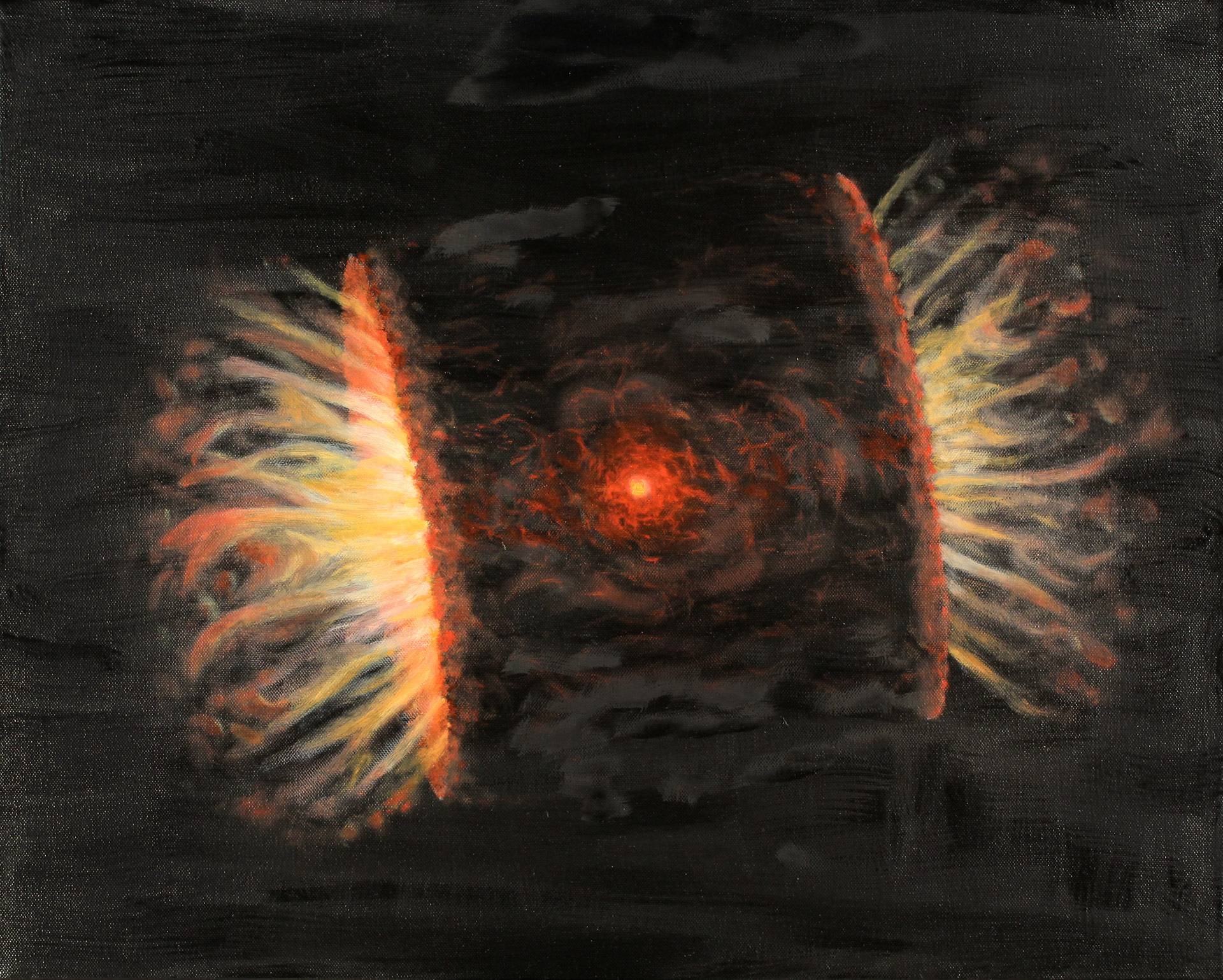
Using the Altair adaptive optics system with the Gemini North Telescope, two NOAO astronomers were able to observe the shell of escaping material around the star known as Sakurai’s Object (V4334 Sgr).
Stellar lifetimes are measured in billions of years, so changes in their appearance rarely take place on a human timescale. Thus an opportunity to observe a star passing from one stage of life to another on a timescale of months to years is very exciting, as there are only a very few examples known. One such star is Sakurai’s Object (V4334 Sgr). First reported by a Japanese amateur astronomer in 1996 as a “nova-like object,” Sakurai’s Object had been only a few years before the faint central star of a planetary nebula. In the 1990’s Sakurai’s Object brightened by a factor of 10000. This brightening has been attributed to a final helium shell flash. In this process the burned out core of the star at the center of the planetary nebula re-ignites.
The final helium shell flash is violent, ejecting a cloud of dust and gas that forms a thick cocoon around the star blocking all visible light. By 2000 the dust cloud was so thick that Sakurai’s Object was not visible even with the Hubble Space Telescope (HST). Scientists at the National Optical Astronomy Observatory (NOAO) have been observing the sky in the area of Sakurai’s Object waiting for infrared radiation to break through the dust cloud. Infrared radiation penetrates dust much more efficiently than optical light. A detection of the infrared light would mean that the dust cloud is breaking apart, ultimately permitting light from the star to escape.
Using the Altair adaptive optics (AO) system with the Gemini North telescope on Mauna Kea in Hawai’i to compensate for distortions to starlight caused by the Earth’s atmosphere, two NOAO astronomers were able to observe the shell of escaping material around the star. According to Dr. Richard Joyce, who was in charge of the imaging program, “Using AO at Gemini gave us an unprecedented view into the heart of this object and showed us a number of faint stars where Sakurai’s Object should be.” The team compared the Gemini images to views by the Hubble Space Telescope, taken before Sakurai’s Object had faded from view, to obtain a precise location for the object. The Gemini AO images have a resolution of 0.04 arc-second (this is equivalent to asking someone to tell if you are holding up one finger or two – from a distance of 200 miles) which clearly resolved many of the stars that ordinarily would be blurred together from ground-based telescopic views. “The initial Gemini images in 2010 showed a faint fuzzy spot near the Sakurai location. It’s amazing that we could see this level of detail,” says Joyce. “By 2013 Sakurai’s Object was obvious at this location with two ejected clouds thanks to these remarkable observations.”
Dr. Kenneth Hinkle, lead author, says, “Sakurai’s object appears to be forming a bipolar nebula: in the past three years two lobes of gas have been observed moving outward from the central star. The bipolar nebula is roughly aligned to the planetary nebula. The planetary nebula is formed from gas lost more than 10,000 years ago by the red giant. The co-alignment suggests that there is either a companion star or planet in the system.” The accompanying artist’s conception represents what the present expanding shell of gas and dust around the star may look like. Because it is enshrouded in dust, Sakurai’s object is much brighter in the infrared region of the spectrum than in visible light. In this illustration, the star appears bright red since blue light from the star is absorbed by the dust.
As stars like the sun reach the end of their lives they expand and cool to become luminous red giants. When their nuclear fuel is exhausted a resulting stellar core, a cooling ember, is called a white dwarf. However, in 10-15 percent of stars like the sun, enough hydrogen and helium remain to start nuclear burning again, rapidly re-igniting the faint white dwarf. This phase is called a final flash. While not uncommon, this pulse lasts for such a short time that seeing it is very rare: there are only three stars currently known to be undergoing final flash evolution. Estimates of the frequency of such a final flash object in our galaxy suggest that one occurs about once every ten years. The previous one observed by astronomers erupted in 1919.
Located in the constellation Sagittarius, in the direction of the center of our Milky Way galaxy, the distance to Sakurai’s object can be measured from the expansion of the dust cloud. The current data show that it is about 6,800 to 12,000 light-years from Earth. As the cloud of debris expands it will be possible to refine our knowledge of the distance and other parameters of this interesting object.
The team’s results will be published in the Astrophysical Journal.
The National Optical Astronomy Observatory (NOAO) is operated by Association of Universities for Research in Astronomy Inc. (AURA) under a cooperative agreement with the National Science Foundation.
Never miss a breakthrough: Join the SciTechDaily newsletter.
Follow us on Google and Google News.