
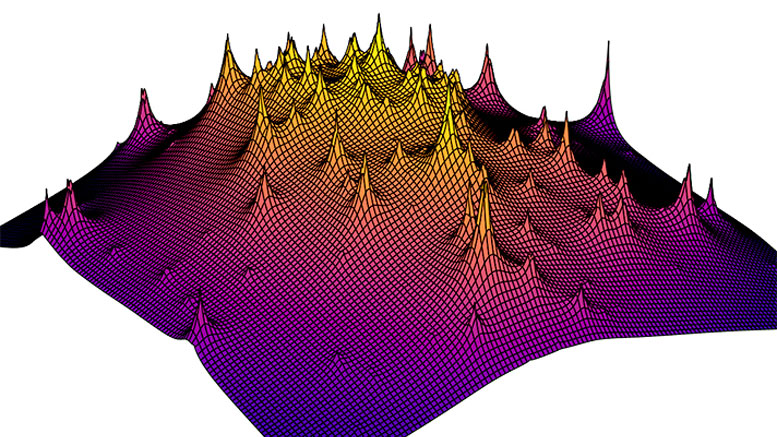
A team of astrophysicists has produced one of the highest-resolution maps of dark matter to date, offering a detailed case for the existence of cold dark matter.
The dark matter map is derived from Hubble Space Telescope Frontier Fields data of a trio of galaxy clusters that act as cosmic magnifying glasses to peer into older, more distant parts of the universe, a phenomenon known as gravitational lensing.
Yale astrophysicist Priyamvada Natarajan led an international team of researchers that analyzed the Hubble images. “With the data of these three lensing clusters we have successfully mapped the granularity of dark matter within the clusters in exquisite detail,” Natarajan said. “We have mapped all of the clumps of dark matter that the data permit us to detect, and have produced the most detailed topological map of the dark matter landscape to date.”
Scientists believe dark matter — theorized, unseen particles that neither reflect nor absorb light, but are able to exert gravity — may comprise 80% of the matter in the universe. Dark matter may explain the very nature of how galaxies form and how the universe is structured. Experiments at Yale and elsewhere are attempting to identify the dark matter particle; the leading candidates include axions and neutralinos.
“While we now have a precise cosmic inventory for the amount of dark matter and how it is distributed in the universe, the particle itself remains elusive,” Natarajan said.
Dark matter particles are thought to provide the unseen mass that is responsible for gravitational lensing, by bending light from distant galaxies. This light bending produces systematic distortions in the shapes of galaxies viewed through the lens. Natarajan’s group decoded the distortions to create the new dark matter map.
Significantly, the map closely matches computer simulations of dark matter theoretically predicted by the cold dark matter model; cold dark matter moves slowly compared to the speed of light, while hot dark matter moves faster. This agreement with the standard model is notable given that all of the evidence for dark matter thus far is indirect, said the researchers.
The high-resolution simulations used in the study, known as the Illustris suite, mimic structure formation in the universe in the context of current accepted theory. A study detailing the findings appeared on February 28 in the journal Monthly Notices of the Royal Astronomical Society.
Other Yale researchers involved in the study were graduate students Urmila Chadayammuri and Fangzhou Jiang, faculty member Frank van den Bosch, and former postdoctoral fellow Hakim Atek. Additional co-authors came from institutions worldwide: Mathilde Jauzac from the United Kingdom and South Africa; Johan Richard, Eric Jullo, and Marceau Limousin from France; Jean-Paul Kneib from Switzerland; Massimo Meneghetti from Italy; and Illustris simulators Annalisa Pillepich, Ana Coppa, Lars Hernquist, and Mark Vogelsberger from the United States.
The research was supported in part by grants from the National Science Foundation, the Science and Technology Facilities Council, and NASA via the Space Telescope Institute HST Frontier Fields initiative.
Reference: “Mapping substructure in the HST Frontier Fields cluster lenses and in cosmological simulations” by Priyamvada Natarajan, Urmila Chadayammuri, Mathilde Jauzac, Johan Richard, Jean-Paul Kneib, Harald Ebeling, Fangzhou Jiang, Frank van den Bosch, Marceau Limousin, Eric Jullo, Hakim Atek, Annalisa Pillepich, Cristina Popa, Federico Marinacci, Lars Hernquist, Massimo Meneghetti and Mark Vogelsberger, 6 February 2017, MNRAS.
DOI: 10.1093/mnras/stw3385
Never miss a breakthrough: Join the SciTechDaily newsletter.
Follow us on Google and Google News.
1 Comment
Dark as it may seem this Dark Matter may not even have matter in it, like trying to grasp air into your hand not everything in our universe fits in our known physics. And to try identify this seem to fit more the finger of God (Biblical Creator) than calling it a “dark matter” you first have to know what kind of matter or substance it is to detect and understand. Then again the universe is a vast unexplored space and we’re only at the tip of our solar system. And to say we can grasp what Dark Matter is in all its splendor is like trying to catch God in His trousers which is ridiculously impossible.