
Close Menu
    Facebook X (Twitter) Instagram
    SciTechDaily
    • Biology
    • Chemistry
    • Earth
    • Health
    • Physics
    • Science
    • Space
    • Technology
    Facebook X (Twitter) Pinterest YouTube RSS
    SciTechDaily
    Home»Space»Astrophysicists Unleash Planetary Power To Probe the Universe’s Deepest Mysteries
    Space

    Astrophysicists Unleash Planetary Power To Probe the Universe’s Deepest Mysteries

    By Hong Kong University of Science and TechnologyJune 5, 2024No Comments3 Mins Read
    Facebook Twitter Pinterest Telegram LinkedIn WhatsApp Email Reddit
    Share
    Facebook Twitter LinkedIn Pinterest Telegram Email Reddit
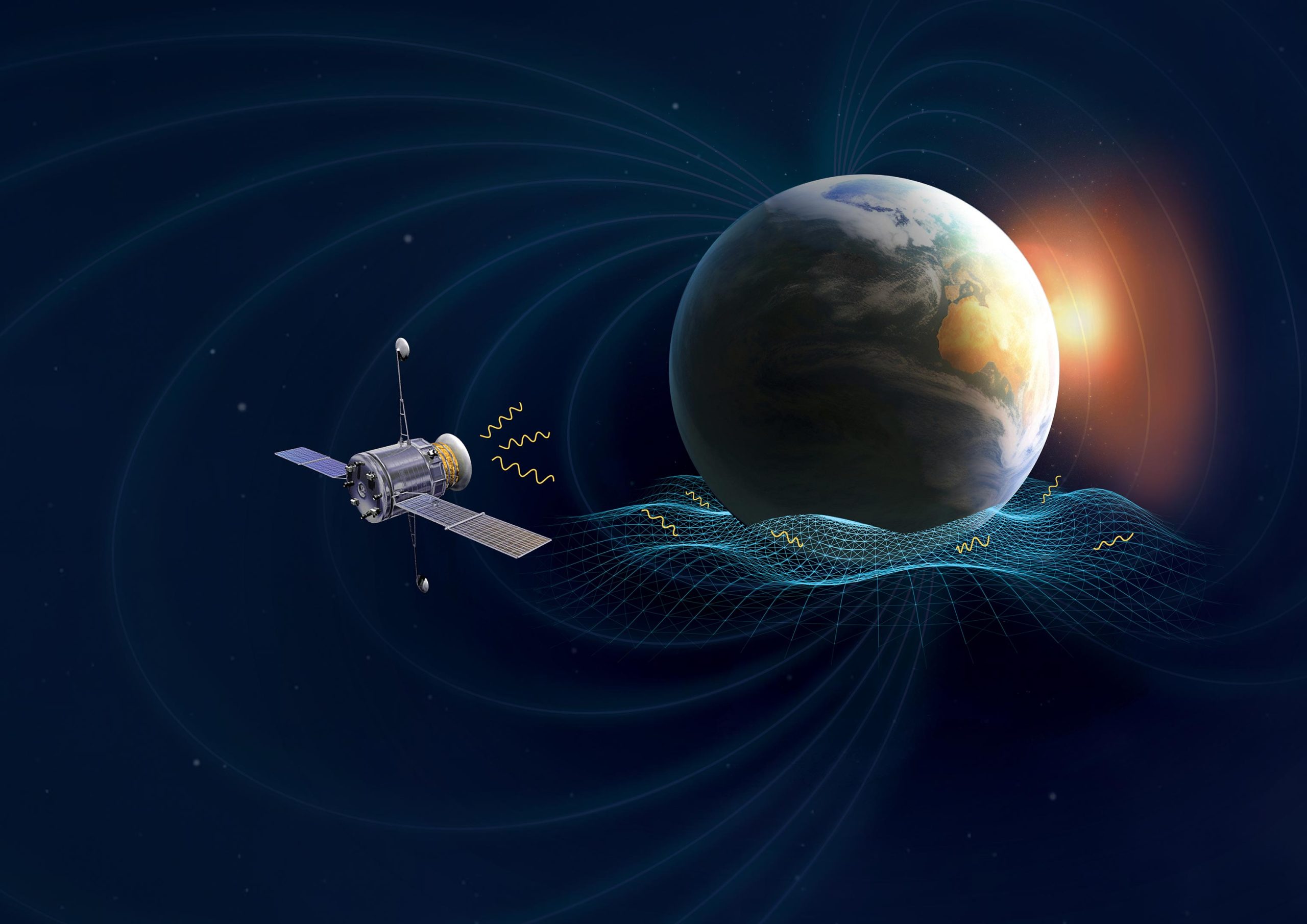
    Astronomical Telescope in the Earth’s Magnetosphere As Gravitational Wave Detector
    The groundbreaking concept proposed by HKUST Department of Physics Prof. Liu’s team allows a single astronomical telescope in the Earth’s magnetosphere to function as a detector for GW signals. Credit: HKUST

    Researchers have introduced an innovative gravitational wave detection method using astronomical telescopes to convert gravitational waves into electromagnetic signals within planetary magnetospheres, facilitating the study of the universe’s early stages and cosmic phenomena.

    Scientists have proposed a groundbreaking method of detecting high-frequency gravitational waves (HFGWs).  Led by Prof. Tao Liu, Associate Professor from the Department of Physics at the Hong Kong University of Science and Technology (HKUST), the research team’s innovative approach may enable the successful detection of HFGWs by utilizing existing and technologically feasible astronomical telescopes in a planetary magnetosphere. This would open up new possibilities for studying the early universe and violent cosmic events in an effective and technically viable way.

    Challenges in Gravitational Wave Observation

    Gravitational waves (GWs) are produced by various astronomical phenomena, such as phase transitions in the early universe and collisions of primordial black holes. However, their effects are extremely weak and have been discovered only in relatively low frequency band using the method of interferometry. Observing the universe using GWs thus presents significant technological challenges, particularly in probing the high-frequency band above one kilohertz, where the usage of interferometry becomes strongly restricted.

    Breakthrough in Electromagnetic Conversion of GWs

    To address this difficulty, Prof. Tao Liu and his postdoctoral fellow Dr. Chen Zhang have collaborated with Prof. Jing Ren from the Institute of High Energy Physics at the Chinese Academy of Sciences, and achieved a significant breakthrough in their recent study. The research capitalizes on the intriguing physical effect that GWs residing within a magnetic field can be converted to potentially detectable electromagnetic waves. By leveraging the extended paths within planetary magnetosphere, the conversion efficiency is increased, yielding more signals of electromagnetic waves. The detection capability can be further enhanced for telescopes with a wide field of view because of the expansive angular distribution of signal flux within such a planet laboratory.

    Advantages of the New Detection Method

    This innovative method allows a single astronomical telescope to function as a detector for GW signals. By combining multiple telescopes, a wide coverage of HFGW frequencies, ranging from megahertz to 1028 hertz, can be achieved. This frequency range is equivalent to the electromagnetic spectrum used in astronomical observations and includes a large portion that has never been explored in the detection of GWs before. The study provides an initial assessment of sensitivity for satellite-based detectors in low Earth orbit and ongoing missions within Jupiter’s magnetosphere.

    The research was published in Physical Review Letters in March and was subsequently highlighted by Nature Astronomy in an article titled “Planet-sized laboratories offer cosmological insights” in May. This emphasizes the significance of the research in paving the way for future studies into novel GW detection technologies.

    References:

    “Limits on High-Frequency Gravitational Waves in Planetary Magnetospheres” by Tao Liu, Jing Ren and Chen Zhang, 28 March 2024, Physical Review Letters.
    DOI: 10.1103/PhysRevLett.132.131402

    “Planet-sized laboratories offer cosmological insights” by Morgan Hollis, 21 May 2024, Nature Astronomy.
    DOI: 10.1038/s41550-024-02285-w

    Never miss a breakthrough: Join the SciTechDaily newsletter.
    Follow us on Google and Google News.

    Astronomy Astrophysics Gravitational Waves Hong Kong University of Science and Technology
    Share. Facebook Twitter Pinterest LinkedIn Email Reddit

    Related Articles

    Gravitational Wave Search No Hum Drum Hunt – “Map to the Potential El Dorado of Gravitational Waves”

    Spinning Neutron Stars Reveal New Insights Into Elusive Continuous Gravitational Waves

    Deciphering the Lives of Double Neutron Stars Using the Ripples in the Fabric of Space and Time

    Gravitational-Wave Scientists’ Brilliant New Method To Refine the Hubble Constant – The Expansion and Age of the Universe

    Whispers From the Dark Side: What Gravitational Waves Can Reveal About Dark Matter

    “Heaviest Black Hole Collision” Detected by Gravitational Waves Might Actually Be a Boson Star Merger

    Massive Stellar Triples Leading to Sequential Binary Black-Hole Mergers

    New Measurement of the Hubble Constant – Rate of Expansion of the Universe – From Combined Observations of Neutron Stars

    Gravitational Wave Search Finds Tantalizing New Clue: Unexplained Fluctuations in Space-Time

    Leave A Reply Cancel Reply

    • Facebook
    • Twitter
    • Pinterest
    • YouTube

    Don't Miss a Discovery

    Subscribe for the Latest in Science & Tech!

    Trending News

    Collapsing Plasma May Hold the Key to Cosmic Magnetism

    This Breakthrough Solar Panel Generates Power From Both Sunlight and Raindrops

    Scientists Uncover New Metabolic Effects Beyond Weight Loss of Mounjaro

    Scientists Discover Cancer Tumors Are “Addicted” to This Common Antioxidant

    1,800 Miles Down: Scientists Uncover Mysterious Movements at the Edge of Earth’s Core

    Scientists Discover Hidden “Good Fats” in Green Rice That Could Transform Nutrition

    Your Child’s Clothes Could Contain Toxic Lead, Study Finds

    Researchers Break a 150-Year-Old Math Law With a Surprising Donut Discovery

    Follow SciTechDaily
    • Facebook
    • Twitter
    • YouTube
    • Pinterest
    • Newsletter
    • RSS
    SciTech News
    • Biology News
    • Chemistry News
    • Earth News
    • Health News
    • Physics News
    • Science News
    • Space News
    • Technology News
    Recent Posts
    • Natural Oils vs. Antibiotics: The Swine Study That Could Change Farming
    • The Biggest Volcanic Event in Earth’s History Transformed an Entire Oceanic Plate
    • Scientists Warn: Humanity Has Pushed the Planet Past Its Limits
    • Stronger Flu Shot Linked to Nearly 55% Lower Alzheimer’s Risk, Study Finds
    • Researchers Say That Eating Mango With Avocado Offers Surprising Heart Benefits
    Copyright © 1998 - 2026 SciTechDaily. All Rights Reserved.
    • Science News
    • About
    • Contact
    • Editorial Board
    • Privacy Policy
    • Terms of Use

    Type above and press Enter to search. Press Esc to cancel.