
Close Menu
    Facebook X (Twitter) Instagram
    SciTechDaily
    • Biology
    • Chemistry
    • Earth
    • Health
    • Physics
    • Science
    • Space
    • Technology
    Facebook X (Twitter) Pinterest YouTube RSS
    SciTechDaily
    Home»Chemistry»Atomic Disorder in Surface Materials Is Key to Better Hydrogen Storage
    Chemistry

    Atomic Disorder in Surface Materials Is Key to Better Hydrogen Storage

    By Lawrence Livermore National LaboratoryNovember 29, 2021No Comments3 Mins Read
    Facebook Twitter Pinterest Telegram LinkedIn WhatsApp Email Reddit
    Share
    Facebook Twitter LinkedIn Pinterest Telegram Email Reddit
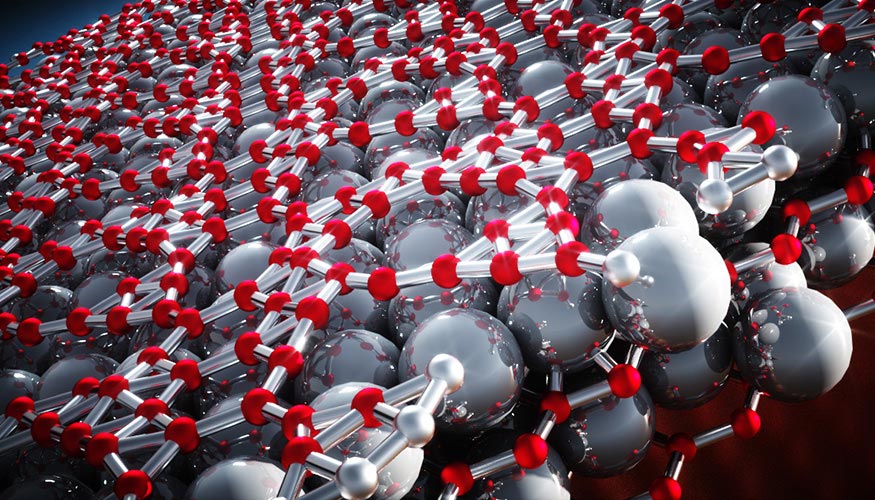
    Disordered Boron Surface Structure
    Disordered boron surface structure of magnesium diboride probed by atomistic modeling. Credit: LLNL

    Atomic disorder on boron-based materials boosts hydrogen uptake rates and may reshape how scientists design materials for energy storage and advanced technologies.

    Lawrence Livermore National Laboratory (LLNL) scientists have found that atomic disorder in certain boron-based hydrogen storage systems can potentially improve the rate of hydrogen uptake.

    Metal boride surfaces and their single-layer variants — known as borophenes — are generally thought to feature a regular arrangement of atoms at low to moderate temperatures. The LLNL team proved that in many cases, these atoms actually disorder dynamically: a surprising phenomenon in contrast to conventional understanding of how most solid-state surfaces behave. The surface disorder means each atomic site has different local properties. According to the team’s research, some of these sites can make dissociation of hydrogen molecules easier, which in turn is expected to accelerate activation of the material during hydrogen storage.

    Broad Impact Across Energy and Electronic Technologies

    The findings have implications for other applications, too. In addition to hydrogen storage, metal borides and borophenes can be used for superconductivity, electrocatalysis, optoelectronics, and as coatings for thermal and corrosion resistance. In several of these applications, the specific boron surface atom arrangements play an outsized role in determining the overall performance.

    When performing in silico design of materials whose functions — hydrogen storage, superconducting performance, electrocatalytic reactivities — are closely tied to their surface configurations, a comparison of apples and oranges occurs if the assumption of static, ordered surfaces does not actually hold.

    “What we found here is an exceptional example, showing surfaces of a crystalline material can actually be amorphous and dynamic. We need to rigorously revisit some of our basic assumptions in the surface science community,” said LLNL materials scientist Sichi Li, lead author of a paper appearing in Nature Communications.

    “If the surfaces are crystalline and ordered, every site is basically the same. Disordered surfaces create a whole range of surface reactivities. If we can use this capability, it could be a new approach for custom-tuning surface functionality for faster energy storage and conversion,” said LLNL materials scientist and co-author Brandon Wood, who leads the LLNL team on materials-based hydrogen storage.

    Reference: “Spontaneous dynamical disordering of borophenes in MgB2 and related metal borides” by Sichi Li, Harini Gunda, Keith G. Ray, Chun-Shang Wong, Penghao Xiao, Raymond W. Friddle, Yi-Sheng Liu, ShinYoung Kang, Chaochao Dun, Joshua D. Sugar, Robert D. Kolasinski, Liwen F. Wan, Alexander A. Baker, Jonathan R. I. Lee, Jeffrey J. Urban, Kabeer Jasuja, Mark D. Allendorf, Vitalie Stavila and Brandon C. Wood, 1 November 2021, Nature Communications.
    DOI: 10.1038/s41467-021-26512-4

    Other LLNL authors include Keith Ray, Penghao Xiao, ShinYoung Kang, Alexander Baker and Jonathan Lee.

    The work is funded by the Department of Energy, Office of Energy Efficiency and Renewable Energy, Hydrogen and Fuel Cell Technologies Office, through the Hydrogen Storage Materials Advanced Research Consortium (HyMARC).

    Never miss a breakthrough: Join the SciTechDaily newsletter.
    Follow us on Google and Google News.

    DOE Energy Hydrogen Lawrence Livermore National Laboratory
    Share. Facebook Twitter Pinterest LinkedIn Email Reddit

    Related Articles

    Cutting Costs and Increasing Efficiency: New Catalyst Revolutionizes Hydrogen Production

    Extracting a Clean Fuel From Water – A Groundbreaking Low-Cost Catalyst

    Department of Energy’s “Fairly Simple” Breakthrough Makes Accessing Stored Hydrogen More Efficient

    Unusual Property in Hydrogen Fuel Device Discovered – Could Be Ultimate Guide to Self-Improvement

    Tuning Electrode Surfaces to Drive the Sunlight-Powered Reactions That Split Water Into Clean Fuel

    Speeding Toward Improved Hydrogen Fuel Production With a New Nanomaterial

    Researchers Find New Way to Convert Carbon Dioxide Into Usable Fuel

    New Electrolyte Improves Cycle Life of Next-Generation Lithium-Ion Batteries

    Turning CO2 Into Fuels, Plastics and Other Valuable Products

    Leave A Reply Cancel Reply

    • Facebook
    • Twitter
    • Pinterest
    • YouTube

    Don't Miss a Discovery

    Subscribe for the Latest in Science & Tech!

    Trending News

    Bone-Strengthening Discovery Could Reverse Osteoporosis

    Scientists Uncover Hidden Trigger Behind Stem Cell Aging

    Scientists Find Way to Reverse Fatty Liver Disease Without Changing Diet

    Could Humans Regrow Limbs? New Study Reveals Promising Genetic Pathway

    Scientists Reveal Eating Fruits and Vegetables May Increase Your Risk of Lung Cancer

    Scientists Reverse Brain Aging With Simple Nasal Spray

    Scientists Uncover Potential Brain Risks of Popular Fish Oil Supplements

    Scientists Discover a Surprising Way To Make Bread Healthier and More Nutritious

    Follow SciTechDaily
    • Facebook
    • Twitter
    • YouTube
    • Pinterest
    • Newsletter
    • RSS
    SciTech News
    • Biology News
    • Chemistry News
    • Earth News
    • Health News
    • Physics News
    • Science News
    • Space News
    • Technology News
    Recent Posts
    • Europe’s Most Active Volcano Just Got Stranger – Here’s Why Scientists Are Rethinking It
    • Why Are Giant Ants Letting Tiny Ants Crawl All Over Them?
    • Revolutionary Technique Sends Healthy Mitochondria Exactly Where They’re Needed
    • This Student Recreated the Universe in a Bottle. What She Discovered Could Help Reveal How Life Started on Earth
    • Alzheimer’s Symptoms May Start Outside the Brain, Study Finds
    Copyright © 1998 - 2026 SciTechDaily. All Rights Reserved.
    • Science News
    • About
    • Contact
    • Editorial Board
    • Privacy Policy
    • Terms of Use

    Type above and press Enter to search. Press Esc to cancel.