
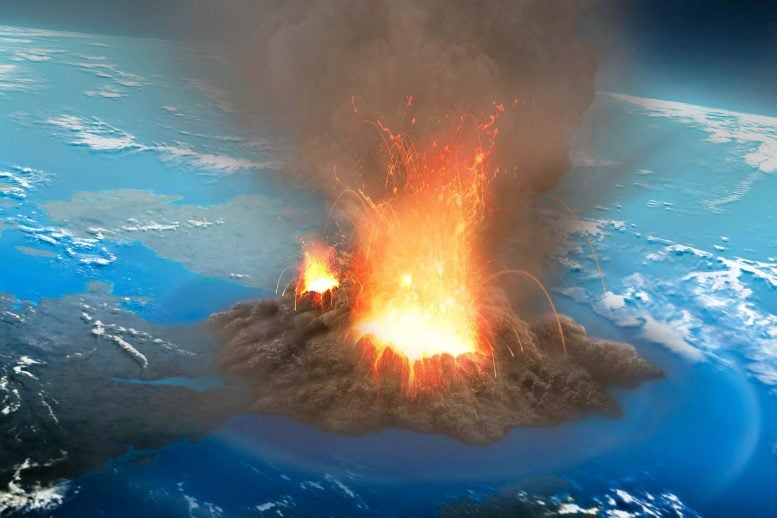
A new study has implications for how the world might be better protected against future volcano collapses.
An international study led by Monash scientists has discovered how volcanoes experience stress. The study, published recently in Scientific Reports, has implications for how the world might be better protected against future volcano collapses.
Volcanic collapse is the worst-case scenario during volcanic crises. It can trigger dangerous tsunamis or devastating pyroclastic flows (for example Mount Saint Helens).
“But, these events are very difficult to predict because we often don’t know what is happening inside active volcanoes, and what forces might make them unstable,” said lead study author Dr. Sam Thiele, a recent PhD graduate from the Monash University School of Earth, Atmosphere and Environment.
“Research on volcano growth helps us to understand these internal processes and the associated forces that could trigger a deadly collapse or eruption,” he said.
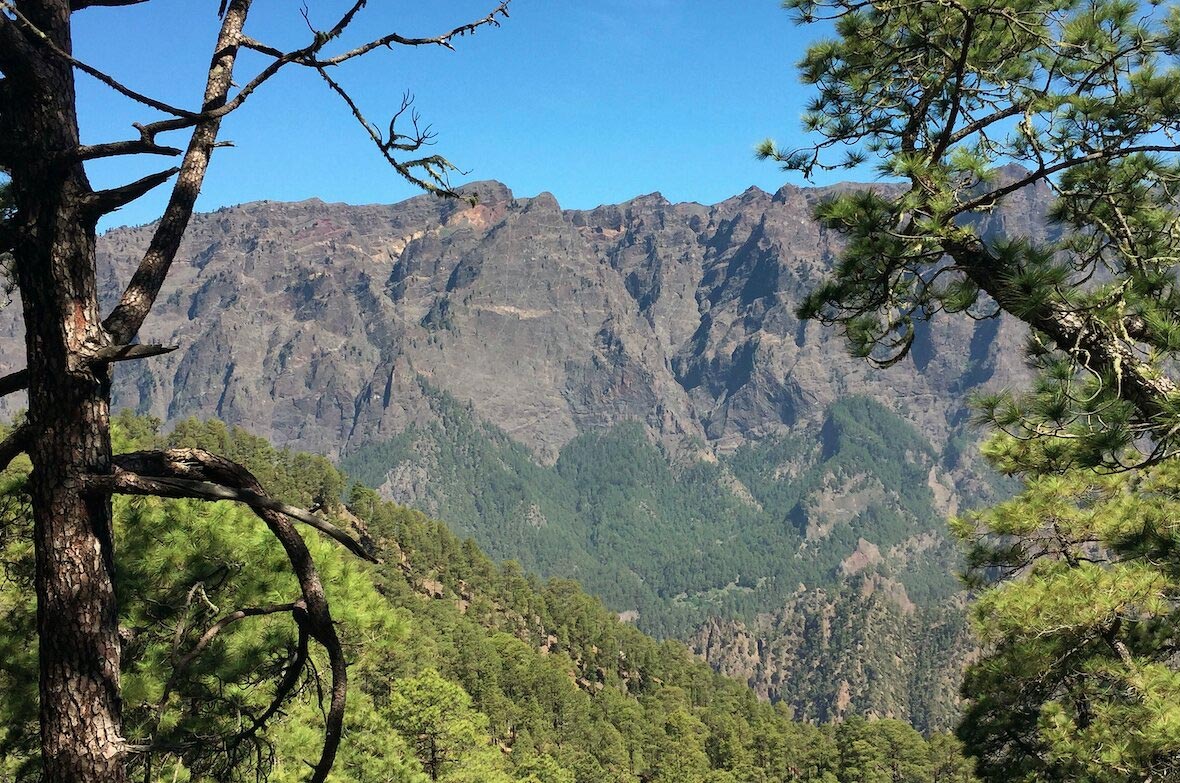
The research team used drones to create a cm-resolution map of the internal structure of a now dormant volcano on La Palma in the Canary Islands, and measured the width of hundreds of thousands of cracks through which magma flowed during past eruptions.
This allowed them to estimate the forces acting within the volcano, and show that these slowly build up over time, causing the volcano to become ‘stressed’ and potentially unstable.
By measuring the width of cracks in the volcano through which magma was transported they were able to estimate the forces involved, which helps to predict future volcanic eruptions.
The geological features that the research team mapped are formed when molten intrusions, called dykes, solidify to form a framework inside what is otherwise a comparatively weak structure comprising mostly layers of lava and ash.
“This is one of the first studies to look at the long-term effects of magma movement within a volcano,” said study co-author Professor Sandy Cruden, from the Monash University School of Earth, Atmosphere and Environment.
“We found that volcanoes gradually become ‘stressed’ by repeated movement of this magma, potentially destabilizing the whole volcano, influencing future collapses and eruptions,” he said.
Reference: “Dyke apertures record stress accumulation during sustained volcanism” by Samuel T. Thiele, Alexander R. Cruden, Steven Micklethwaite, Andrew P. Bunger and Jonas Köpping, 15 October 2020, Scientific Reports.
DOI: 10.1038/s41598-020-74361-w
Never miss a breakthrough: Join the SciTechDaily newsletter.
Follow us on Google and Google News.
9 Comments
“Dyke” is the British/colonial spelling of what American geologists call dikes. Americans give a different meaning to dyke. I’m surprised to see the British spelling in what I presume to be an American news outlet. It is inconsistent with the normal preference for American spellings.
I can see how the dissection and expansion of the walls of a volcano can contribute to flank failures, as with Mount St. Helens. However, the classic explanation of a caldera collapse is the rapid expulsion of the contents of the magma chamber, and consequent loss of support of the overlying edifice. I don’t really see anything in the article to disprove that.
It is a pleasure to see British spellings. Also the use of metric in ‘the 2km high cliff’ American spelling and imperial units can grate at times. Monash University is in Australia.
“Monash University is in Australia.” Yes, a former British colony!
If you find American spelling to be grating, then surely you can be sympathetic to an American finding British spelling on an American website to be grating.
“A 2km high cliff that exposes the core of the Tuburiente volcano — you can just see the igneous ‘dykes’ that transported magma inside the volcano.”
I can just see horizontal structures. Are they the igneous dykes?
From Encyclopedia Britannica: “Dike, also called dyke or geological dike, in geology, tabular or sheetlike igneous body that is often oriented vertically or steeply inclined to the bedding of preexisting intruded rocks; similar bodies oriented parallel to the bedding of the enclosing rocks are called sills. A dike set is composed of several parallel dikes; when the number of dikes is large, the term dike swarm is used. Dikes have a wide range of rock compositions. They commonly have a porphyritic texture, i.e., larger crystals within a finer-grained ground mass, indicating two periods of crystallization.”
There is a much clearer picture showing volcanic dikes as shown in an Alaskan geological formation at: https://www.britannica.com/science/dike-igneous-rock
Britannica used both ‘dikes’ and ‘dykes’ to describe these phenomenons; they don’t seem too concerned about using the work equally in both the the definition, which is a direct quotation from the encyclopedia. In fact, the word ‘dike’ was used more on the definition that the ‘dyke’ word. Possibly they were trying to avoid the slang word that refers to a lesbian.
“Possibly they were trying to avoid the slang word that refers to a lesbian.”
Possibly, but I’m not a mind reader. It is customary to put the preferred or most commonly used word first in a definition. The American Geological Institute’s “Dictionary of Geological Terms” states succinctly, “dyke English spelling of dike.”
It refers “dyke swarm” to “See dike SWARM.”
The volcanoes are only going to get worse. We have huge planets inside out lunar distance, magnetically grabbing earth. Don’t believe me, go outside of your lightzone, look N-NE after sunset. You will see massive dark areas blocking the stars. Look closely and you will see circumference. Earth has been turning on it’s side since October 2010. Look at your moon when it first comes up. Take a pic, then take a pic every three hours till it sets. It appears to be doing a cartwheel but, if you look closely the craters roll with the shadow.
why is science so great? another problem to figure out!😊