

Researchers have uncovered how atoms subtly rearrange themselves for up to a trillionth of a second before releasing low-energy electrons after X-ray excitation.
Together with collaborators from around the world, scientists from the Molecular Physics Department at the Fritz Haber Institute have uncovered how atoms change their arrangement before emitting low energy electrons during a decay triggered by X-ray radiation. For the first time, the team was able to resolve the timing of this process in detail, offering new insight into mechanisms that contribute to radiation damage.
Radiation-induced decay processes
When high-energy radiation, such as X-rays, interacts with matter, it can leave atoms and molecules in excited, unstable states. Those excited states typically relax through decay processes that can break chemical bonds and disrupt the biomolecules that cells rely on. Because many different decay routes can follow the initial hit, identifying the specific steps and their timing is a key part of understanding why radiation can be so damaging, and how that damage might be limited.
In this study, the team focused on electron-transfer-mediated decay (ETMD), a mechanism that is especially important in radiation chemistry and biological damage research because it can produce low-energy electrons through interactions between neighboring atoms. In ETMD, an irradiated atom relaxes by taking an electron from a nearby partner, and the energy released in that transfer then ionizes another neighbor. In other words, the decay is non local, with multiple atoms sharing the burden of stabilizing the system.
Using a carefully chosen model system, the team was able to follow how atoms move and reorganize themselves before this unusual electronic decay takes place. Their results represent the most detailed view so far of ETMD in both real space and real time.
Sophisticated combination of experiment and theory
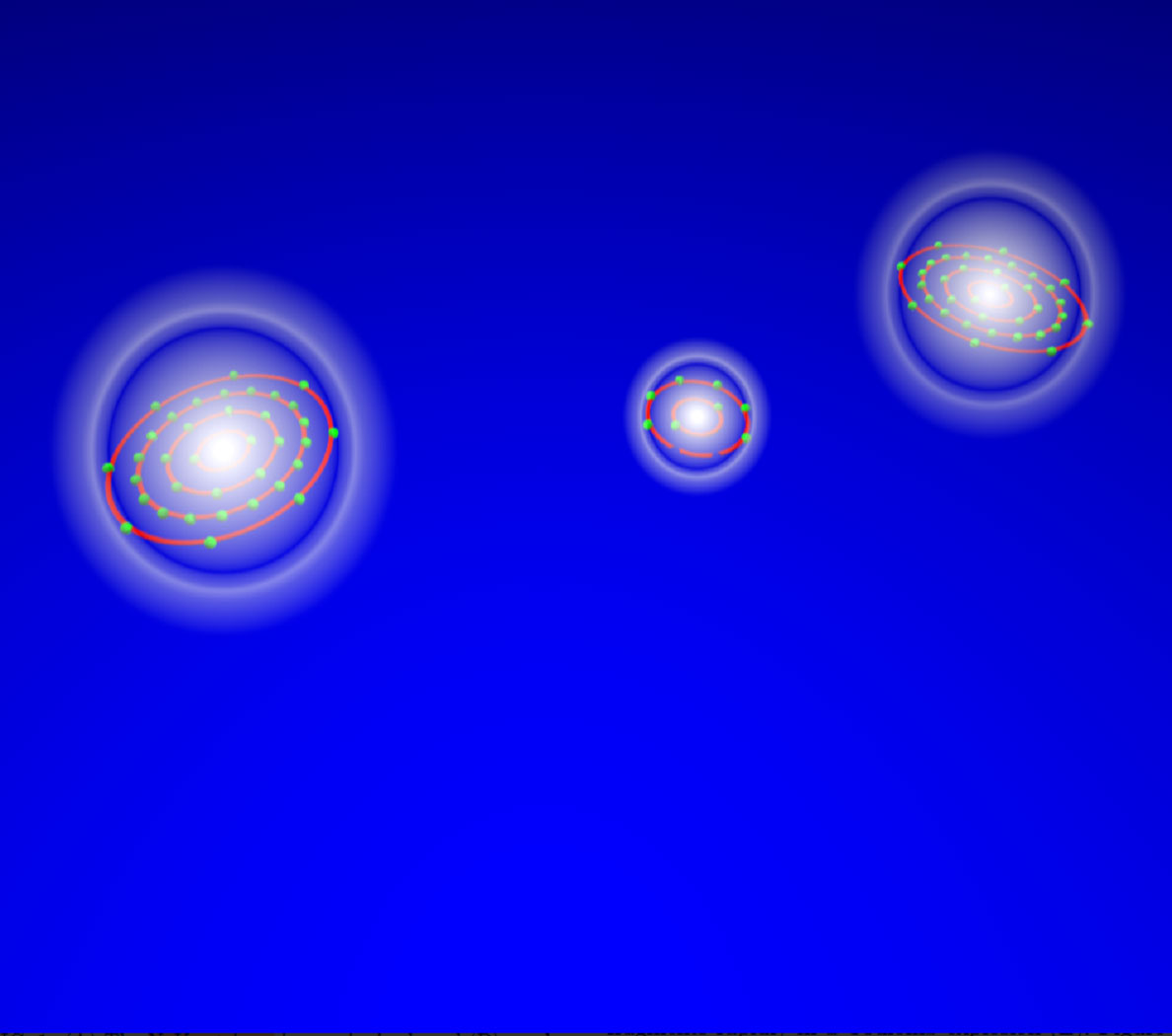
To achieve this, the international collaboration studied a simple system made up of one neon atom weakly bound to two krypton atoms (NeKr2 trimer). After the neon core was ionized with soft X-rays, the scientists tracked the system for up to one picosecond, a very long time on the atomic scale, before it ultimately decayed by transferring an electron between neighboring atoms and releasing a low-energy electron.
The measurements were carried out using an advanced COLTRIMS reaction microscope at the synchrotron facilities BESSY II (Berlin) and PETRA III (Hamburg). This allowed the researchers to reconstruct the exact arrangement of the atoms at the moment the decay occurred. To fully understand the experimental data, they also performed fully dimensional ab initio simulations, following thousands of possible atomic motion pathways and calculating the likelihood of decay along each one.
Taking a movie of the non-local electronic decay
What they discovered was striking: the atoms do not remain frozen in their initial configuration. Instead, they undergo pronounced roaming-like motion, continuously reshaping the molecular geometry and strongly influencing when and how the decay occurs.
“We can literally watch how the atoms move before the decay happens,” says Florian Trinter, one of the lead authors. “The decay is not just an electronic process – it is steered by nuclear motion in a very direct and intuitive way.”
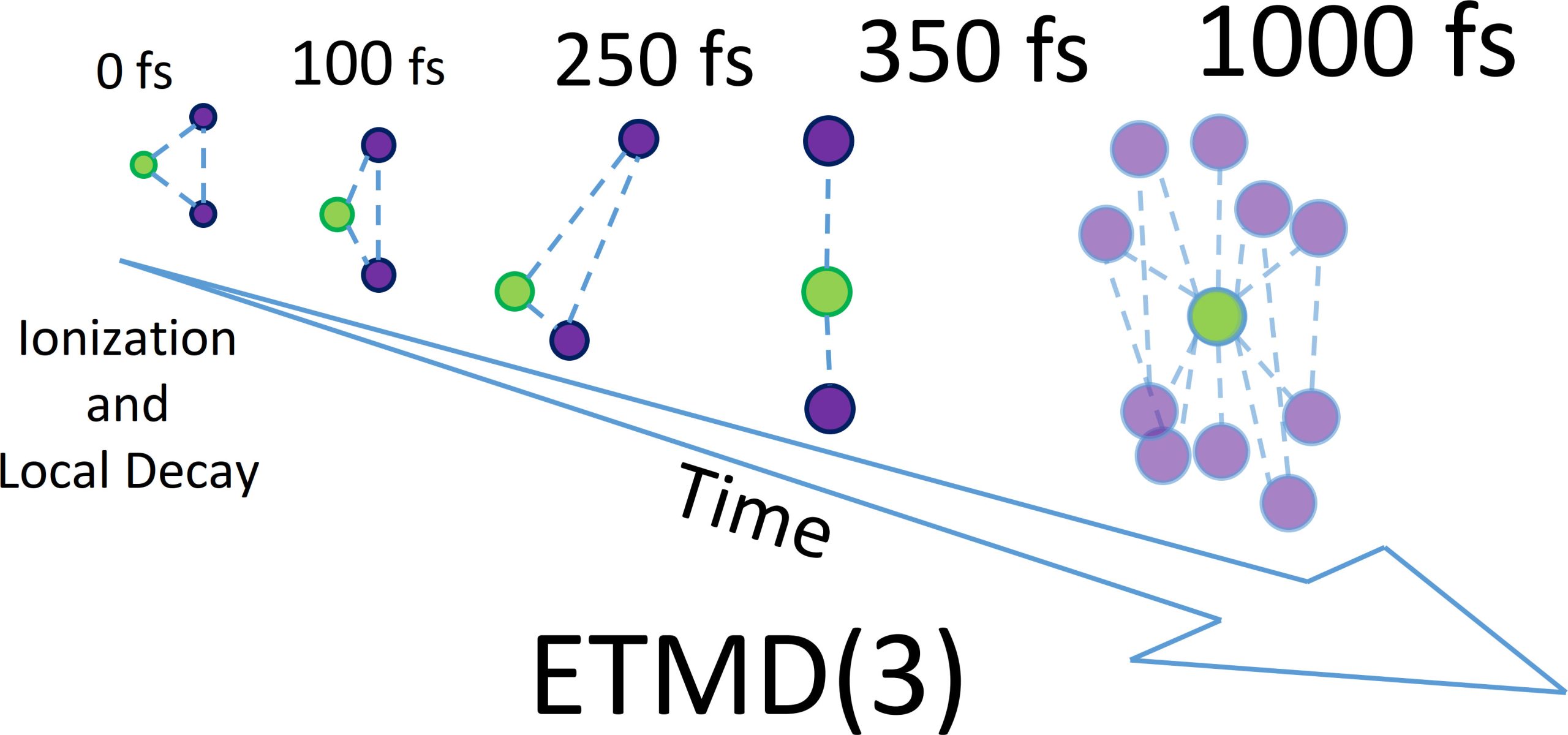
The results reveal that ETMD does not happen from a single “preferred” structure. Instead, different molecular geometries dominate at different times: At early times, the decay occurs near the ground-state geometry, while at intermediate times one krypton atom approaches the neon atom closely and the second drifts farther away – an optimal setup for electron donation and long-range energy transfer. At later times, the system explores almost linear and highly distorted configurations, reflecting a pendular, roaming-like motion of the atoms. This dynamic reshaping leads to strongly time-dependent decay rates, varying by nearly an order of magnitude depending on geometry.
“The atoms explore large regions of configuration space before the decay finally takes place,” explains Till Jahnke, senior author of the study. “This shows that nuclear motion is not a minor correction – it fundamentally controls the efficiency of non-local electronic decay.”
Why It Matters
ETMD has attracted increasing attention because it efficiently produces low-energy electrons, which are known to cause chemical damage in liquids and biological matter. Understanding how ETMD depends on molecular structure and motion is therefore crucial for modeling radiation damage in water and biomolecular environments, as well as for interpreting ultrafast X-ray experiments. Moreover, the current findings are very helpful for developing multiscale theoretical approaches that embed accurate decay rates into large, complex systems.
By providing a detailed benchmark for the smallest system that supports ETMD involving three atoms, the present study lays the groundwork for extending these ideas to liquids, solvated ions, and biological environments.
“This work shows how non-local electronic decay can be used as a powerful probe of molecular motion,” the authors conclude. “It opens the door to imaging ultrafast dynamics in weakly bound matter with unprecedented detail.”
Reference: “Tracking the Complex Dynamics of Electron-Transfer-Mediated Decay in Real Space and Time” by Florian Trinter, Jaroslav Hofierka, Jonas Rist, Max Kircher, Miriam Weller, Niklas Melzer, Dimitrios Tsitsonis, Angelina Geyer, Jan Kruse, Gregor Kastirke, Joshua B. Williams, Tsveta Miteva, Reinhard Dörner, Markus S. Schöffler, Maksim Kunitski, Nicolas Sisourat, Lorenz S. Cederbaum and Till Jahnke, 22 January 2026, Journal of the American Chemical Society.
DOI: 10.1021/jacs.5c15510
Funding: Deutsche Forschungsgemeinschaft, European Research Council
Never miss a breakthrough: Join the SciTechDaily newsletter.
Follow us on Google and Google News.
5 Comments
Atoms Don’t Sit Still: Scientists Catch Them Roaming Before X-Ray Damage Strikes。
WHY?
What will remain still?
Ignoring pseudoscience will only make so-called science more hypocritical and contemptible. Ask researchers: How do you understand particles?
The value of scientific theory lies in revealing truth rather than maintaining dogma. In today’s physics, some so-called peer-reviewed publications — including the Proceedings of the National Academy of Sciences, Physical Review Letters, Science, Nature, and others—stubbornly insist on and promote the following:
1. Even though θ and τ particles exhibit differences in experiments, physics can claim they are the same particle. This is science.
2. Even though topological vortices and antivortices have identical structures and opposite rotational directions, physics can define their structures and directions as entirely different. This is science.
3. Even though two sets of cobalt-60 rotate in opposite directions and experiments reveal asymmetry, physics can still define them as mirror images of each other. This is science.
4. Even though vortex structures are ubiquitous—from cosmic accretion disks to particle spins—physics must insist that vortex structures do not exist and require verification. Only the particles that like God, Demonic, or Angelic are the most fundamental structures of the universe. This is science.
5. Even though everything occupies space and maintains its existence in time, physics must still debate and insist on whether space exists and whether time is a figment of the human mind. This is science.
6. Even though space, with its non-stick, incompressible, and isotropic characteristics, provides a solid foundation for the development of physics, physics must still insist that the ideal fluid properties of space do not exist. This is science.
and so on.
Contemporary physics and so-called peer-reviewed publications (including the Proceedings of the National Academy of Sciences, Physical Review Letters, Science, Nature, Science Bulletin, etc.) stubbornly believe that two sets of counter rotating cobalt-60 are two mirror images of each other, constructing a more shocking pseudoscientific theoretical framework in the history of science than the “geocentric model”. This pseudo scientific framework and system have seriously hindered scientific progress and social development.
These guys and the so-called peer-reviewed publications they manipulate no longer know what shame is:
Example 1
Two sets of cobalt-60 are manually rotated in opposite directions, and even without detection, people around the world know that they will not be symmetrical because these two objects are not mirror images of each other at all. However, a group of so-called physicists and so-called academic publications do not believe it. They conducted experiments and the results were indeed asymmetric, but they still firmly believed that these two objects were mirror images of each other, and the asymmetry was due to a violation of the previous natural laws (CP violation). In the history of science, there can never be a dirtier and uglier operation and explanation than this.
—— Excerpted from https://scitechdaily.com/what-happens-when-light-gains-extra-dimensions/#comment-947619.
Example 2
Please see how the so-called “mystery of θ – τ” is explained: θ and τ are completely identical in all measurable physical properties such as mass, lifetime, charge, spin, etc. However, experimental observations have shown that the θ meson decays into two π mesons, while the τ meson decays into three π mesons, making it difficult for physicists to explain why they are so similar. Physicist Martin Block proposed a highly challenging idea: θ and τ are the same particle, but in weak interactions, parity is not conserved. An easy to understand explanation is the following analogy:: There are two boxes of apples with identical weight, color, and taste. However, when one box is opened, there are two apples, while when the other box is opened, there are three apples. This confuses the old farmer who buys apples. He circled around the orchard and came up with a highly challenging idea: these two boxes of apples are not from the same tree, so they are the same.
—— Excerpted from https://scitechdaily.com/what-happens-when-light-gains-extra-dimensions/#comment-947686.
Any so-called evidence tainted by human intervention risks distorting our understanding and cognition of the intrinsic dynamics of natural laws.
—— Excerpted from https://zhuanlan.zhihu.com/p/1996561896279667777.
Using a carefully chosen model system, the team was able to follow how atoms move and reorganize themselves before this unusual electronic decay takes place. Their results represent the most detailed view so far of ETMD in both real space and real time.
VERY GOOD.
Science should place greater value on observing phenomena in their natural state, understanding laws from a holistic, self-organizing perspective. Artificial evidence must be grounded in nature, avoiding the direct equating of phenomena under extreme conditions with nature’s essence. Only in this way can humanity move closer to the profound and self-consistent truth of nature.
—— Excerpted from https://zhuanlan.zhihu.com/p/2002360899126724079.
Physics needs more people who care about physics and science, rather than so-called peer-reviewed publications — including the Proceedings of the National Academy of Sciences, Physical Review Letters, Science, Nature, and others — their brown-noses (small flatters) — such as Science Bulletin, etc.