
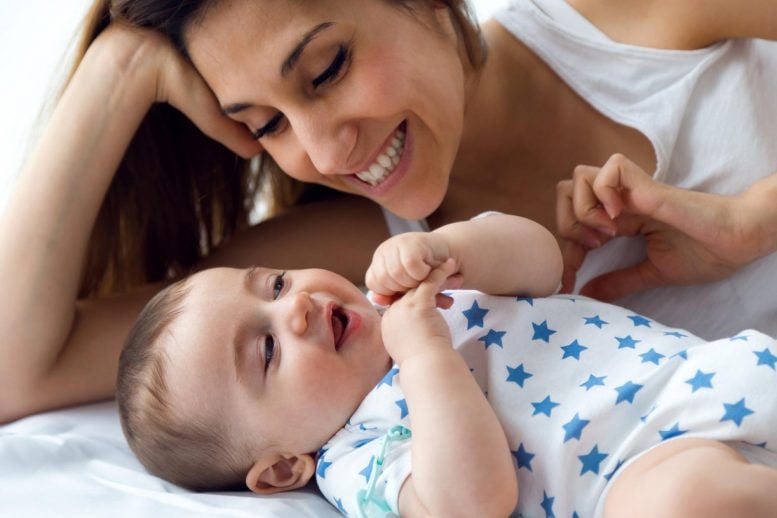
Baby talk boosts attention in all infants, supporting healthy language development.
It can be hard to resist lapsing into an exaggerated, singsong tone when you talk to a cute baby. And that’s with good reason. Babies will pay more attention to baby talk than regular speech, regardless of which languages they’re used to hearing, according to a study by UCLA’s Language Acquisition Lab and 16 other labs around the globe.
The study found that babies who were exposed to two languages had a greater interest in infant-directed speech — that is, an adult speaking baby talk — than adult-directed speech. Research has already shown that monolingual babies prefer baby talk.
Multilingual Babies Respond Just Like Monolinguals
Some parents worry that teaching two languages could mean an infant won’t learn to speak on time, but the new study shows bilingual babies are developmentally right on track. The peer-reviewed study, published today by Advances in Methods and Practices in Psychological Science, found bilingual babies became interested in baby talk at the same age as those learning one language.
“Crucially for parents, we found that development of learning and attention is similar in infants, whether they’re learning one or two languages,” said Megha Sundara, a UCLA linguistics professor and director of the Language Acquisition Lab. “And, of course, learning a language earlier helps you learn it better, so bilingualism is a win-win.”
In the study, which took place at 17 labs on four continents, researchers observed 333 bilingual babies and 384 monolingual babies, ranging in age from 6 to 9 months and 12 to 15 months. UCLA’s lab was the only one to provide data on bilingual babies who grew up hearing both English and Spanish. Sundara and Victoria Mateu, a UCLA assistant professor of Spanish and Portuguese, observed babies who were 12 to 15 months old.
Each baby would sit on a parent’s lap while recordings of an English-speaking mother, using either infant-directed speech or adult-directed speech, played from speakers on the left or the right. Computer tracking measured how long each baby looked in the direction of each sound.
Tracking Attention Through Eye Movement
“The longer they looked, the stronger their preference,” Mateu said. “Babies tend to pay more attention to the exaggerated sounds of infant-directed speech.”
Infants’ interest in English baby talk was very fine-tuned, the study noted. Bilingual parents indicated the percentage of time English was spoken at home compared to Spanish. The more English the bilingual babies had been exposed to, the stronger their preference for infant-directed speech compared to adult-directed speech. However, even babies with no exposure to English preferred the English baby talk to the grown-up talk, Mateu said.
Baby talk is found across most languages and cultures, but English has one of the most exaggerated forms, Sundara said.
“Baby talk has a slower rate of speech across all languages, with more variable pitch, and it’s more animated and happy,” she said. “It varies mainly in how exaggerated it is.”
Led by Krista Byers-Heinlein, a psychology professor at Concordia University in Montreal, the study involved labs in the United States, Canada, Europe, Australia, and Singapore. The study’s global reach strengthened the results, Sundara said.
“When you do language research, you want to know that the results aren’t just some quirk of the language you’re studying,” she said.
Maternal Education May Influence Baby Talk
According to the study, 6- to 9-month-old babies who had mothers with higher levels of education preferred baby talk more than babies whose mothers had less education.
“We suspect that perhaps the mothers with higher education levels spoke more to the babies and used infant-directed speech more often,” Mateu said.
This study is one of the first published by the ManyBabies Consortium, a multi-lab group of researchers. Byers-Heinlein believes the unusual international, multilingual collaboration creates a model for future studies that include a similar breadth of languages and cultures.
“We can really make progress in understanding bilingualism, and especially the variability of bilingualism, thanks to our access to all these different communities,” she said.
As the research continues, parents can babble to their babies in one language or two, and rest easy knowing they won’t cause any confusion.
Reference: “A multi-lab study of bilingual infants: Exploring the preference for infant-directed speech” by Krista Byers-Heinlein Angeline Tsui Christina Bergmann Alexis Black Anna Brown M. Carbajal Samantha Durrant Christopher Fennell Anne-Caroline Fievet Michael Frank Anja Gampe Judit Gervain Nayeli Gonzalez-Gomez Kiley Hamlin Naomi Havron Mikołaj Hernik Shila Kerr Hilary Killam Kelsey Klassen Jessica Kosie Ágnes Melinda Kovács Casey Lew-Williams Liquan Liu Nivedita Mani Caterina Marino Meghan Mastroberardino Victoria Mateu claire noble Adriel John Orena Linda Polka Christine Potter Melanie Schreiner Leher Singh Melanie Soderstrom Megha Sundara Connor Waddell Janet Werker Stephanie Wermelinger, 23 March 2021, Advances in Methods and Practices in Psychological Science.
DOI: 10.31234/osf.io/sqh9d
Never miss a breakthrough: Join the SciTechDaily newsletter.
Follow us on Google and Google News.
1 Comment
Were these babies that had previously been exposed to ‘baby talk’ from their parents and had learned to associate the pitch and intonation with attention and other rewards?