
Loggerhead hatchlings travel thousands of miles guided by an astonishing built-in navigation system that uses the Earth’s magnetic field.
Scientists trained young turtles to “dance” in response to magnetic fields they associated with food, allowing researchers to test whether the animals rely on seeing or feeling magnetic cues. After temporarily disabling the turtles’ ability to sense magnetic fields using a strong magnetic pulse, the hatchlings danced far less, revealing that they navigate by feeling magnetic forces.
Hatchlings Born With Magnetic Navigation Tools
Loggerhead turtles can detect the Earth’s magnetic field in two different ways, yet scientists had not determined which sense the animals rely on when using the built-in magnetic map that guides their movements from birth. Researchers at the University of North Carolina at Chapel Hill now report in Journal of Experimental Biology that young loggerheads determine their position during migration by feeling changes in the Earth’s magnetic field.
When hatchlings leave the beach where they were born, they begin migrations that span thousands of miles and can last for decades. Despite their small size, these young turtles are not wandering aimlessly. They hatch with the ability to sense magnetic information that acts like an internal compass for direction and a magnetic map that lets them know where they are as they travel.
How Animals Detect Earth’s Magnetic Field
Animals can sense magnetic fields in two general ways. One possibility involves light-sensitive molecules that react to the magnetic field and might allow an organism to see magnetic patterns. The other involves tiny particles of magnetite within the body that could shift in response to magnetic forces and provide a sense of touch. Researchers at the University of North Carolina at Chapel Hill wanted to pinpoint which of these mechanisms loggerhead hatchlings rely on during their long ocean journey.
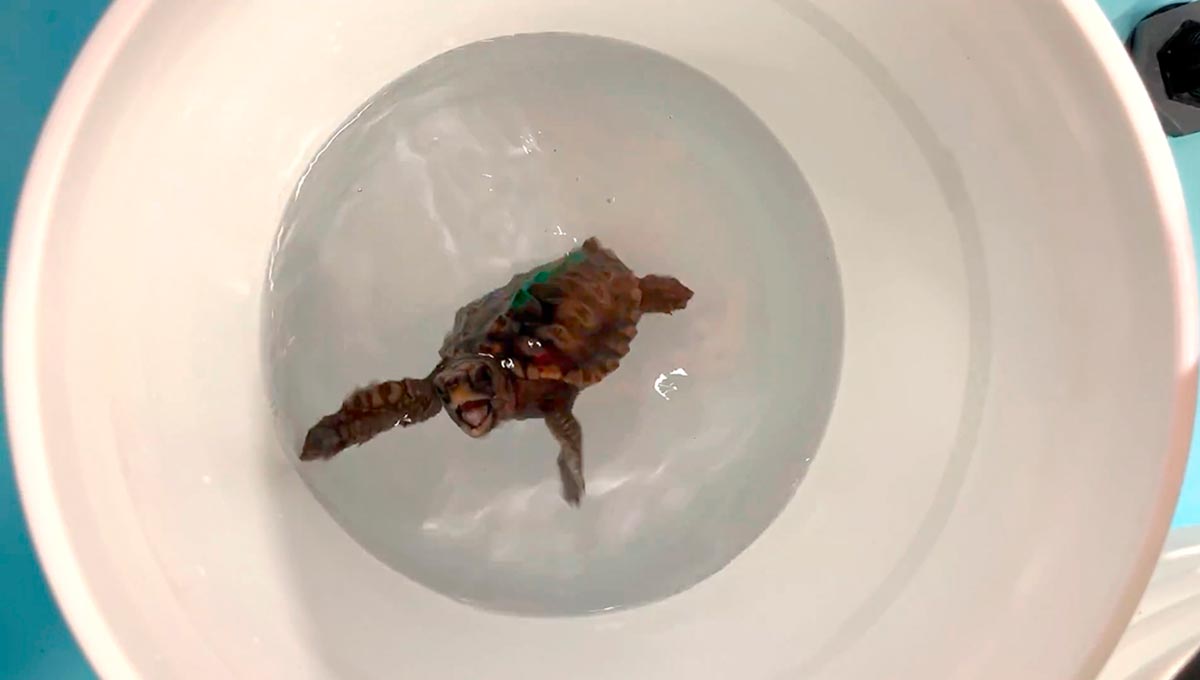
A young loggerhead turtle ‘dancing’ (tilting its body, opening its mouth and waggling its front flippers) in response to a magnetic field it has learned to associate with food. Credit: Video credit: Alayna Mackiewicz
Training Turtles to ‘Dance’ for Magnetic Fields
Earlier work by Kayla Goforth, Catherine Lohmann, Ken Lohmann and their colleagues showed that hatchling loggerheads can learn to connect a particular magnetic field with the arrival of food. Instead of responding like Pavlov’s dogs, the turtles display a distinctive “dance” when they recognise the magnetic conditions they associate with feeding. They lift part of their bodies above the water, open their mouths, and move their front flippers in an excited wiggle.
By placing the hatchlings in a specific magnetic field at feeding time, the team taught them to perform this dance whenever they were later exposed to that same magnetic signature.
“They are very food motivated and eager to dance when they think there is a possibility of being fed,” laughs Alayna Mackiewicz from the University of North Carolina at Chapel Hill.
Magnetic Pulse Experiments Reveal the Key Sense
The team then realized that they could use this clever trick to tell them whether the turtles were potentially seeing, or feeling, the Earth’s magnetic field if they zapped the hatchlings with a strong magnetic pulse that temporarily disabled their ability to feel the field. If the zapped hatchlings stopped dancing, then they were feeling the magnetic field, but if they continued to dance, then they were using some other sense to detect the magnetic map.
But training the hatchlings was no mean feat. “It’s really fun but takes up quite a bit of time,” says Mackiewicz, who, with Dana Lim (University of North Carolina at Chapel Hill), spent 2 months feeding 8 newly hatched loggerhead youngsters in the magnetic field that is found around the Turks and Caicos islands, so they would learn to dance when they experienced the magnetic field later. In addition, the duo trained other hatchlings to recognize the magnetic field near Haiti.
Then, Mackiewicz and Lim transferred each youngster to a large metal coil that produced a strong magnetic pulse that would temporarily disable the hatchling’s ability to feel a magnetic field. After that, they placed each youngster in the magnetic field that they had been trained to recognize to find out whether they had stopped dancing.
Sure enough, after being zapped, the turtles danced less, suggesting that they were feeling the magnetic field, which tells them where they are on their map, and not seeing it.
Two Magnetic Senses Working Together
The team admits that the hatchlings may also use other senses to tell them where they are located on their global magnetic map, but feeling the field is an essential component of their ability.
And, as the youngsters are known to use their additional magnetic sense – which may enable them to see magnetic fields – as a compass that tells them in which direction they are traveling, it is clear that the two senses complement each other, allowing the youngsters to identify their location and set a bearing wherever they might be.
Reference: “Disruption of the sea turtle magnetic map sense by a magnetic pulse” by Alayna G. Mackiewicz, Abigail M. Glazener, Kayla M. Goforth, Dana S. Lim, Catherine M. F. Lohmann and Kenneth J. Lohmann, 20 November 2025, Journal of Experimental Biology.
DOI: 10.1242/jeb.251243
Never miss a breakthrough: Join the SciTechDaily newsletter.
Follow us on Google and Google News.
2 Comments
Do we ever have enough learning at the expense of animals? What happened to these poor babies at the end of the experiment? How would the “researchers” like to be in the position of the turtles?
You are a sick person – this animal is in dire straights.