
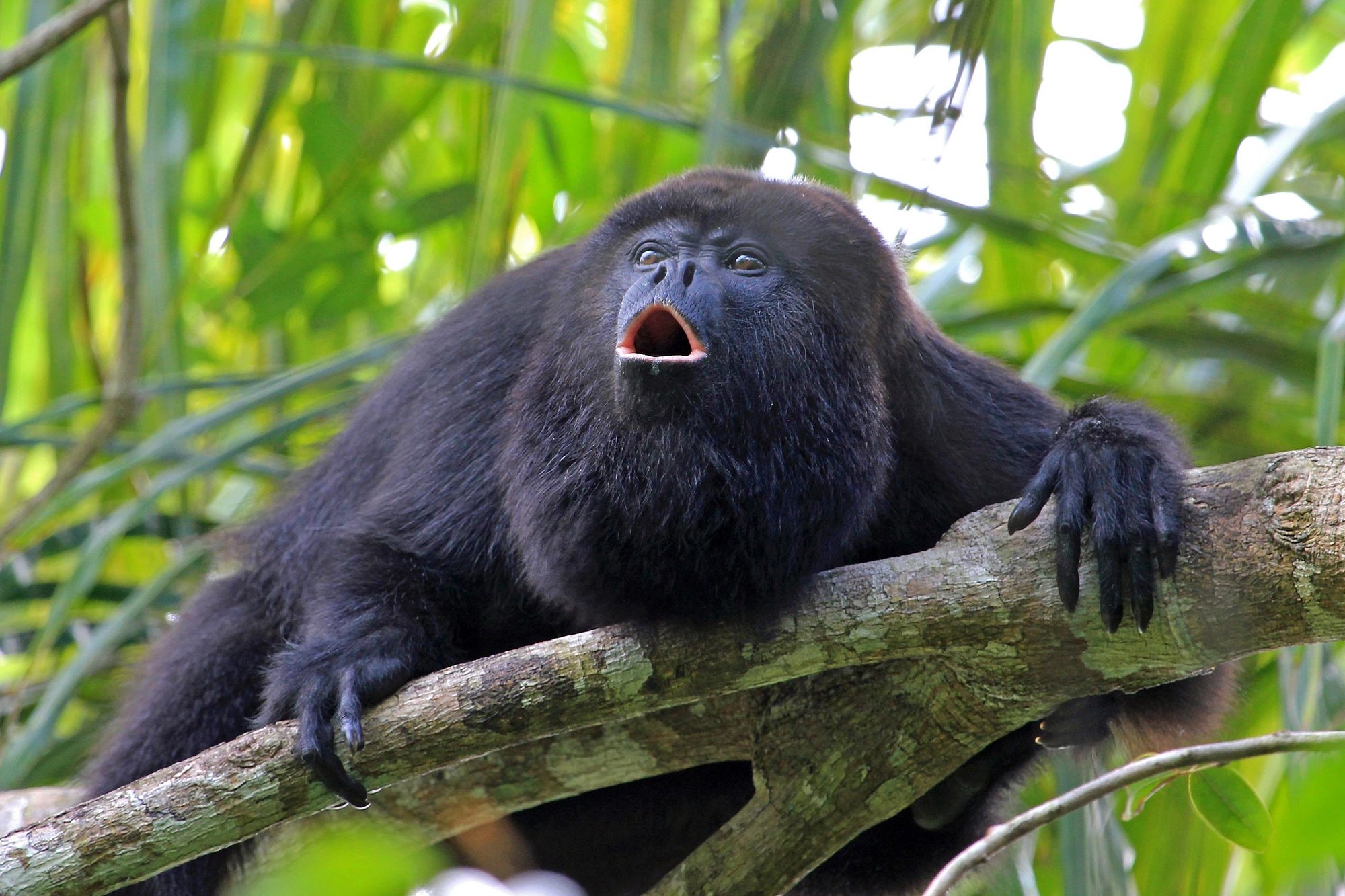
Researchers found that black howler monkeys can link routes and take shortcuts using flexible mental maps—showing navigation skills similar to humans.
Ever since humans began committing their view of the world to flat slabs of rock and papyrus, we had a sense that our mental maps are laid out in much the same way. However, our mental maps are nothing like paper maps. Humans rely on route-based maps. These internal maps, also used by animals, are composed of well-trodden routes linking frequently visited locations, with little understanding of where these routes lie relative to one another. Yet, humans are able to supplement these rudimentary representations with knowledge of the distances we cover and direction to take occasional short-cuts. Yet many creatures negotiate far more complex environments and need to navigate efficiently, so being able to combine knowledge of separate routes to take shortcuts would be useful.
Can other animals navigate like humans? Black howler monkeys (Alouatta pigra) comb the forests of Mexico, Belize, and Guatemala in search of fruit and edible vegetation, so Miguel de Guinea (Oxford Brookes University, UK), Sarie Van Belle (University of Texas at Austin, USA), and colleagues from Mexico and the UK wondered whether the primates are also capable of refining their route-based mental maps. The team publishes their discovery that black howler monkeys adapt their mental maps in the same way as humans, making them the first animal capable of navigating like us, in Journal of Experimental Biology.
However, GPS-tagging the endangered primates wasn’t possible, so de Guinea and his colleagues had no choice but to visit the forests covering the Mayan ruins in Palenque National Park, Mexico, and follow the roaming animals. “We’d arrive at the study area where our focal group was expected to be found before sunrise,” says de Guinea, explaining that it was relatively easy to locate the troops of black howler monkeys, from 4 to 11 individuals, as they called loudly in the morning. Then de Guinea, Van Belle, field assistant Elsa Barrios and an international team of volunteers pursued the monkeys, at ground level, wherever they roved through their 50-hectare domain. “Sometimes the monkeys decided to travel to the top of the tallest temple in the area, making us climb at a very fast pace in intense heat to reach them,” says de Guinea. On other occasions, the primates dragged the scientists across steep waterfalls. One time the monkeys encountered a 5m gap on one of their regular routes; “a tree had fallen overnight,” Van Belle explains. “They stopped for half an hour and then traveled along the edge to reconnect with the second half of their travel path… as if they knew this was a new obstacle and they needed to consider their options on what to do next,” she laughs.
Evidence of Shortcutting and Cognitive Flexibility
After a year of tracking five groups of black howler monkeys, de Guinea and Van Belle painstakingly reconstructed the monkeys’ movements as they covered 91.5km (56.9mi) over 250 days, repeatedly revisiting their favorite fruit trees – always approaching from a few select directions – traveling through the same sequences of trees. In contrast, when the pair simulated how the animals would move if they were roving randomly through the park, the virtual primates rarely revisited the same routes. The black howlers were clearly following mental maps of familiar routes, like humans.
In addition, the researchers compared the distances covered by the foraging monkeys with the routes used by the simulated primates, and it was evident that the black howlers were able to link routes together in order to navigate between distant locations. They can supplement their simple route-based view of the world with knowledge of direction and the distances between locations to take short-cuts and maneuver efficiently through the ever-changing forest. “It was a big effort to collect such detailed and reliable data, but it was worth it to understand the fascinating cognitive skills that black howler monkeys demonstrate in the wild,” says de Guinea.
Reference: “Cognitive maps in the wild: revealing the use of metric information in black howler monkey route navigation” by Miguel de Guinea, Alejandro Estrada, K. Anne-Isola Nekaris and Sarie Van Belle, 12 August 2021, Journal of Experimental Biology.
DOI: 10.1242/jeb.242430
Never miss a breakthrough: Join the SciTechDaily newsletter.
Follow us on Google and Google News.