
New research may have solved a long-standing geological mystery in the United States that has puzzled scientists for more than 150 years.
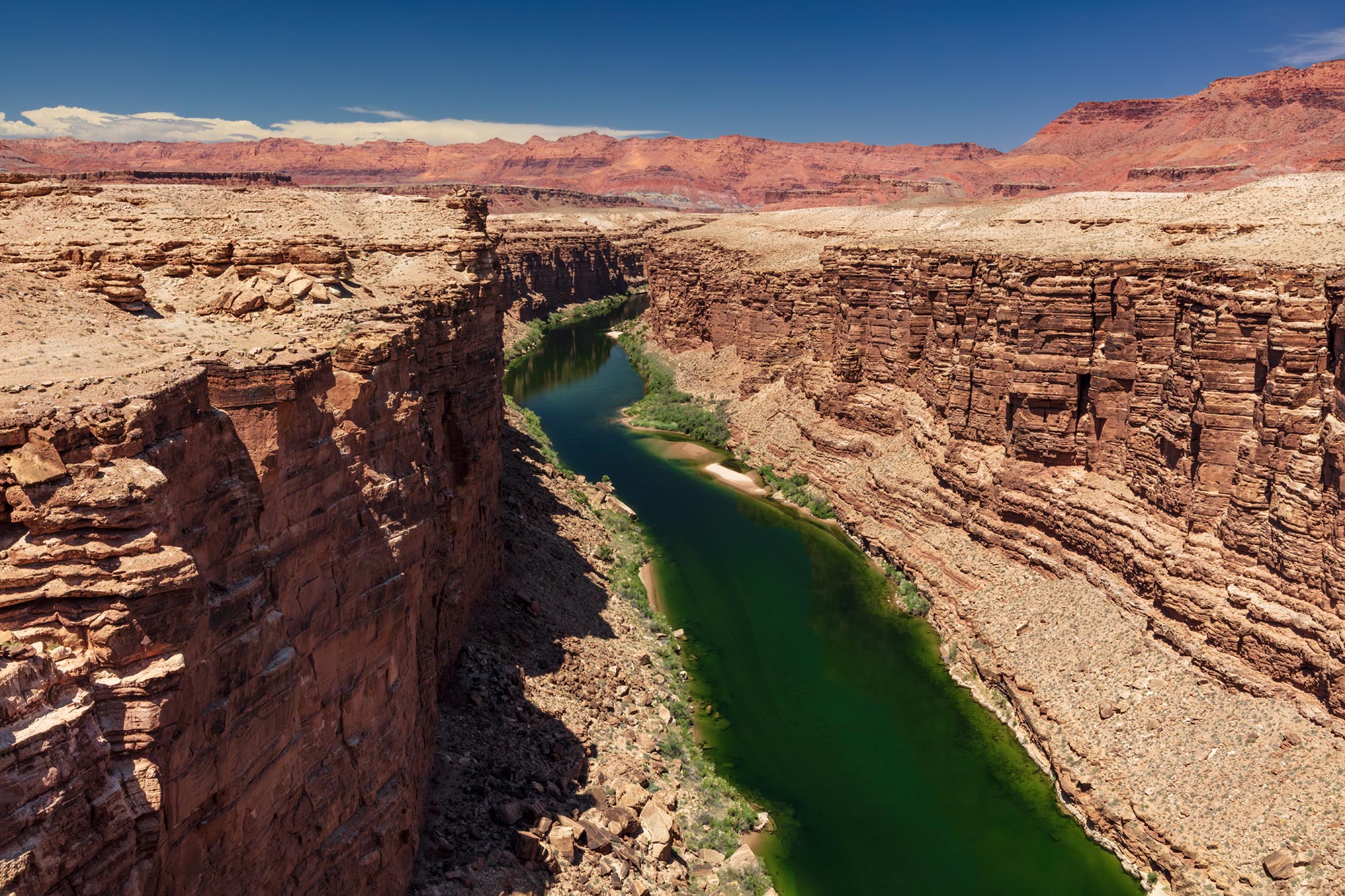
Scientists have spent more than a century trying to understand how the Green River, the largest tributary of the Colorado River, managed to carve a canyon roughly 700 meters deep straight through Utah’s Uinta Mountains, which rise to about 4 km in height, rather than diverting around them.
This question is especially confusing because the Uinta Mountains formed around 50 million years ago, while the Green River has occupied its present course for less than eight million years.
Researchers from universities in the UK and the USA now report strong evidence pointing to a process known as ‘lithospheric dripping’, in which sections of the Earth’s crust sink and later rebound over long timescales, as the likely explanation for the river’s path.
According to their findings, the Green River was able to cut through the mountains when the land surface temporarily dropped as a lithospheric drip formed beneath the region several million years ago. During this period of subsidence, the river eroded the exposed rock and established the channel it still follows today, including the Canyon of Lodore, eventually connecting with the Colorado River system.
A hidden process reshapes landscapes
Dr. Adam Smith, of the University of Glasgow’s School of Geographical & Earth Sciences, is the paper’s lead author. He said: “The merging of the Green and Colorado Rivers millions of years ago altered the continental divide of North America. It created the line that separates the rivers that flow into the Pacific from those that flow into the Atlantic, and created new habitat boundaries for wildlife that influenced their evolution. It’s an enormously significant area of the continent.
“For about 150 years now, geologists have debated over exactly how the rivers merged, which is a particularly challenging question for a tectonically inactive area where major geological events are rarer. We think that we’ve gathered enough evidence to show that lithospheric drip, which is still a relatively new concept in geology, is responsible for pulling the land down enough to enable the rivers to link and merge.”
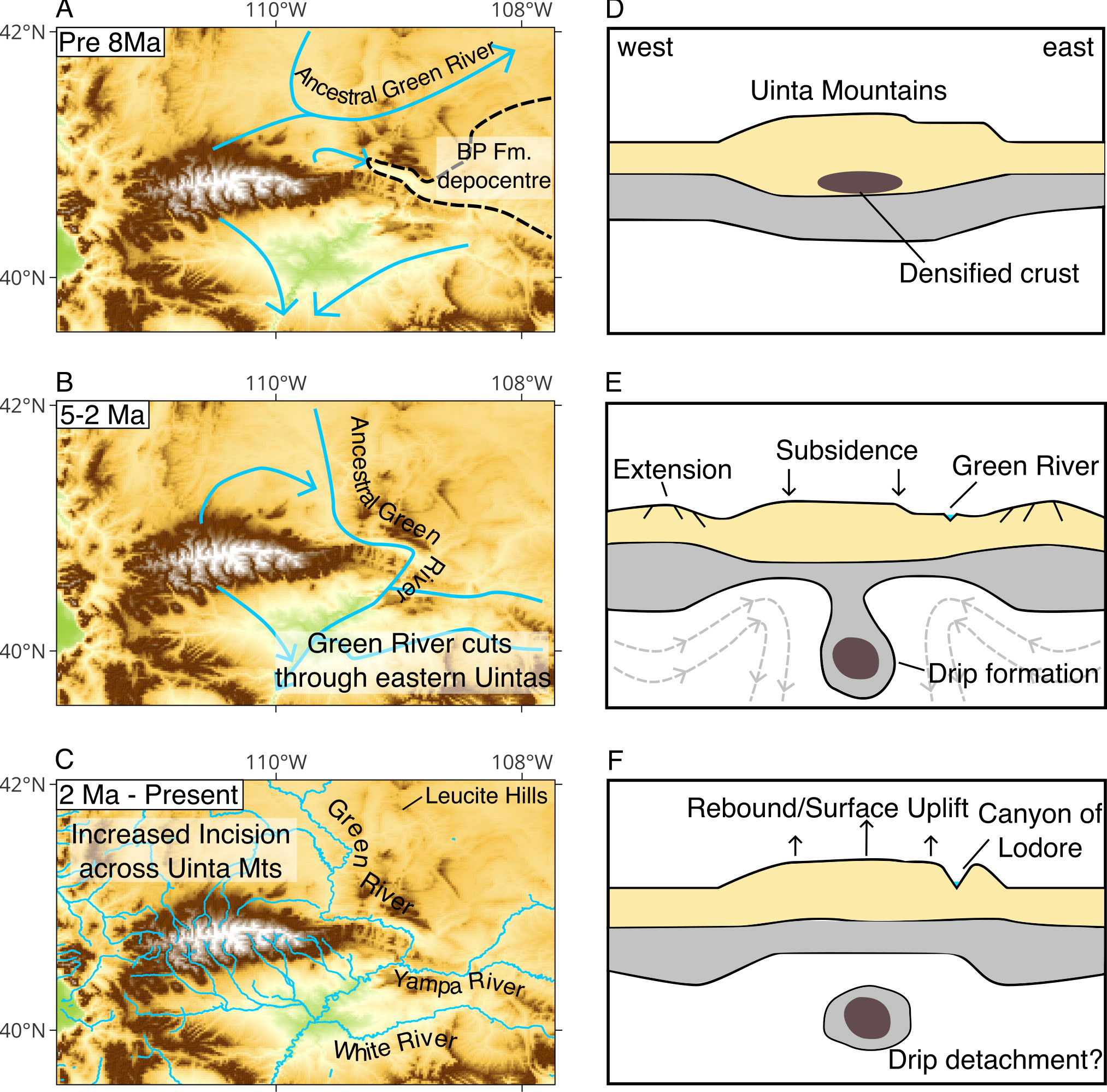
Lithospheric drips form when dense, mineral-rich material accumulates at the base of the Earth’s crust and eventually becomes heavy enough to sink into the mantle beneath. As this material descends, it pulls the overlying crust downward, lowering sections of mountain ranges.
Once the sinking mass detaches and continues downward on its own, the surface above rebounds. This process leaves behind a recognizable uplift pattern across the landscape, often described as a ‘bullseye’ centered on the original location of the drip.
Seismic data reveals subsurface structure
In a study published in the Journal of Geophysical Research: Earth Surface, the researchers describe how they combined seismic imaging with advanced computational modelling to investigate the region.
Seismic imaging, which works in a similar way to a CT scan, allows scientists to visualize structures beneath the Earth’s surface by analyzing how seismic waves travel during earthquakes. Using data from earlier seismic studies, the team identified a cold, circular anomaly located about 200 km below the surface. Measuring between 50 and 100 km across, this feature is interpreted as the detached portion of the lithospheric drip.
By estimating how far this mass has descended and calculating its rate of movement, the researchers concluded that the drip likely separated between two and five million years ago. This timing aligns closely with previous estimates for when the Green River carved its path through the mountains and became integrated into the Colorado River system.
Multiple lines of evidence converge
Further support comes from modeling the surrounding river networks, which revealed the characteristic bullseye-shaped uplift pattern associated with lithospheric dripping. The researchers also found that the crust beneath the Uinta Mountains is several kilometers thinner than expected for a range of its elevation, consistent with the loss of dense lower-crustal material.
When they calculated how much the surface would rise after such material was removed, the result matched an elevation change of just over 400 meters inferred from the river network analysis, reinforcing their interpretation.
Dr. Smith added: “This is a long paper, because we wanted not just to lay out the case for a lithospheric drip creating the route of the Green River but also to acknowledge some previous theories. The evidence we’ve collected strongly contradicts the idea that the river predated the mountains, or that sediment deposits might have built up enough for the river to overtop the range, or that erosion from the south of the mountains captured the Green River.
“We hope that this paper will help resolve a longstanding debate about one of North America’s most significant river systems, and help build the growing body of evidence that lithospheric drips may be the hidden answer to more tectonic mysteries than we’ve previously realized.”
Reference: “A Lithospheric Drip Triggered Green and Colorado River Integration” by Adam G. G. Smith, Matthew Fox, Scott R. Miller, Matthew C. Morriss and Leif S. Anderson, 2 February 2026, Journal of Geophysical Research: Earth Surface.
DOI: 10.1029/2025JF008733
Never miss a breakthrough: Join the SciTechDaily newsletter.
Follow us on Google and Google News.