
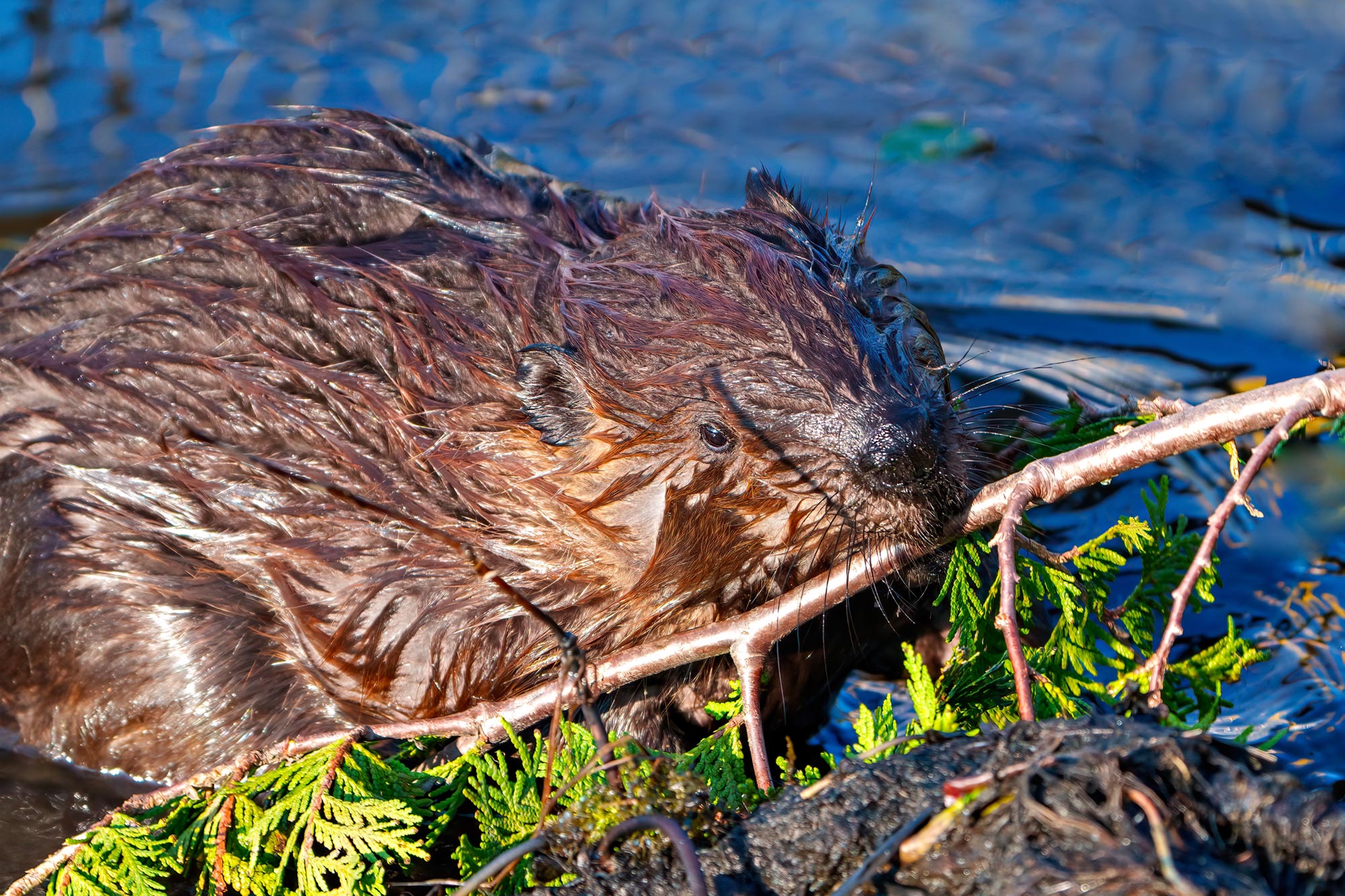
Beavers are quietly turning rivers into powerful natural carbon traps.
Beavers may be far more important to the climate than previously thought. A new international study led by researchers at the University of Birmingham suggests these animals can transform river systems into powerful carbon dioxide sinks by reshaping wetlands and waterways.
Published in Communications Earth & Environment, the research is the first to calculate both the carbon dioxide (CO2) released and captured as a result of beaver activity in suitable wetland environments. The project involved scientists from the University of Birmingham, Wageningen University, the University of Bern, and several international partners. The study focused on a stream corridor in northern Switzerland that has experienced more than 10 years of beaver activity.
The researchers discovered that wetlands created by beavers stored carbon at rates up to ten times greater than nearby systems without beavers. During the 13-year study period, the wetland accumulated an estimated 1,194 tonnes of carbon, equal to 10.1 tonnes of CO2 per hectare annually.
Dr. Joshua Larsen, from the University of Birmingham and lead senior author of the study, said: “Our findings show that beavers don’t just change landscapes: they fundamentally shift how CO2 moves through them. By slowing water, trapping sediments, and expanding wetlands, they turn streams into powerful carbon sinks. This first-of-its-kind study represents an important opportunity and breakthrough for future nature-based climate solutions across Europe.”
How beaver dams trap carbon
Beavers have gradually returned to rivers and natural habitats across Europe after decades of conservation work. According to the researchers, these animals significantly change the way CO2 is stored, transported, and retained in headwater streams, which are the smaller upstream sections where rivers begin.
As beavers construct dams, they flood stream edges, create wetlands, redirect groundwater flow, and trap large amounts of both organic and inorganic material, including CO2. These changes reshape entire ecosystems and increase the amount of carbon stored in the landscape.
The findings suggest that restoring beaver populations in appropriate wetland areas could help capture and store large amounts of carbon while reducing the amount that returns to the atmosphere.
Beaver wetlands become long-term carbon sinks
To measure the full environmental impact, the researchers combined high-resolution hydrological data, chemical analysis, sediment sampling, greenhouse gas (GHG) monitoring, and long-term modeling. The result was the most detailed carbon budget ever created for a European landscape influenced by beavers.
The wetland acted as a net carbon sink, storing an average of 98.3 ± 33.4 tonnes of carbon each year. Scientists found this was largely driven by the removal and storage of dissolved inorganic carbon beneath the surface.
The study also revealed seasonal differences. In summer, falling water levels exposed more sediment, temporarily increasing carbon dioxide (CO2) emissions and turning the area into a short-term carbon source.
Across the full year, however, the buildup of sediments, vegetation, and deadwood led to substantial overall carbon storage. Researchers also found that methane (CH4) emissions, often a concern in wetlands, were extremely low and accounted for less than 0.1% of the total carbon budget.
Dr. Lukas Hallberg from the University of Birmingham and corresponding author of the study, said: “Within just over a decade, the system we studied had already transformed into a long-term carbon sink, far exceeding what we would expect from an unmanaged stream corridor. This highlights the enormous potential of beaver-led restorations and offers valuable insights into potential land-use planning, rewilding strategies, and climate policy.”
Beaver wetlands and climate change
As sediments and deadwood continue to build up in beaver-created wetlands, more carbon becomes locked away over time. The researchers found that these sediments contained up to 14 times more inorganic carbon and eight times more organic carbon than nearby forest soils. Deadwood from forests along riverbanks, streams, and wetlands (known as riparian forests) represented nearly half of all long-term stored carbon.
These carbon stores could remain stable for decades, suggesting that beaver-modified wetlands may function as dependable long-term carbon sinks as long as the dams remain intact.
Dr. Annegret Larsen, Assistant Professor in the Soil Geography and Landscape Group at Wageningen University, said: “Our research shows that beavers are powerful agents of carbon capture and adsorption. By reshaping waterways and creating rich wetland habitats, beavers physically change how carbon is stored across landscapes.”
Researchers estimate that if beavers recolonized all suitable floodplain areas in Switzerland, their wetlands could offset 1.2–1.8% of the country’s yearly carbon emissions. These climate benefits could occur naturally without direct human management or additional financial cost.
The study, led by the University of Birmingham, Wageningen University, the University of Bern, and international collaborators, examined a Swiss stream corridor that has supported beaver activity for more than a decade.
As beaver populations continue to grow, scientists say more research will be needed to better understand how these animals could influence future ecosystems and long-term carbon storage.
Reference: “Beavers can convert stream corridors to persistent carbon sinks” by Lukas Hallberg, Annegret Larsen, Natalie Ceperley, Raphael d’Epagnier, Tom F. Brouwers, Bettina Schaefli, Sarah Thurnheer, Josep Barba, Christof Angst, Matthew Dennis and Joshua R. Larsen, 18 March 2026, Communications Earth & Environment.
DOI: 10.1038/s43247-026-03283-8
Never miss a breakthrough: Join the SciTechDaily newsletter.
Follow us on Google and Google News.
2 Comments
thanks
“Researchers also found that methane (CH4) emissions, often a concern in wetlands, were extremely low and accounted for less than 0.1% of the total carbon budget.”
This is a surprising claim considering that it is generally accepted that wetlands and termites are the major contributors to the atmosphere’s natural methane. That may be because the authors acknowledge that their monitoring system did not collect ebullitive (bubbling) releases of methane into the atmosphere. Also, their statement that the net carbon sink, storing an average of 98.3 ± 33.4 tonnes of carbon each year, is low precision. It apparently is also only a 1-sigma uncertainty. If the nominal value and its associated uncertainty is recast as a percentage with a 2-sigma probability — 98.3 ± 68.0% or ranging between 31.5 to 165.1 — it is easier to see how imprecise the estimate is; it doesn’t warrant a digit after the decimal point.
It certainly raises the question whether the methodology for accounting for methane was done correctly, because it doesn’t agree with the accepted view that wetlands are important sources of methane, as the authors even acknowledge in the quote above. The bottom line is that there is a possibility that the reintroduction of beavers could exacerbate the production of ‘greenhouse gases.’ This study does not adequately address that concern.