
Close Menu
    Facebook X (Twitter) Instagram
    SciTechDaily
    • Biology
    • Chemistry
    • Earth
    • Health
    • Physics
    • Science
    • Space
    • Technology
    Facebook X (Twitter) Pinterest YouTube RSS
    SciTechDaily
    Home»Earth»Beneath a Desert Moon: Astronaut Captures Breathtaking Image From Space Station
    Earth

    Beneath a Desert Moon: Astronaut Captures Breathtaking Image From Space Station

    By NASA Earth ObservatoryOctober 9, 2023No Comments2 Mins Read
    Facebook Twitter Pinterest Telegram LinkedIn WhatsApp Email Reddit
    Share
    Facebook Twitter LinkedIn Pinterest Telegram Email Reddit
    Beneath Desert Moon Annotated
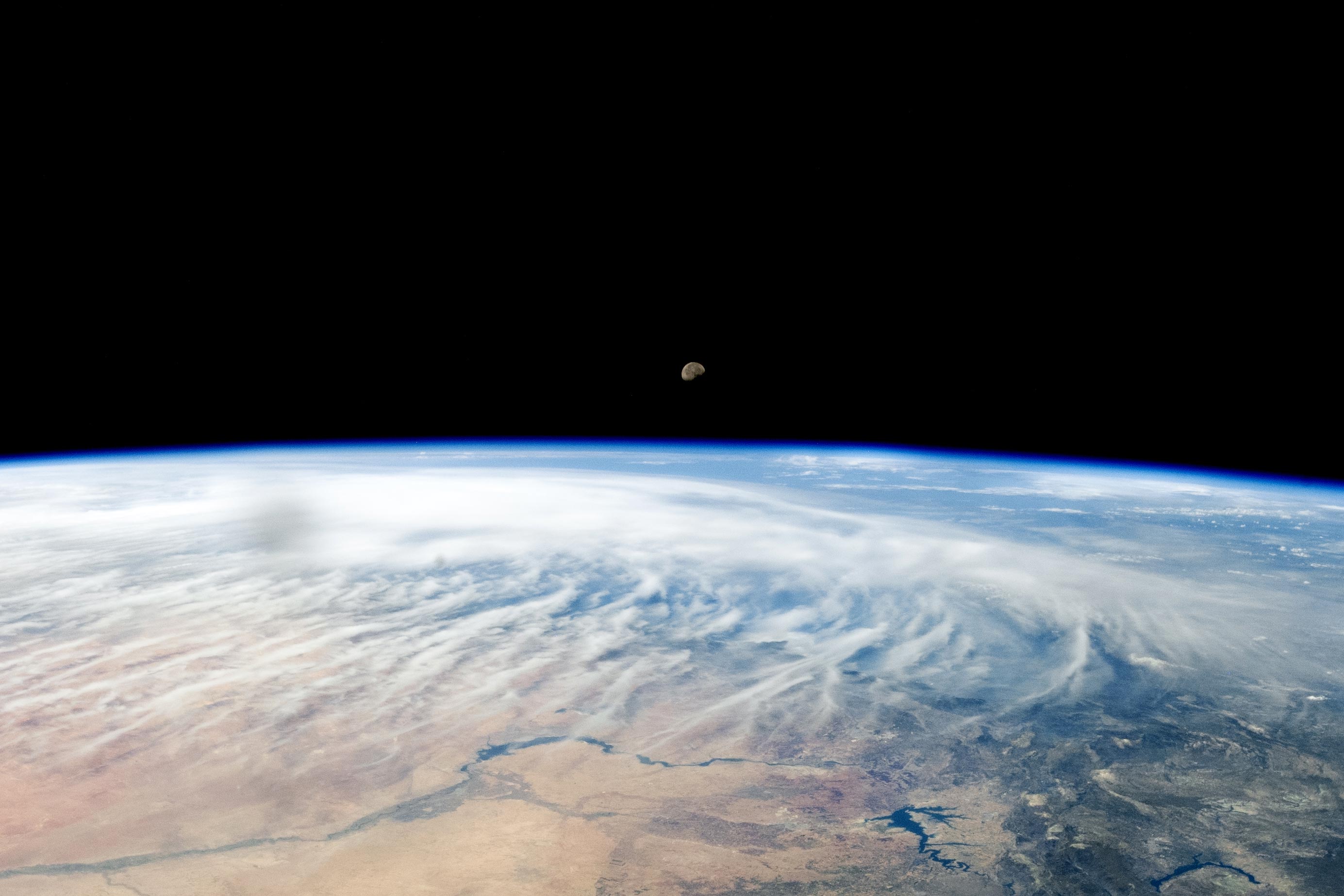
    Photo of the Earth and Moon captured on June 8, 2023, by an astronaut aboard the International Space Station while orbiting over Iraq.

    An oblique-angle photo taken from above the Middle East captures the Moon peeking over Earth’s atmospheric limb.

    An astronaut aboard the International Space Station captured this photo of the Earth and Moon while orbiting over Iraq (not pictured). Taken at an oblique angle from an altitude of 252 miles (406 kilometers), the photo has a perspective that highlights Earth’s atmospheric limb, or the edge of the atmosphere.

    The blue-toned haze that fades into the darkness of space is the mesosphere, which reaches an altitude of about 50 miles (80 kilometers). Above the mesosphere is the thermosphere. Although this layer is part of Earth’s atmosphere, it is commonly considered part of outer space.

    In the center of the image, Earth’s moon peeks over the horizon. The Moon is about 251,000 miles (405,500 kilometers) away from Earth at its furthest point, or apogee. In this image, the Moon is in the waning gibbous phase, which occurs between the full-moon and half-moon phases.

    Below the wispy clouds in the middle of the view is Lake Assad, a Euphrates River reservoir in northern Syria. Lake Assad is Syria’s largest lake and a primary source of the region’s drinking and irrigation water. The Tabqa Dam, which created the lake, is the largest hydroelectric dam in the country.

    Astronaut photograph ISS069-E-18445 was acquired on June 8, 2023, with a Nikon D5 digital camera using a focal length of 25 millimeters. It is provided by the ISS Crew Earth Observations Facility and the Earth Science and Remote Sensing Unit, Johnson Space Center. The image was taken by a member of the Expedition 69 crew. The image has been cropped and enhanced to improve contrast, and lens artifacts have been removed. The International Space Station Program supports the laboratory as part of the ISS National Lab to help astronauts take pictures of Earth that will be of the greatest value to scientists and the public, and to make those images freely available on the Internet. Caption by Minna Adel Rubio, GeoControl Systems, JETS Contract at NASA-JSC.

    Never miss a breakthrough: Join the SciTechDaily newsletter.
    Follow us on Google and Google News.

    NASA NASA Earth Observatory
    Share. Facebook Twitter Pinterest LinkedIn Email Reddit

    Related Articles

    NASA Satellite Watches as Bush Fire Scorches Land Near Phoenix

    “Wedge Failure” Landslide in Alaska

    Muddy Flooding After Catastrophic Dam Failures in Michigan Seen From Space

    Scientists Concerned As Denman Glacier Retreats Both Above and Below the Water Line

    NASA Scientists Collect Moon-Like Rocks From Site in Montana

    NASA Satellites Spot Several Wildfires Near Chernobyl Exclusion Zone

    Shocking Disappearance of Ecuador’s Tallest Waterfall

    Heading Off a Locust Invasion Using NASA Satellites

    Plankton-Fueled Agulhas Current Ocean Eddy Is 93 Miles Wide

    Leave A Reply Cancel Reply

    • Facebook
    • Twitter
    • Pinterest
    • YouTube

    Don't Miss a Discovery

    Subscribe for the Latest in Science & Tech!

    Trending News

    Stanford Scientists Discover a Remarkable Way To Rescue Dying Corals in Just Seven Weeks

    0 to 15 MPH in a Single Swipe: New Research Reveals How Ancient Giant Sea Monsters Ambushed Their Prey

    Late-Night Snacking Could Be Putting Your Liver at Risk

    40 Years of Superconductor Science Just Got Turned Upside Down by a Stunning Discovery

    A 50-Year-Old Mystery: Scientists Discover What May Have Killed Brazil’s Frogs

    Scientists Discover Exercise Changes the Body in Ways We Never Fully Understood

    Scientists Restore Memory in Mice With Alzheimer’s by Boosting a Single Brain Protein

    Scientists Create “Super Ice” That’s 10 Times Stronger and Rivals Concrete in Strength

    Follow SciTechDaily
    • Facebook
    • Twitter
    • YouTube
    • Pinterest
    • Newsletter
    • RSS
    SciTech News
    • Biology News
    • Chemistry News
    • Earth News
    • Health News
    • Physics News
    • Science News
    • Space News
    • Technology News
    Recent Posts
    • Scientists Turn Major Crude Oil Problem Into an Unexpected Energy Breakthrough
    • Ancient Skeletons Reveal a Secret Hidden in Medieval Sicily for 1,000 Years
    • Scientists Discover a $10 Flood Protection Trick That Works Better Than Sandbags
    • Researchers Discover a Surprising Twist in How Our Cells Age
    • Scientists Discover Chronic Back Pain Can Change How Your Brain Sees You
    Copyright © 1998 - 2026 SciTechDaily. All Rights Reserved.
    • Science News
    • About
    • Contact
    • Editorial Board
    • Privacy Policy
    • Terms of Use

    Type above and press Enter to search. Press Esc to cancel.