
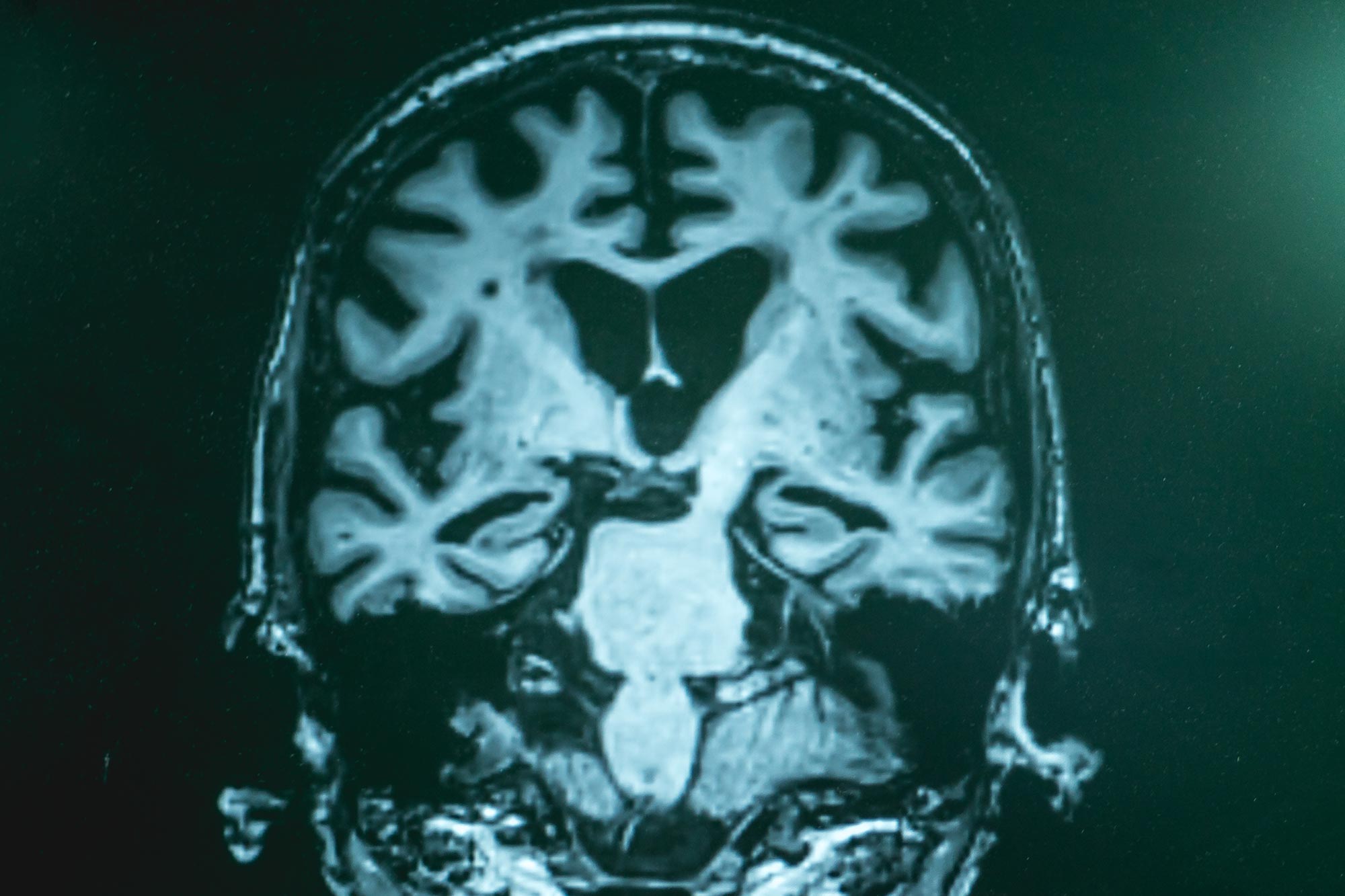
A new light-based imaging approach has produced an unprecedented chemical map of the Alzheimer’s brain.
Rice University researchers have produced what they describe as the first full, label-free molecular atlas of an Alzheimer’s brain in an animal model. In simple terms, they created a brain-wide “chemical map” that can help scientists study where the disease appears to take hold and how it spreads over time. Alzheimer’s is also a major public health threat, killing more people than breast cancer and prostate cancer combined.
Instead of focusing only on classic pathology markers, the team examined the brain’s underlying chemistry using a light-based imaging approach paired with machine learning. Their study, published in ACS Applied Materials and Interfaces, shows that Alzheimer ’s-linked chemical shifts are patchy across the brain rather than uniform. It also suggests those shifts extend beyond amyloid plaques, the best-known feature of the disease.
To read out these chemical differences, the researchers used hyperspectral Raman imaging, a specialized version of Raman spectroscopy. The method uses laser light to capture molecular “fingerprints,” allowing scientists to distinguish compounds based on how they scatter light.
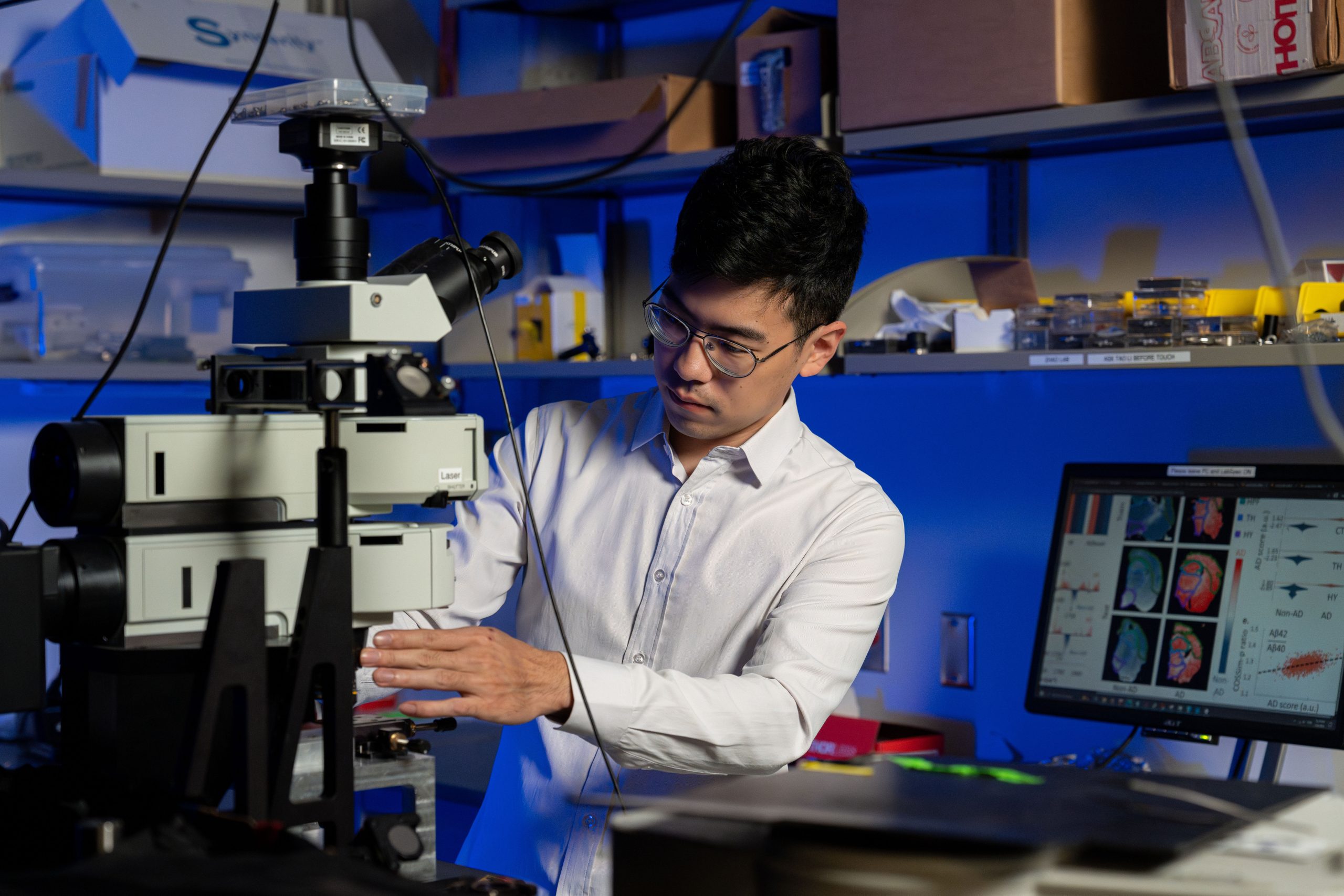
“Traditional Raman spectroscopy takes one measurement of chemical information per molecular site,” said Ziyang Wang, an electrical and computer engineering doctoral student at Rice who is a first author on the study. “Hyperspectral Raman imaging repeats this measurement thousands of times across an entire tissue slice to build a full map. The result is a detailed picture showing how chemical composition varies across different regions of the brain.”
Rice University scientists have developed the first complete, label-free molecular atlas of the Alzheimer’s brain in an animal model. Credit: Jorge Vidal/Rice University
Using this approach, the researchers scanned entire brains one tissue slice at a time. They assembled thousands of overlapping spectra to produce detailed molecular maps of both healthy and Alzheimer’s affected brains. The data were collected without labels, meaning the samples were not treated with dyes, fluorescent proteins, or molecular tags before imaging.
“This means we observed the brain as is, capturing a complete, unaltered portrait of its chemical makeup,” Wang said. “I think this makes the approach more unbiased and better suited for discovering new disease-related changes that might otherwise be missed.”
Machine Learning Reveals Hidden Patterns
Because hyperspectral imaging produces enormous amounts of information, the team relied on machine learning (ML) to analyze the data. They began with unsupervised ML, which detects patterns without prior instructions about what to find. These algorithms grouped tissue samples according to similarities in their molecular signals.
The researchers then applied supervised ML, training models with samples already identified as Alzheimer’s or non Alzheimer’s. This allowed them to measure how strongly different brain regions displayed chemical features associated with the disease.
“We found that the changes caused by Alzheimer’s disease are not spread evenly across the brain,” Wang said. “Some regions show strong chemical changes, while others are less affected. This uneven pattern helps explain why symptoms appear gradually and why treatments that focus on only one problem have had limited success.”
The analysis also uncovered broader metabolic differences between healthy and diseased brains. Cholesterol and glycogen levels varied across disparate brain regions, with the starkest contrast found in areas linked to memory ⎯ , especially in the hippocampus and cortex.
“Cholesterol is important for maintaining brain cell structure, and glycogen serves as a local energy reserve,” said Shengxi Huang, associate professor of electrical and computer engineering and materials science and nanoengineering and corresponding author on the study. “Together, these findings support the idea that Alzheimer’s involves broader disruptions in brain structure and energy balance, not only protein buildup and misfolding,” added Huang, who is also a member of the Ken Kennedy Institute, the Rice Advanced Materials Institute, and the Smalley-Curl Institute.
From Concept to Whole-Brain Mapping
The idea for the project germinated from long discussions about how to study the Alzheimer’s brain in a different way.
“At first, we were measuring only small areas of brain tissue,” Wang said. “Then I thought, what if we could map the entire brain and gain a much broader view? It took several rounds of testing and trial and error before the measurements and analysis worked well together.”
Wang remembers the excitement of seeing the full chemical map of the Alzheimer’s brain for the first time.
“Patterns emerged that had not been visible under regular imaging,” Wang said. “Seeing those results was deeply satisfying. It felt like revealing a hidden layer of information that had been there all along, waiting for the right way to be analyzed.”
By providing the first detailed chemical maps of the Alzheimer’s brain created without dyes or other molecular markers, the study unlocks a new perspective on the disease as a whole. The researchers say they hope that building on this knowledge could enable earlier detection and better strategies to slow disease progression.
Reference: “Machine Learning-Enhanced Hyperspectral Raman Imaging for Label-Free Molecular Atlas of Alzheimer’s Brain” by Ziyang Wang, Jeewan C. Ranasinghe, Dennis C. Y. Chan, Ashley Gomm, Rudolph E. Tanzi, Can Zhang, Nanyin Zhang and Shengxi Huang, 31 December 2025, ACS Applied Materials & Interfaces.
DOI: 10.1021/acsami.5c22623
The research was supported by the National Science Foundation (2246564, 1934977), the National Institutes of Health (1R01AG077016) and the Welch Foundation (C2144).
Never miss a breakthrough: Join the SciTechDaily newsletter.
Follow us on Google and Google News.