
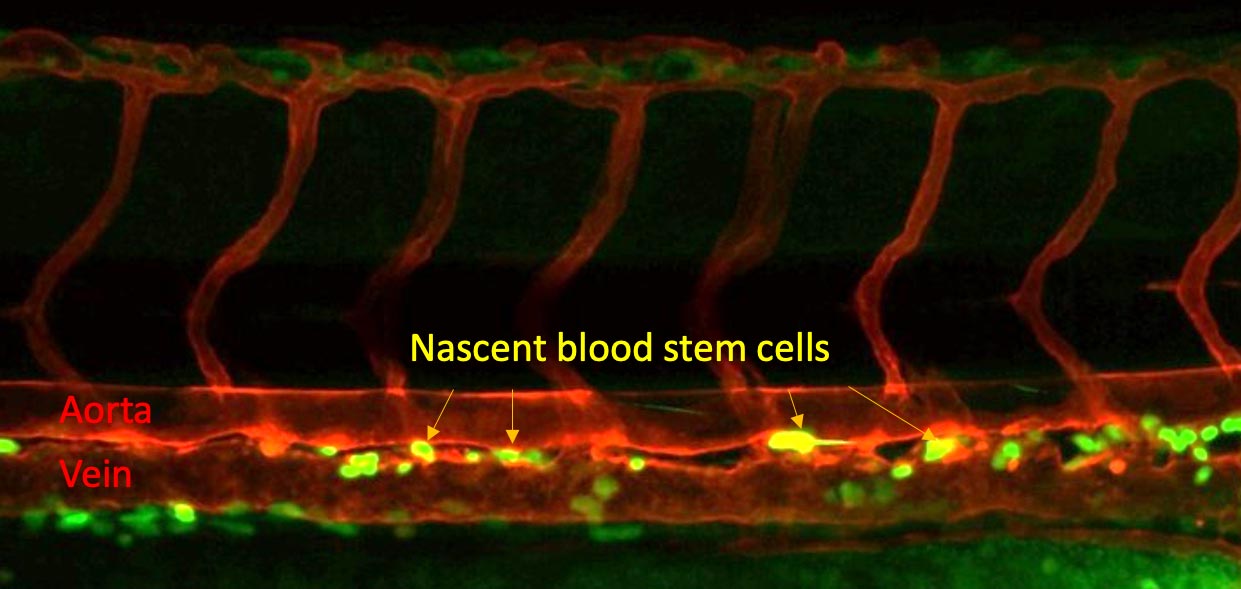
Scientists discovered that an immune receptor called Nod1, typically used to detect infections, also helps form blood stem cells during embryonic development. This opens the door to lab-made, patient-specific stem cells that could replace risky bone marrow transplants.
In a breakthrough that could transform treatments for blood disorders, scientists have discovered that a sensor used by the body to detect bacterial infections also helps create blood stem cells. This surprising dual role opens the door to lab-grown, patient-specific stem cells, potentially removing the need for bone marrow transplants.
The discovery comes from a team led by Raquel Espin Palazon, assistant professor of genetics, development, and cell biology at Iowa State University. Published in Nature Communications, the research builds on her earlier work showing that the same immune signals used to fight infections take on a completely different job during the earliest stages of life. In developing embryos, these signals help form the blood and vascular systems.
The team found that a protein called Nod1, known for sensing harmful microbes, also prompts specialized cells in embryos to become blood stem cells—the foundational cells that produce all types of blood. Understanding this process could lead to methods for creating blood stem cells in the lab from a patient’s own cells.
“This would eliminate the challenging task of finding compatible bone marrow transplant donors and the complications that occur after receiving a transplant, improving the lives of many leukemia, lymphoma, and anemia patients,” Espin Palazon said.
A Critical Cue
Stem cells are both the factories and the raw materials of a body, repeatedly dividing to self-renew and build new cells for specific tissues. Pluripotent stem cells in embryos can make any kind of cell a body needs, while adult stem cells are limited to producing particular types. Blood stem cells, also known as hematopoietic stem cells, make all of the blood’s components. A lifetime supply of blood stem cells is created before birth inside an embryo.
The immune receptor Espin Palazon’s team identified activates in an embryo before endothelial cells start becoming stem cells, priming them for the transition.
“We know blood stem cells form from endothelial cells, but the factors that set up the cell to switch identity were enigmatic,” she said. “We didn’t know that this receptor was needed or that it was needed this early, before blood stem cells even form.”
Researchers zeroed in on Nod1 by analyzing public databases of human embryos and studied it using zebrafish, which share about 70% of their genome with humans. Blood stem cell creation tracked closely with Nod1 levels as its effects were inhibited or enhanced.
To confirm Nod1 also plays a role in human blood development, the research team worked with the Children’s Hospital of Philadelphia. Researchers there produce human induced pluripotent stem cells, which are generated from mature samples but genetically reprogrammed to behave like the make-anything stem cells found in embryos. Induced pluripotent stem cells can create most types of blood cells, though not functional blood stem cells. But when researchers took away Nod1, blood production faltered, as it did with blood stem cells in zebrafish.
Toward Self-Derived Stem Cells
Figuring out that Nod1 is a prerequisite for blood stem cells to develop is progress for scientists hoping to design a system for producing blood stem cells from human samples, which could offer a revolutionary new option for patients suffering from blood disorders. Instead of a life-saving infusion of blood stem cells via a transplant of bone marrow, the spongy insides of bones that hold most of a body’s blood stem cells, patients could be treated with stem cells that originated in their own bodies. Self-derived stem cells could avoid the risks of graft-versus-host disease, a common and potentially deadly reaction that occurs when a patient’s immune system perceives the transplant as a threat to be attacked.
“This would be a huge advancement for regenerative medicine,” Espin Palazon said.
Espin Palazon’s team is continuing to untangle the complex interactions in which blood stem cells arise, including refining the timeline. Understanding when signals are expressed is essential to developing the methods for making blood stem cells.
“The timing is so crucial. It’s like when you’re cooking and you need to add ingredients in a specific order,” she said.
Further research will benefit from the collaboration with Children’s Hospital of Philadelphia, which trained one of the study’s co-authors, Clyde Campbell, adjunct assistant professor of genetics, development, and cell biology, on the protocols to create induced pluripotent stem cells.
“My group at Iowa State University will continue working towards a life without blood disorders. I believe our investigations will pave the road to finally create therapeutic-grade blood stem cells to cure blood disorder patients,” Espin Palazon said.
Reference: “Nod1-dependent NF-kB activation initiates hematopoietic stem cell specification in response to small Rho GTPases” by Xiaoyi Cheng, Radwa Barakat, Giulia Pavani, Masuma Khatun Usha, Rodolfo Calderon, Elizabeth Snella, Abigail Gorden, Yudi Zhang, Paul Gadue, Deborah L. French, Karin S. Dorman, Antonella Fidanza, Clyde A. Campbell and Raquel Espin-Palazon, 23 November 2023, Nature Communications.
DOI: 10.1038/s41467-023-43349-1
In addition to Espin Palazon and Campbell, other Iowa State co-authors on the study include first author Xiaoyi Cheng, a graduate student; Karin Dorman, professor and Dale D. Grosvenor Chair of genetics, development and cell biology; graduate students Masuma Khatun Usha and Rodolfo Calderon; research associate Elizabeth Snella; and former undergraduate Abigail Gorden. Antonella Fidanza at the University of Edinburgh and Giulia Pavani, Deborah French and Paul Gadue at Children’s Hospital of Philadelphia also contributed to this work.
Funding for the research came in part from a $2 million grant from the National Institutes of Health and a $380,000 grant from the Roy J. Carver Charitable Trust.
Never miss a breakthrough: Join the SciTechDaily newsletter.
Follow us on Google and Google News.