
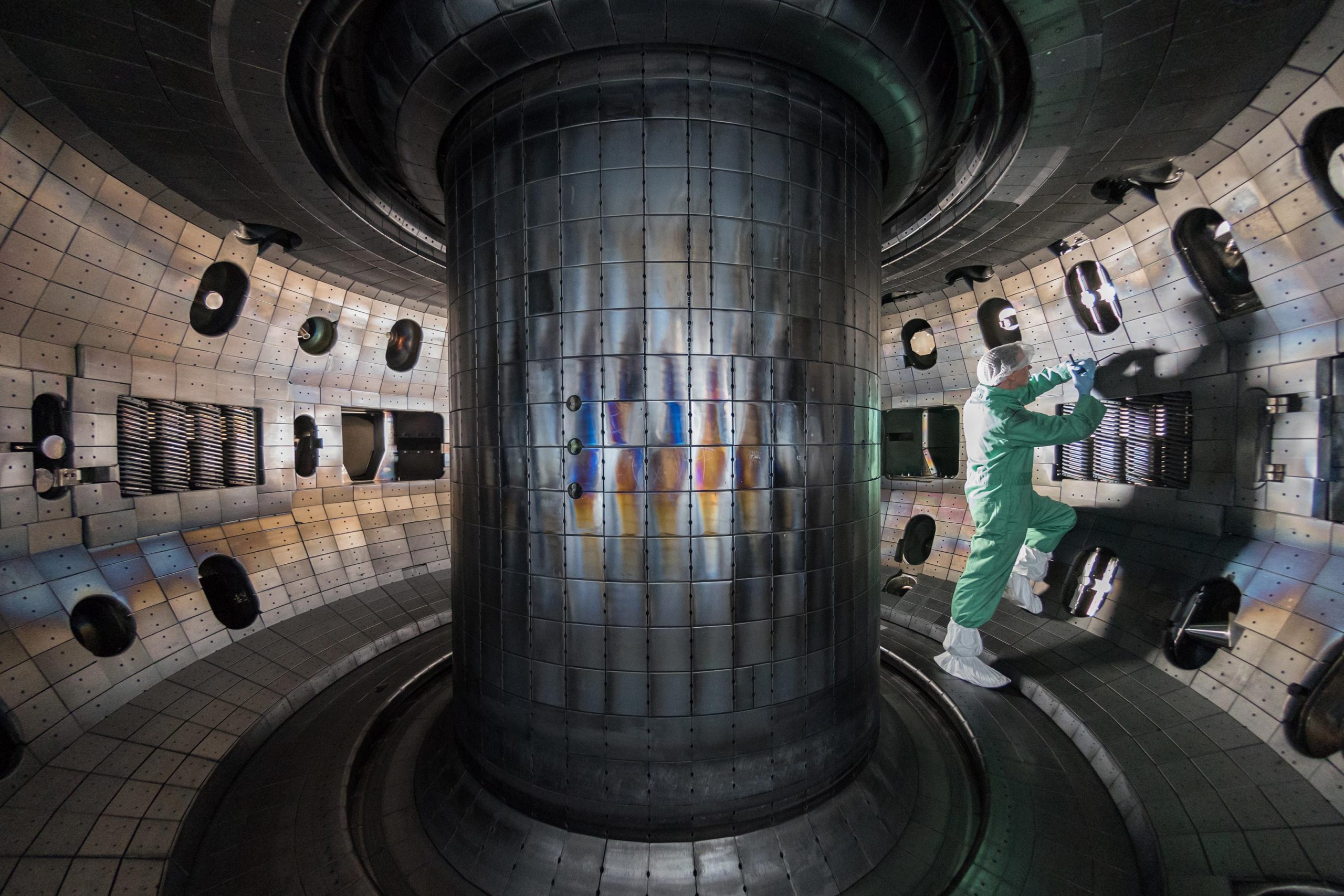
Can theory and computation methods help the search for the best divertor material and thus contribute to making fusion energy a reality?
Exploring nuclear fusion as a clean energy source reveals a critical need for advanced plasma-facing materials. MARVEL lab researchers identified materials that might withstand fusion’s extreme conditions and proposed alternatives to tungsten, the current choice.
Nuclear Fusion and the Material Challenge
Nuclear fusion offers a promising solution to our energy challenges, potentially providing an almost limitless power source without greenhouse gas emissions. However, significant technological hurdles remain, especially regarding the materials required for fusion reactors. These reactors rely on materials that can endure the extreme conditions at the plasma interface.
The ITER project, an experimental European reactor under construction in southern France, includes a critical component called a divertor. This device extracts heat and ash generated by the fusion reaction and channels the intense flow of heat and particles from the plasma to specific surfaces for cooling. The divertor’s plasma-facing materials must not only withstand extremely high temperatures but also endure a continuous barrage of neutrons, electrons, charged ions, and high-energy radiation.
For ITER, tungsten was selected for the divertor due to its exceptional heat resistance. However, other materials, like carbon fibers and ceramics, were previously considered. The question remains whether tungsten will continue to be the best choice for future reactors, as researchers continue exploring alternatives that might better withstand fusion’s unique demands.
MARVEL Laboratory’s Computational Approach
Can theory and computation methods help the search for the best divertor material and thus contribute to making fusion a reality? Scientists in Nicola Marzari’s MARVEL laboratory at EPFL decided to answer the question, and in a new article in PRX Energy, they present a method for large-scale screening of potential plasma-facing materials and a shortlist of the most promising ones.
First of all, the scientists had to find a way to make computations treatable. “A realistic simulation of the dynamics at the plasma-material interface would require simulating the behavior of thousands of atoms over several milliseconds, which would not be feasible with ordinary computational power,” says Andrea Fedrigucci, a PhD student in the THEOS lab and first author of the paper. “So we decided to select a few key properties that a plasma facing material needs to have, and use them as an indication of how well the material may perform on the divertor.”
First, the scientists looked at the Pauling file database, a large collection of known inorganic crystal structures, and created a workflow to find the ones that have enough resistance to survive the temperatures found in the reactor. This can be understood by looking at their thermal capacity, thermal conductivity, melting temperature and density. Because the surface temperature of a material layer depends on its thickness, they also computed the maximum thickness that each material can have before melting and ranked the materials accordingly. In the case of materials for which information on the maximum thickness could not be computed, they used a Pareto optimization method to rank them according to the previously mentioned properties.
The Shortlisting Process Begins
The result was a first shortlist of 71 candidates. At this stage, a very non-computational and old-school method had to be used.
“I patiently looked up the literature on each of them to check if they had already been tested and discarded, or if there were properties that would prevent their use in a fusion reactor and that were not in the database, such as a tendency to erosion or degradation of their thermal properties under plasma and neutron bombardment.”
Interestingly, this part of the study led to discarding as divertor materials some innovative materials that have recently been proposed for application in fusion reactors, such as high-entropy alloys.
Final Selection of Promising Materials
In the end, 21 materials remained, on which a DFT workflow was applied to calculate two key properties that a good plasma fusion material should have: the surface binding energy, which is a measure of how easy it is to extract an atom from the surface, and the formation energy of a hydrogen interstitial, that measures a proxy of tritium solubility in the crystal structure.
“If a divertor material is excessively eroded during its operational lifetime, the released atoms disperse into the plasma, leading to a reduction in its temperature,” says Fedrigucci. “In addition, if the material is chemically reactive with tritium, it can subtract the tritium available for fusion and cause an accumulation of tritium inventory that exceeds the safety limits imposed for this type of technology.”
In the end, the final ranking based on all the key properties includes some usual suspects that have been extensively tested: tungsten itself in metallic (W) and carbide forms (WC and W2C), diamond and graphite, boron nitride, and transition metals, such as molybdenum, tantalum, and rhenium. But there were also a few surprises, such as a peculiar phase of tantalum nitride or other ceramics based on boron and nitrogen, that have never been tested for this application.
In the future, says Fedrigucci, the group hopes to leverage neural networks to better simulate what really happens to materials in the reactor, including the interaction with neutrons that could not be simulated here.
Reference: “Comprehensive Screening of Plasma-Facing Materials for Nuclear Fusion” by Andrea Fedrigucci, Nicola Marzari and Paolo Ricci, 29 October 2024, PRX Energy.
DOI: 10.1103/PRXEnergy.3.043002
Never miss a breakthrough: Join the SciTechDaily newsletter.
Follow us on Google and Google News.
2 Comments
Isn’t the core of the fusion reactor so hot that absolutely nothing can contain that heat long enough before it melts or burns off?
The idea is to contain the plasma with a magnetic field, which is inside a vacuum chamber, which still has to withstand very high temperatures because it is close to the plasma, but not touching it.