
Close Menu
    Facebook X (Twitter) Instagram
    SciTechDaily
    • Biology
    • Chemistry
    • Earth
    • Health
    • Physics
    • Science
    • Space
    • Technology
    Facebook X (Twitter) Pinterest YouTube RSS
    SciTechDaily
    Home»Chemistry»Biochemists Reveal New Insight on Bacterium That Protects Plants From Disease
    Chemistry

    Biochemists Reveal New Insight on Bacterium That Protects Plants From Disease

    By Sasha Mushegian, American Society for Biochemistry and Molecular BiologyFebruary 5, 2018No Comments3 Mins Read
    Facebook Twitter Pinterest Telegram LinkedIn WhatsApp Email Reddit
    Share
    Facebook Twitter LinkedIn Pinterest Telegram Email Reddit
    Biochemists Reveal New Insight into Molecular Weapons of the Plant Microbiome
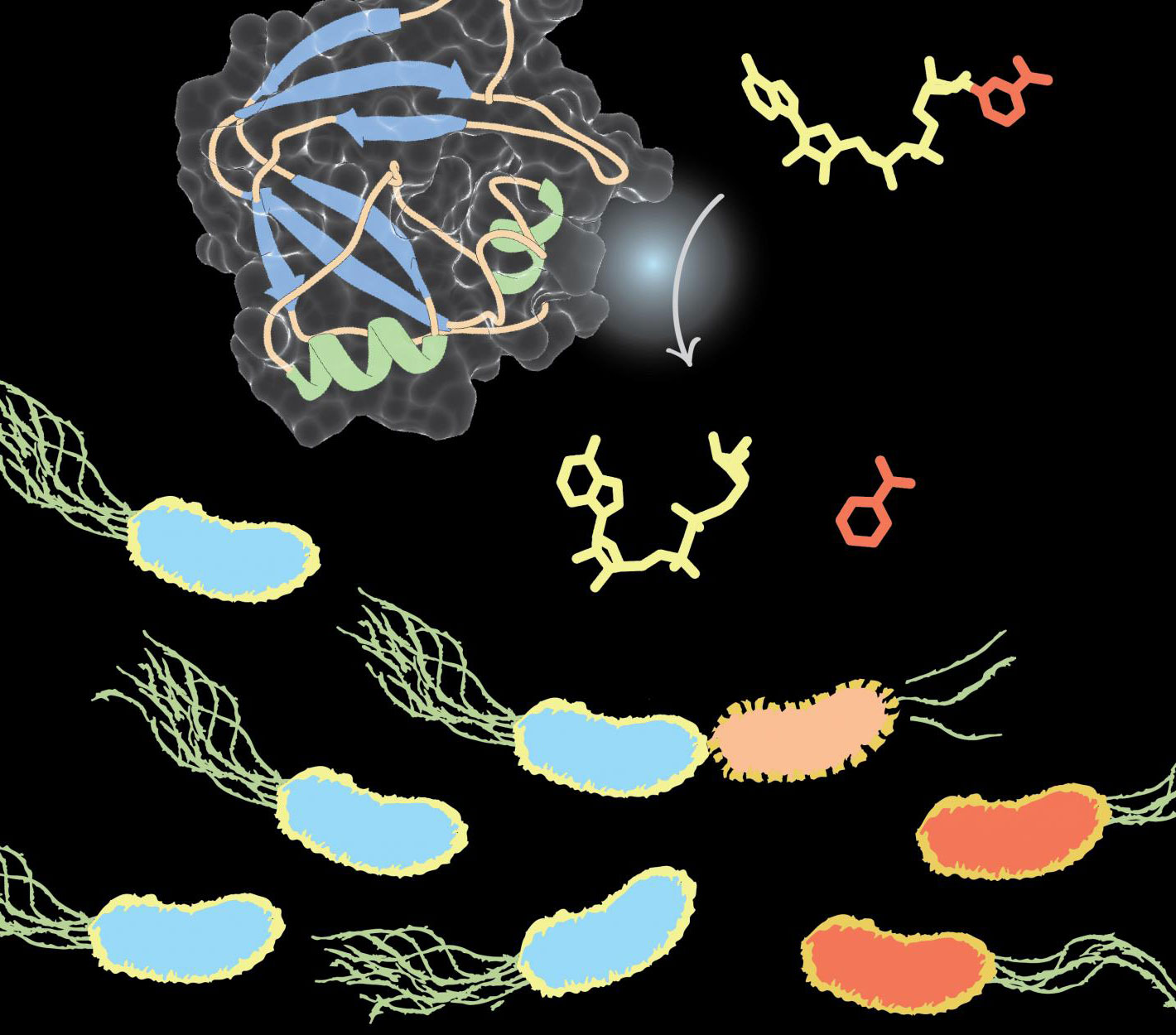
    Image depicts Tne2, an NAD-degrading enzyme secreted through the type 6 secretion system of the plant-protective bacterium Pseudomonas protegens. Credit: John Whitney, McMaster University

    Like all organisms, plants are associated with bacterial communities in which helpful and harmful bacteria compete for dominance. Among the weaponry of these warring bacteria are molecular syringes that some bacteria can use to inject toxins into others. In a study published in the February 2 issue of the Journal of Biological Chemistry, researchers at McMaster University in Canada pinpointed the identity of one such toxin used by a soil-dwelling bacterium that protects plants from disease.

    The bacterium Pseudomonas protegens can kill soil-dwelling plant pathogens, including fungi and bacteria that attack the roots of important crops such as cotton. Pseudomonas protegens releases diverse antimicrobial compounds into the soil, but John Whitney was curious specifically about the compounds that it was injecting directly into other bacteria through the type VI secretion system, or T6SS.

    “[The T6SS] is this molecular nanomachine that injects toxic protein into other species of bacteria and kills them,” Whitney said. “Plant protective bacteria that have [T6SS] can protect plants from pathogens better relative to [bacteria] that don’t have it.”

    Jenny Tang and Nathan Bullen, undergraduate students from the University of Waterloo working with Whitney on a co-op work-study assignment, spearheaded the discovery that the toxic protein used by P. protegens against other bacteria acts on a molecule found in nearly all living cells: nicotinamide adenine dinucleotide, or NAD+. NAD+ is a cofactor, or “helper” molecule, in many biochemical reactions. By injecting a protein that destroys NAD+, P. protegens is able to kill other bacteria.

    The team then investigated the genome sequences of many other bacteria to see how widespread the strategy of targeting NAD+ is in microbial warfare. They found that many bacteria with secretion systems carry genes similar to the one encoding the NAD-targeting toxin.

    “We started to see that this isn’t just a way of killing that is enacted by plant-protective bacteria,” Whitney said. “If you look at the distribution of this (protein) among all sequenced bacteria, it appears that many different bacteria in many different environmental niches use this mode of action to outcompete other bacteria.”

    The abundance of these toxins in nature raises many questions: How do different bacteria in different environments evolve to resist this toxin? Are NAD-targeting toxins more effective against some bacterial species than others? Understanding the diversity of bacterial weapons is an active area of study among agricultural researchers who would like to develop better ways to fight plant diseases.

    “The identification and characterization of antibacterial toxins produced by plant-protective bacteria may one day allow us to engineer these bacteria to have enhanced ability to suppress pathogens,” Whitney said.

    Reference: “Diverse NADase effector families mediate interbacterial antagonism via the type VI secretion system” by Jenny Y. Tang, Nathan P. Bullen, Shehryar Ahmad and John C. Whitney, February 2018, Journal of Biological Chemistry.
    DOI: 10.1074/jbc.RA117.000178

    Never miss a breakthrough: Join the SciTechDaily newsletter.
    Follow us on Google and Google News.

    Bacteria Biochemistry Disease McMaster University Medicine Molecular Biology
    Share. Facebook Twitter Pinterest LinkedIn Email Reddit

    Related Articles

    Scientists Identify Specific Enzyme Related to Colon Cancer

    Shining Molecules Detect Tau Pathology in Alzheimer’s Disease

    Yale Study Reveals Why BRCA Gene Resists Cancer Treatment

    Newly Discovered Protein Offers Vast Potential for Cancer Treatment

    Natural Toxins Combined With Synthetic Drugs Could Disarm Cancer, Drug-Resistant Bacteria

    Researchers Identify a Superbug’s Secret to Antibiotic Resistance

    New Drug Candidate Kills Cancer Cells Better Than Cisplatin

    Stimulating Resolution Programs Limit Consequences of Infection

    Unlocking Chemical Pathways to Synthesize Chemicals Found in Nature

    Leave A Reply Cancel Reply

    • Facebook
    • Twitter
    • Pinterest
    • YouTube

    Don't Miss a Discovery

    Subscribe for the Latest in Science & Tech!

    Trending News

    JWST Finds a “Star” 100 Billion Times Brighter Than Any Star Should Be

    Scientists Find a Hidden Biological Link Across Different Forms of Autism

    Astronomers Discover a Ghostly River of Stars That Could Reveal Dark Matter

    Why Is Colorectal Cancer Rising in People Under 50? New Clues Point to the Environment

    Quantum Fluctuations Break a Crystal’s Symmetry Rules

    Why Does an Irregular Heartbeat Strike 40 Years Early in Some People?

    Scientists Reveal How ADHD Could Fuel Creative Thinking

    Scientists Find Just 3 Minutes of Sprinting Can Transform Blood Chemistry

    Follow SciTechDaily
    • Facebook
    • Twitter
    • YouTube
    • Pinterest
    • Newsletter
    • RSS
    SciTech News
    • Biology News
    • Chemistry News
    • Earth News
    • Health News
    • Physics News
    • Science News
    • Space News
    • Technology News
    Recent Posts
    • More Screen Time, Better Thinking? An 8-Year Study Finds a Surprising Link
    • A Vast Clean Energy Source May Be Hiding Beneath Australia’s Red Soil
    • Scientists Uncover Signs of an Ancient Climate “Tipping Point”
    • Cleaner Cars May Be Hiding a New Pollution Problem
    • Common Plant Chemical Linked to Widespread Organ Damage in Aquatic Animals
    Copyright © 1998 - 2026 SciTechDaily. All Rights Reserved.
    • Science News
    • About
    • Contact
    • Editorial Board
    • Privacy Policy
    • Terms of Use

    Type above and press Enter to search. Press Esc to cancel.