
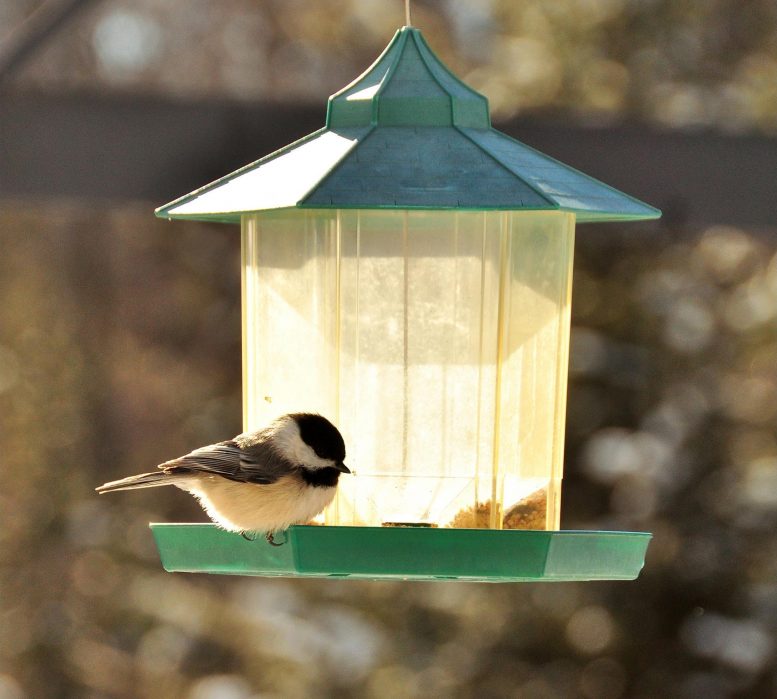
Seeds and fat balls do more than just fill small birds’ stomachs. New research from Lund University in Sweden shows that feeding during the wintertime causes birds to be healthier, since they do not have to expend as much energy fighting infections.
A small change in body temperature can be fatal for humans. Small birds, meanwhile, lower their body temperature at night by several degrees during the winter. Just like us, the birds attempt to save energy when it is cold. If they are exposed to infection, the body’s first reaction is to raise its temperature, which clashes with the bird’s simultaneous need to save energy by lowering body temperature.
“We investigated how access to food during winter affected the balancing act between maintaining a low body temperature in order to save energy, and the possibility of raising body temperature in order to fight infection,” says Hannah Watson, a biologist at Lund University.
The study shows that birds who were fed during the winter did not need to lower their body temperature as much at night as birds who did not have access to feeding tables. They had gathered enough energy to survive a winter night in spite of a having higher body temperature.
When the birds were exposed to a simulated infection, all the birds had essentially the same temperature during a fever. Instead of conserving energy to survive the winter, the birds without access to extra food were forced to use more energy in order to raise their body temperature high enough to battle infection.
Unexpected Findings on Immune Response
“We had expected to find that the birds that had access to birdfeeders would have more energy to fight an infection, and that as a result they would exhibit a stronger fever response. Our results, however, show the opposite – birds that did not have access to a reliable source of food had the strongest reaction to infection. This enabled them to reach the same fever temperature as the birds with extra food,” says Hannah Watson.
Climate change and human activity are having an ever-increasing impact on animals. Wild animals come into contact with new pathogens that they have never encountered before. Bird feeding, then, can have positive and negative effects. Birds that visit feeding tables are exposed to more infection because of the spread of pathogens, but this could make their immune defenses more tolerant to a new infection. It is therefore important, the researchers argue, to understand the factors that affect animals’ capacity to put up an effective immune response – access to food during winter being one such example.
“A lot of people like to feed the birds. Our study shows that this can have a positive effect on the capacity of our small birds to fight an infection,” concludes Hannah Watson.
Reference: “Thermoregulatory costs of the innate immune response are modulated by winter food availability in a small passerine” by Hannah Watson, Jan-Åke Nilsson and Johan F. Nilsson, 9 April 2023, Journal of Animal Ecology.
DOI: 10.1111/1365-2656.13914
Never miss a breakthrough: Join the SciTechDaily newsletter.
Follow us on Google and Google News.
1 Comment
It is not surprising that individual birds have higher survival rates if humans provide supplemental food during Winter, when resources are scarce.
However, birds evolved into what they are today without assistance from humans. Can we be certain that the impact of supplemental feeding, long-term, will be beneficial to the different species? They have been fine for millions of years without help! Might they become dependent on humans, and their fate become determined by our fate?
“The road to Hell is paved with good intentions.”