
Close Menu
    Facebook X (Twitter) Instagram
    SciTechDaily
    • Biology
    • Chemistry
    • Earth
    • Health
    • Physics
    • Science
    • Space
    • Technology
    Facebook X (Twitter) Pinterest YouTube RSS
    SciTechDaily
    Home»Science»Black Hole Bends Light Back on Itself – Proves Theory Predicted More Than 40 Years Ago
    Science

    Black Hole Bends Light Back on Itself – Proves Theory Predicted More Than 40 Years Ago

    By CaltechApril 12, 20201 Comment4 Mins Read
    Facebook Twitter Pinterest Telegram LinkedIn WhatsApp Email Reddit
    Share
    Facebook Twitter LinkedIn Pinterest Telegram Email Reddit
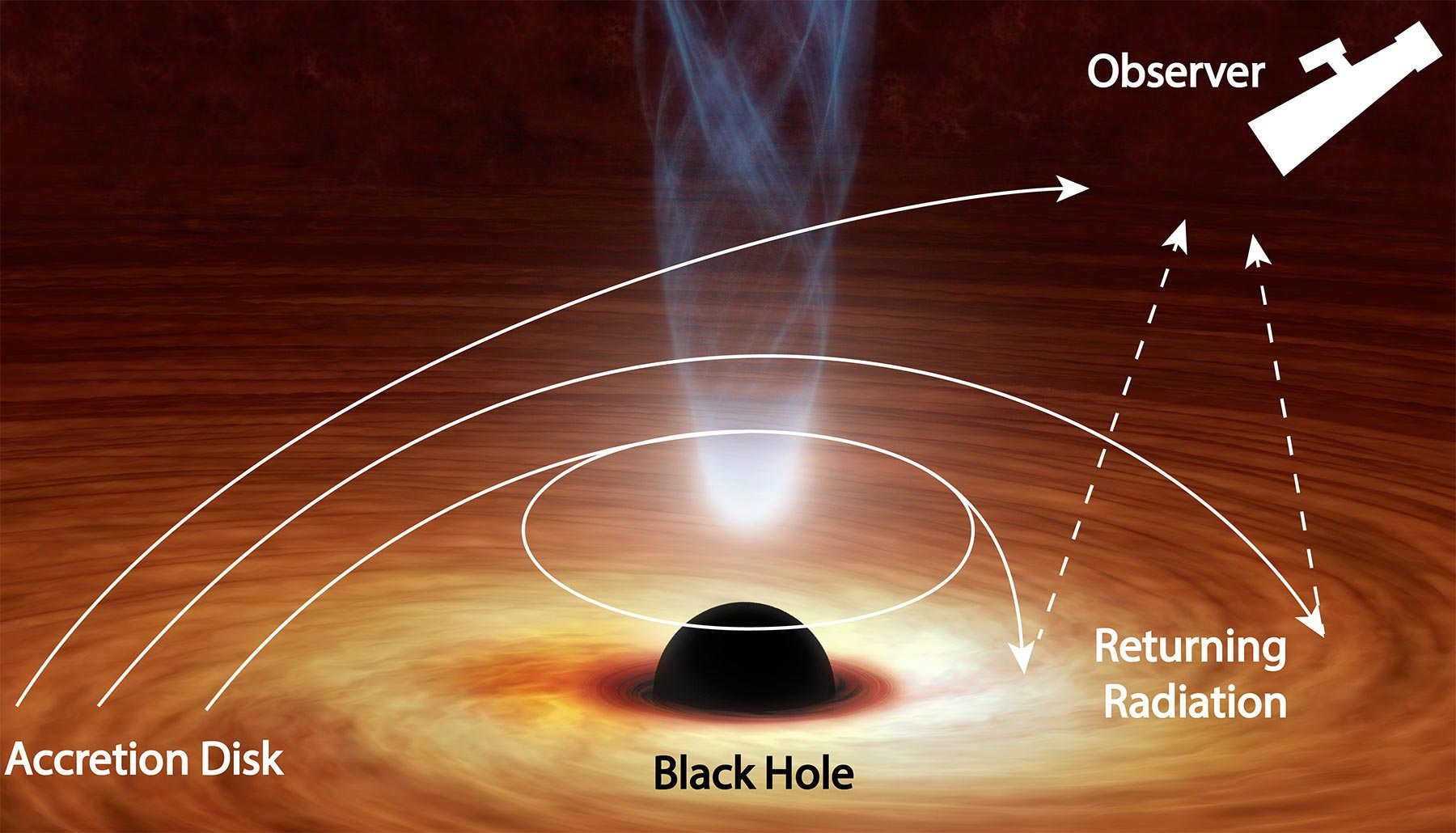
    Black Hole Bends Light Back on Itself
    This illustration shows how some of the light coming from a disk around a black hole is bent back onto the disk itself due to the gravity of the hefty black hole. The light is then reflected back off the disk. Astronomers using data from NASA’s now-defunct Rossi X-ray Timing Explorer (RXTE) mission were able to distinguish between light that came straight from the disk and light that was reflected. The bluish material coming off the black hole is an outflowing jet of energetic particles. Credit: NASA/JPL-Caltech/R. Hurt (IPAC)/R. Connors (Caltech)

    You may have heard that nothing escapes the gravitational grasp of a black hole, not even light. This is true in the immediate vicinity of a black hole, but a bit farther out—in disks of material that swirl around some black holes—light can escape. In fact, this is the reason actively growing black holes shine with brilliant X-rays.

    Now, a new study accepted for publication in The Astrophysical Journal offers evidence that, in fact, not all of the light streaming from a black hole’s surrounding disk easily escapes. Some of it gives in to the monstrous pull of the black hole, turns back, and then ultimately bounces off the disk and escapes.

    “We observed light coming from very close to the black hole that is trying to escape, but instead is pulled right back by the black hole like a boomerang,” says Riley Connors, lead author of the new study and a postdoctoral scholar at Caltech. “This is something that was predicted in the 1970s, but hadn’t been shown until now.”

    The new findings were made possible by combing through archival observations from NASA’s now-defunct Rossi X-ray Timing Explorer (RXTE) mission, which came to an end in 2012. The researchers specifically looked at a black hole that is orbited by a sun-like star; together, the pair is called XTE J1550-564. The black hole “feeds” off this star, pulling material onto a flat structure around it called an accretion disk. By looking closely at the X-ray light coming from the disk as the light spirals toward the black hole, the team found imprints indicating that the light had been bent back toward the disk and reflected off.

    “The disk is essentially illuminating itself,” says co-author Javier Garcia, a research assistant professor of physics at Caltech. “Theorists had predicted what fraction of the light would bend back on the disk, and now, for the first time, we have confirmed those predictions.”

    The scientists say that the new results offer another indirect confirmation of Albert Einstein’s general theory of relativity, and also will help in future measurements of the spin rates of black holes, something that is still poorly understood.

    “Since black holes can potentially spin very fast, they not only bend the light but twist it,” says Connors. “These recent observations are another piece in the puzzle of trying to figure out how fast black holes spin.”

    Reference: “Evidence for Returning Disk Radiation in the Black Hole X-Ray Binary XTE J1550–564” by Riley M. T. Connors, Javier A. García, Thomas Dauser, Victoria Grinberg, James F. Steiner, Navin Sridhar, Jörn Wilms, John Tomsick, Fiona Harrison and Stefan Licklederer, 27 March 2020, The Astrophysical Journal.
    DOI: 10.3847/1538-4357/ab7afc
    CaltechAUTHORS

    The new study, titled, “Evidence for Returning Disk Radiation in the Black Hole X-ray Binary XTEJ1550-564,” was funded by NASA, the Alexander von Humboldt Foundation, and the Margarete von Wrangell Fellowship. Other co-authors are Thomas Dauser, Stefan Licklederer, and Jörn Wilms of The University of Erlangen-Nüremberg in Germany; Victoria Grinberg of the Universität Tübingen in Germany; James Steiner of the MIT Kavli Institute for Astrophysics and Space Research and Harvard University; Navin Sridhar of Columbia University; John Tomsick of UC Berkeley; and Fiona Harrison, the Harold A. Rosen Professor of Physics at Caltech and the Kent and Joyce Kresa Leadership Chair of the Division of Physics, Mathematics and Astronomy.

    Never miss a breakthrough: Join the SciTechDaily newsletter.
    Follow us on Google and Google News.

    Astrophysics Black Hole California Institute of Technology Popular
    Share. Facebook Twitter Pinterest LinkedIn Email Reddit

    Related Articles

    Physicists Create New Model of Ringing Black Holes

    Colossal Black Holes Locked in an Epic Cosmic Dance at Heart of Galaxy

    Black Hole Tears Apart a Star Decades Ago – Goes Unnoticed Until Now

    Astrophysicists Surprised to Find Extreme Black Holes Have “Gravitational Hair” That Can Be Combed

    Hungry Black Hole Among the Most Massive in the Universe – 34 Billion Times the Mass of Our Sun

    Are Black Holes Made of Dark Energy? Error Made When Applying Einstein’s Equations to Model Growth of the Universe?

    Astronomers Link the Launching of the Corona to a Black Hole Flare

    NASA Supercomputer Simulation Shows Neutron Stars Ripping Each Other Apart to Form a Black Hole

    A New Kind of Cosmic Flash May Reveal the Birth of a Black Hole

    1 Comment

    1. James 'Jim' Oss on April 12, 2020 8:51 am

      Do red wavelength light get bent back at steeper angle than blue?

      Reply
    Leave A Reply Cancel Reply

    • Facebook
    • Twitter
    • Pinterest
    • YouTube

    Don't Miss a Discovery

    Subscribe for the Latest in Science & Tech!

    Trending News

    Largest-Ever Study Finds Medicinal Cannabis Ineffective for Anxiety, Depression, PTSD

    250-Million-Year-Old Egg Solves One of Evolution’s Biggest Mysteries

    Living With Roommates Might Be Changing Your Gut Microbiome Without You Knowing

    Century-Old Cleaning Chemical Linked to 500% Increased Risk of Parkinson’s Disease

    What if Your Memories Never Happened? Physicists Take a New Look at the Boltzmann Brain Paradox

    One of the Universe’s Largest Stars May Be Getting Ready To Explode

    Scientists Discover Enzyme That Could Supercharge Ozempic-Like Weight Loss Drugs

    Popular Sweetener Linked to DNA Damage – “It’s Something You Should Not Be Eating”

    Follow SciTechDaily
    • Facebook
    • Twitter
    • YouTube
    • Pinterest
    • Newsletter
    • RSS
    SciTech News
    • Biology News
    • Chemistry News
    • Earth News
    • Health News
    • Physics News
    • Science News
    • Space News
    • Technology News
    Recent Posts
    • Scientists Say This Overlooked Organ Could Hold the Key to Longer Life
    • Want Less Stress? Landmark Study Points to a Simple Habit
    • Scientists Reveal Eating Fruits and Vegetables May Increase Your Risk of Lung Cancer
    • AI Reveals Explosive Growth of Floating Algae Across the World’s Oceans
    • 5.5 Million Bees Discovered Living Beneath a New York Cemetery
    Copyright © 1998 - 2026 SciTechDaily. All Rights Reserved.
    • Science News
    • About
    • Contact
    • Editorial Board
    • Privacy Policy
    • Terms of Use

    Type above and press Enter to search. Press Esc to cancel.