
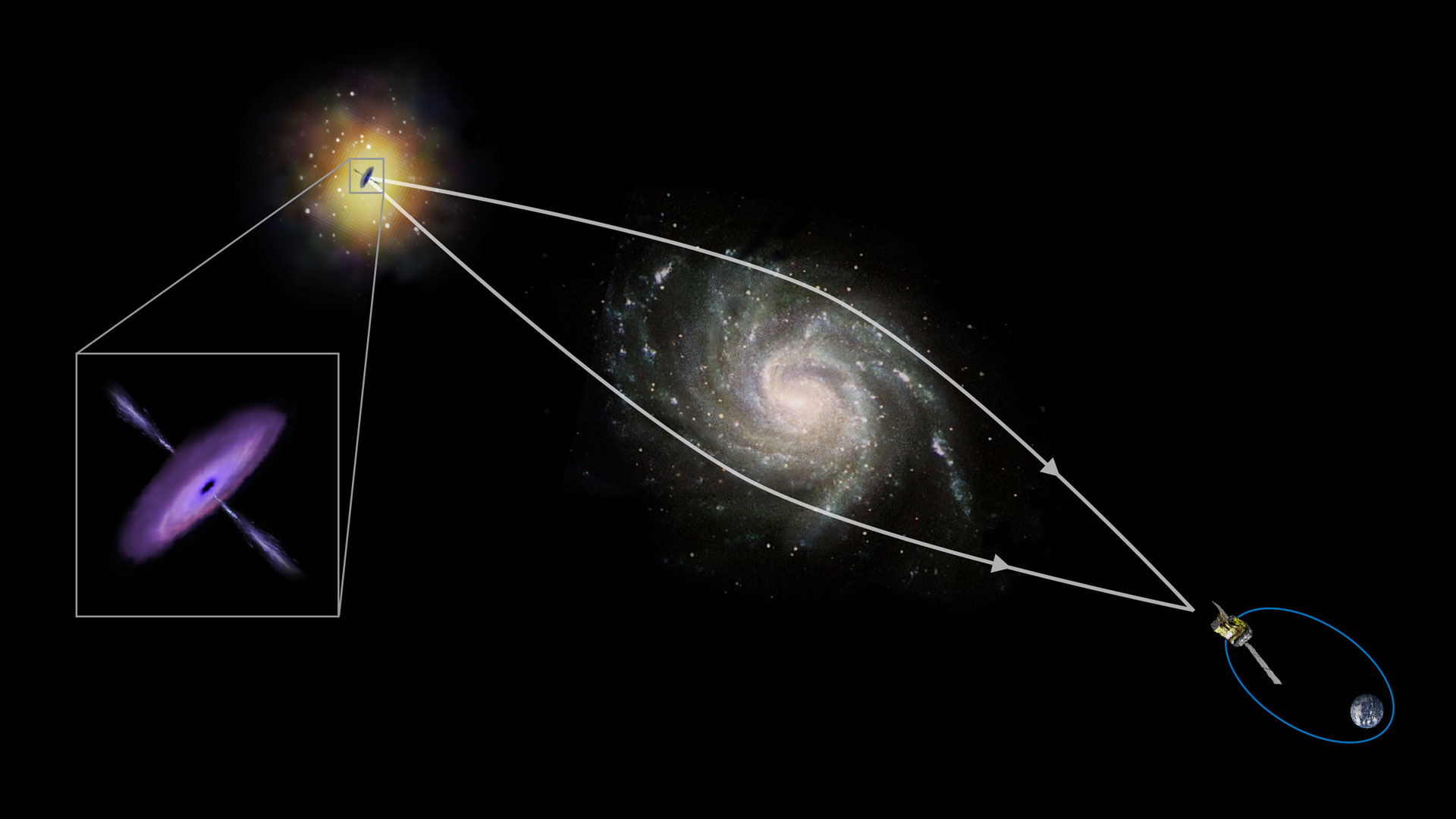
Astronomers used the magnifying effect of the stars to ‘zoom in’ on galaxy PKS 1830-211, revealing very small structures in the distant galaxy.
The Integral, Fermi, and Swift space observatories have used the magnifying power of a cosmic lens to explore the inner regions of a supermassive black hole.
Gamma rays are highly energetic radiation emitted by some of the most extreme objects in our Universe. Jets of gamma rays moving at close to the speed of light stream from the areas around black holes, for example. These jets are thought to be emitted by superheated material spinning wildly as it is devoured by the hungry black hole.
Our telescopes will never be powerful enough to reveal these inner regions, and scientists struggle to examine exactly how these jets are unleashed into the Universe.
“Because we can’t clearly see what’s going on, we don’t fully understand this behavior,” says Andrii Neronov of the University of Geneva, Switzerland, lead author on the Nature Physics paper published online today.
“However, our method allowed us to ‘resolve’ this region, and get an insight into the patch of space directly surrounding a supermassive black hole known as PKS 1830-211.”
This black hole lies many billions of light-years away. Neither ESA’s Integral satellite nor NASA’s Fermi gamma-ray telescope can observe the region unaided, but a lucky coincidence provides a helping hand: gravitational microlensing.

“From Earth, black holes are tiny. They’re just so very far away,” notes Dr Neronov. “Trying to observe PKS 1830-211 is like trying to look at an ant sitting on the Moon.
“None of our telescopes can observe something so small, so we used a trick to resolve the ant: a huge gravitational lens.”
Massive cosmic objects, from single stars to galaxy clusters, bend and focus the light that flows around them with their gravity, acting like giant magnifying glasses.
Dr. Neronov and colleagues used a star sitting between their target and Earth to ‘zoom in’ to the black hole and measure the size of the jet-emitting region – the first time this method has ever been used with gamma rays.
They picked out structures on the same angular scale as that of the Moon ant. The observed patch of sky covers a region about 100 times the Earth–Sun distance. In astronomical terms, this is remarkably small.
“Our observations demonstrate that the gamma rays come from the direct vicinity of the black hole itself,” says Dr Neronov. “This gives us some idea about what is and isn’t important in generating the jets.
“It’s amazing to be able to see such tiny things at such enormous distances from us. I’m very excited to have a ‘black-hole-scope’ to investigate the inner regions of the jets.”
Observing the gamma-ray source with ESA’s Integral and NASA’s Fermi and Swift allowed the astronomers to build up a more complete picture of the radiation streaming out.
The more energetic gamma rays, detected by Fermi, are seen to be coming from the tiny base of the jet – the ‘ant on the Moon’-size region – while the lower energy gamma rays, detected by Integral, were emitted from a much larger surrounding region.
The team also studied X-rays using Integral and Swift. They found these X-rays to be emanating from a region stretching around the hole some 400 billion km or more.
“This black hole is one of the most powerful known objects of its kind. Fully characterizing its emission will hopefully give us real insight into how these jets form,” says Erik Kuulkers, ESA’s Integral project scientist.
“Fortunately, the black hole lies in the field of space located towards the center of our Galaxy, so Integral sees it often.
“These observations provide unique information about the high-energy processes taking place around supermassive black holes, by allowing us to ‘look inside’ tiny structures lying very far away from us.”
Reference: “Central engine of a gamma-ray blazar resolved through the magnifying glass of gravitational microlensing” by Andrii Neronov, Ievgen Vovk and Denys Malyshev, 6 July 2015, Nature Physics.
DOI: 10.1038/nphys3376
Never miss a breakthrough: Join the SciTechDaily newsletter.
Follow us on Google and Google News.
1 Comment
Interesting work if it holds up. The size of the object is subject to a computer program which models the findings. If the code in the program is correct than the objects are the sizes claimed. This work needs to be verified by independent computer code and observation of the black hole.