
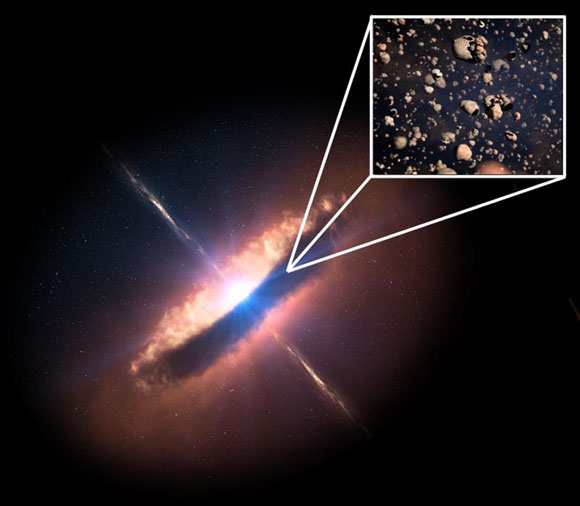
For the first time a team of researchers has discovered of a ring of rocks circling a very young star. These ‘pebbles’ are believed to be a crucial link in formation of planets.
Dr. Jane Greaves of the University of St Andrews presented the work at the National Astronomy Meeting at Venue Cymru in Llandudno, Wales.
Planets are thought to form from the dust and gas that encircles young stars in a disk. Over time, dust particles stick together, until they build up bigger clumps. Eventually, these have enough mass that gravity becomes significant, and over millions of years the clumps crash together to make planets and moons. In our own Solar System, this process took place about 4500 million years ago, with the giant planet Jupiter the first to form.
Since the 1990s, astronomers have found both disks of gas and dust, and nearly 2000 fully formed planets, but the intermediate stages of formation are harder to detect.
Dr. Greaves and team colleague Dr. Anita Richards from the University of Manchester used the e-MERLIN array of radio telescopes centered on Jodrell Bank, Cheshire, and that stretches across England in a so-called interferometer, mimicking the resolution of a single large telescope. Richards took charge of the image processing, which was initially meant just to test the handling of the very large data stream that e-MERLIN generates.
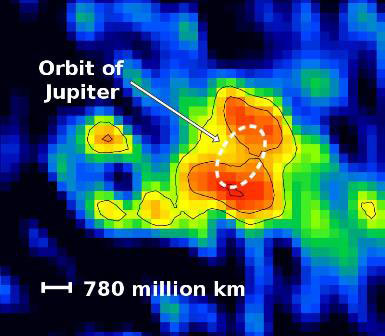
The scientists used the interferometer to observe the star DG Tauri, a relatively youthful star just 2.5 million years old and 450 light-years away in the constellation of Taurus. Looking at radio wavelengths, they discovered a faint glow characteristic of rocks in orbit around the newly formed star.
Richards said: “This was the first time for this project that we folded in data from the 76m-diameter (250ft-diameter) Lovell Telescope at Jodrell Bank, which is the heart of the e-MERLIN array. We knew DG Tauri had a jet of hot gas flowing off its poles – a beacon for stars still in the process of forming – so we had an idea of what to look for.”
‘It was a real surprise to also see a belt of pebbles, with only a fraction of the data we hope to acquire. With the four-fold increase in radio bandwidth we are now working on, we hope to get similar images for a whole zoo of other young stars.”
Dr. Greaves added: “The extraordinarily fine detail we can see with the e-MERLIN telescopes was the key to this discovery. We could zoom into a region as small as the orbit of Jupiter would be in the Solar System. We found a belt of pebbles strung along a very similar orbit – just where they are needed if a planet is to grow in the next few million years. Although we thought this was how planets must get started, it’s very exciting to actually see the process in action!”
The e-MERLIN observations were made at a wavelength of 4.6 cm (about a third of that used in microwave ovens). To give off these radio waves, rocky chunks at least a centimeter in size are needed, and the shape of the belt confirms the rocks as the source of the radio waves.
Team member Dr. John Ilee, also of St Andrews, is working on a related European project to investigate protoplanetary discs around young stars. He added: “Long wavelength data, such as these fantastic e-MERLIN results, will be essential in constraining the next generation of computer models of discs around young stars. Having an accurate idea of the location and amount of the centimeter-sized material in the disc will bring us closer to a consistent picture of how planets may eventually form.”
Greaves leads an international team known as PEBBLeS – the Planet Earth Building Blocks Legacy e-MERLIN Survey. By imaging the rocky belts of many stars, the team will look for clues to how often planets form, and where, around stars that will evolve into future suns like our own. The ultimate aim is to zoom in and see ‘extrasolar Earths’ being born, five times closer in to their host stars than Jupiter’s orbit. Upgrades to e-MERLIN’s capabilities in the next few years, as well as the construction of the new Square Kilometer Array (with its HQ at Jodrell Bank), make this a real possibility.
Never miss a breakthrough: Join the SciTechDaily newsletter.
Follow us on Google and Google News.