
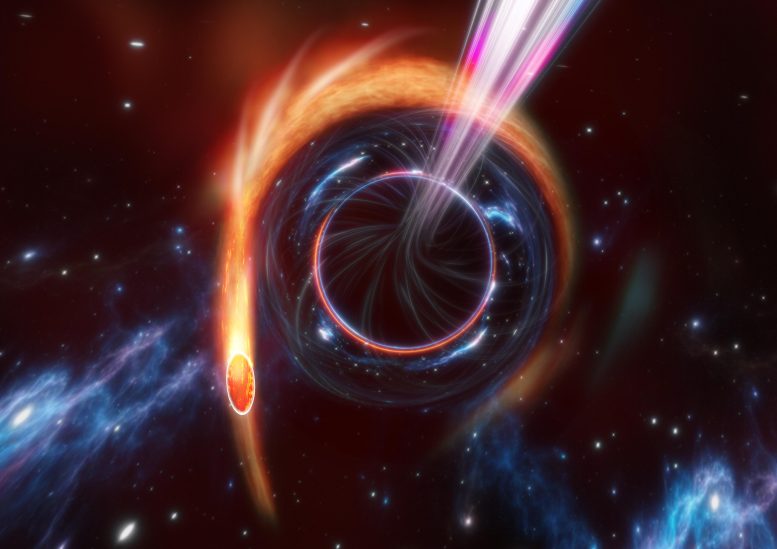
Astronomers at Swinburne University helped identify a rare tidal disruption event (TDE), involving a jet of material traveling close to the speed of light, from a supermassive black hole consuming a star 8.5 billion light-years away.
Astronomers at the Swinburne University of Technology have played an important role in the discovery of a rare luminous jet of matter traveling close to the speed of light, created by a supermassive black hole violently tearing apart a star. Published in the journal Nature, the research brings astronomers one step closer to understanding the physics of supermassive black holes, which sit at the center of galaxies billions of light years away.
Swinburne Professor Jeff Cooke, who is also a Chief Investigator for the ARC Centre of Excellence for Gravitational Wave Discovery (OzGrav), was a key member of the research team.
“Stars that are literally torn apart by the gravitational tidal forces of black holes help us better understand what exists in the Universe,” says Professor Cooke. “These observations help us explore extreme physics and energies that cannot be created on Earth.”
Supermassive, Super Rare, and Super Far Away
When a star gets too close to a supermassive black hole, the star is violently ripped apart by tidal forces, with pieces drawn into orbit around the black hole and eventually completely consumed by it. In extremely rare instances – only about one percent of the time – these so-called tidal disruption events (TDEs) also launch luminous jets of material moving almost at the speed of light.
The co-lead authors of the work, Dr. Igor Andreoni from the University of Maryland and Assistant Professor Michael Coughlin from the University of Minnesota, along with an international team, observed one of the brightest ever TDEs. They measured it to be more than 8.5 billion light years away, or more than halfway across the observable Universe.
The event, officially named “AT2022cmc,” is believed to be at the center of a galaxy that is not yet visible because the intense light from the flash still outshines it. Future space observations may unveil the galaxy when AT2022cmc eventually fades away.
It is still a mystery why some TDEs launch jets while others do not appear to. From their observations, the researchers concluded that the black holes associated with AT2022cmc and other similarly jetted TDEs are likely spinning rapidly. This suggests that a rapid black hole spin may be one necessary ingredient for jet launching—an idea that brings researchers closer to understanding these mysterious objects at the outer reaches of the universe.
Working Together on New Discoveries
More than 20 telescopes operating at all wavelengths were a part of this research. These include the Zwicky Transient Facility in California that made the initial discovery, X-ray telescopes in space and on the International Space Station, radio/mm telescopes in Australia, the US, India, and the French Alps, and optical/infrared telescopes in Chile, the Canary Islands and the US, including the W. M. Keck Observatory in Hawaii.
Swinburne postdoctoral researcher Jielai Zhang, a co-author on the research, says that international collaboration was essential to this discovery.
“Although the night sky may appear tranquil, telescopes reveal that the Universe is full of mysterious, explosive, and fleeting events waiting to be discovered. Through OzGrav and Swinburne international research collaborations, we are proud to be making meaningful discoveries such as this one,” she said.
For more on this research, read:
- Supermassive Black Hole Violently Rips Star Apart, Launches Relativistic Jet
- Astronomers Catch a Black Hole Destroying a Nearby Star
- Astronomers Observe Most Distant Black Hole Devouring a Star
Reference: “A very luminous jet from the disruption of a star by a massive black hole” by Igor Andreoni, Michael W. Coughlin, Daniel A. Perley, Yuhan Yao, Wenbin Lu, S. Bradley Cenko, Harsh Kumar, Shreya Anand, Anna Y. Q. Ho, Mansi M. Kasliwal, Antonio de Ugarte Postigo, Ana Sagués-Carracedo, Steve Schulze, D. Alexander Kann, S. R. Kulkarni, Jesper Sollerman, Nial Tanvir, Armin Rest, Luca Izzo, Jean J. Somalwar, David L. Kaplan, Tomás Ahumada, G. C. Anupama, Katie Auchettl, Sudhanshu Barway, Eric C. Bellm, Varun Bhalerao, Joshua S. Bloom, Michael Bremer, Mattia Bulla, Eric Burns, Sergio Campana, Poonam Chandra, Panos Charalampopoulos, Jeff Cooke, Valerio D’Elia, Kaustav Kashyap Das, Dougal Dobie, José Feliciano Agüí Fernández, James Freeburn, Cristoffer Fremling, Suvi Gezari, Simon Goode, Matthew J. Graham, Erica Hammerstein, Viraj R. Karambelkar, Charles D. Kilpatrick, Erik C. Kool, Melanie Krips, Russ R. Laher, Giorgos Leloudas, Andrew Levan, Michael J. Lundquist, Ashish A. Mahabal, Michael S. Medford, M. Coleman Miller, Anais Möller, Kunal P. Mooley, A. J. Nayana, Guy Nir, Peter T. H. Pang, Emmy Paraskeva, Richard A. Perley, Glen Petitpas, Miika Pursiainen, Vikram Ravi, Ryan Ridden-Harper, Reed Riddle, Mickael Rigault, Antonio C. Rodriguez, Ben Rusholme, Yashvi Sharma, I. A. Smith, Robert D. Stein, Christina Thöne, Aaron Tohuvavohu, Frank Valdes, Jan van Roestel, Susanna D. Vergani, Qinan Wang and Jielai Zhang, 30 November 2022, Nature.
DOI: 10.1038/s41586-022-05465-8
Never miss a breakthrough: Join the SciTechDaily newsletter.
Follow us on Google and Google News.
3 Comments
Wow
These objects are so strong and irresistible, they really should be called “royal holes.”
What are they made of? Pixy dust?
Blackholes are what asstronomers look through.