
Close Menu
    Facebook X (Twitter) Instagram
    SciTechDaily
    • Biology
    • Chemistry
    • Earth
    • Health
    • Physics
    • Science
    • Space
    • Technology
    Facebook X (Twitter) Pinterest YouTube RSS
    SciTechDaily
    Home»Space»Boeing Starliner Undocks From Space Station, Lands in New Mexico
    Space

    Boeing Starliner Undocks From Space Station, Lands in New Mexico

    By NASASeptember 7, 20242 Comments3 Mins Read
    Facebook Twitter Pinterest Telegram LinkedIn WhatsApp Email Reddit
    Share
    Facebook Twitter LinkedIn Pinterest Telegram Email Reddit
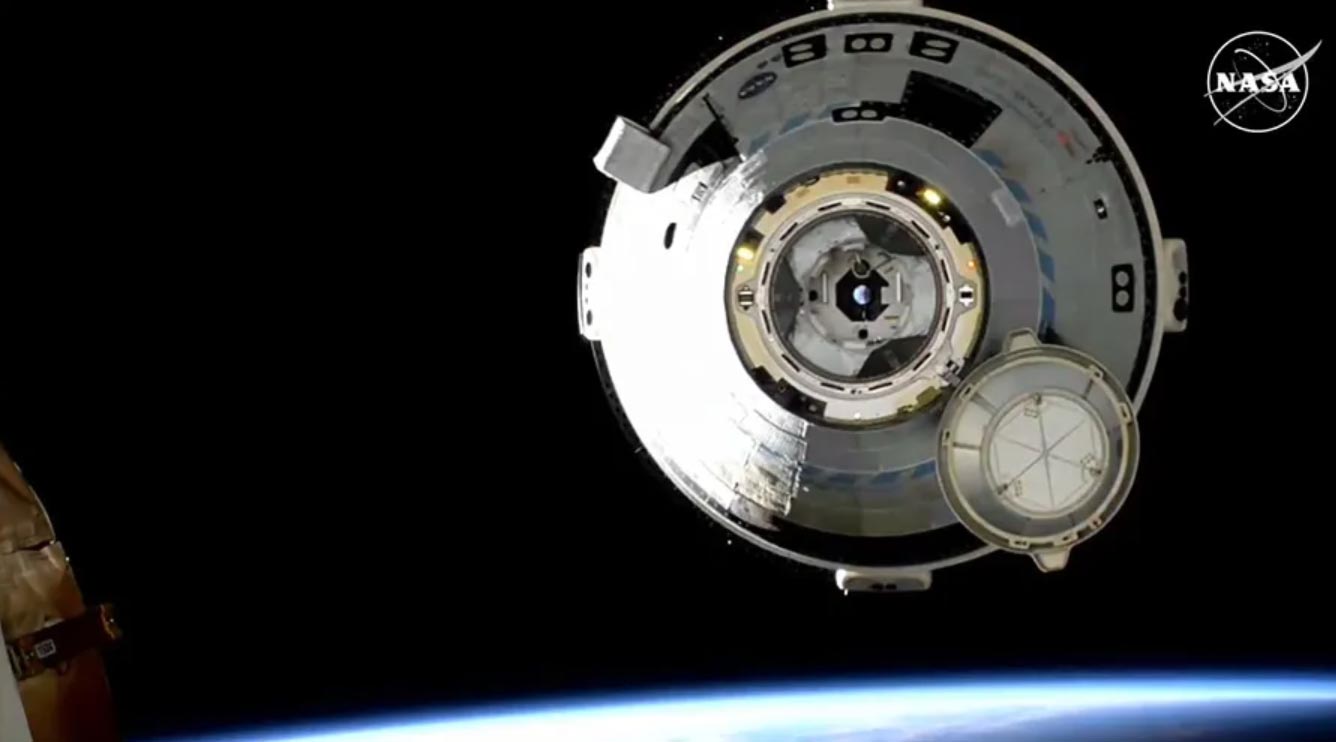
    Uncrewed Starliner Spacecraft Backs Away From the International Space Station
    The uncrewed Starliner spacecraft backs away from the International Space Station shortly after undocking from the Harmony module. Credit: NASA+

    Boeing’s Starliner completed its mission from the International Space Station with a successful deorbit burn, re-entry, and parachute-assisted landing in New Mexico. Its advanced heat shield and airbag system facilitated a safe landing, showcasing its capabilities as a reusable spacecraft.

    At 6:04 p.m. EDT on September 6, Starliner autonomously undocked from the forward-facing port of the International Space Station’s Harmony module, and mission managers gave a “go” for the spacecraft to proceed for a deorbit burn.
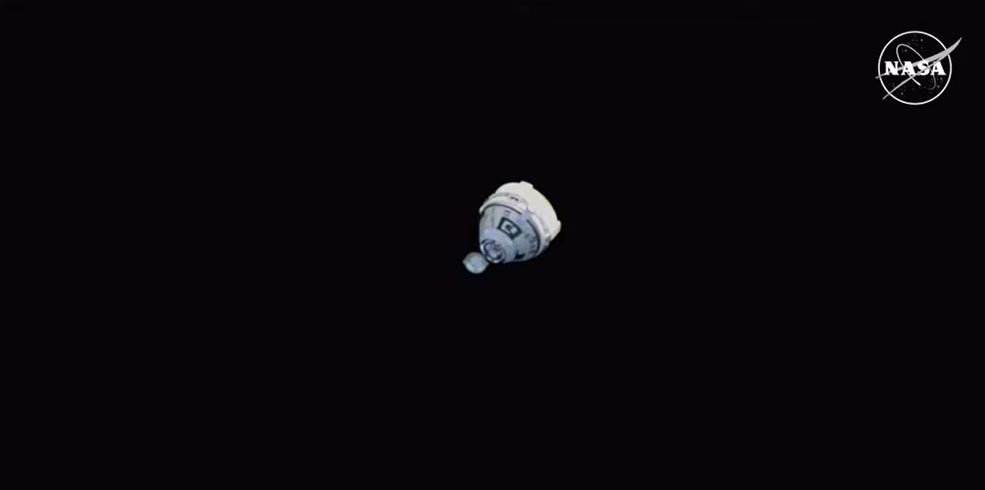
    Uncrewed Starliner Spacecraft After Undocking From the International Space Station
    Boeing’s Starliner spacecraft is seen during its return to Earth after undocking from the International Space Station at 6:04 p.m. EDT on Friday, September 6, 2024. Credit: NASA

    At 11:18 p.m. EDT, Boeing’s uncrewed Starliner spacecraft completed its deorbit burn as expected over the Pacific Ocean. About two and a half minutes later, the spacecraft’s expendable service module separated. The service module provided propulsion and power leading up to the deorbit burn.
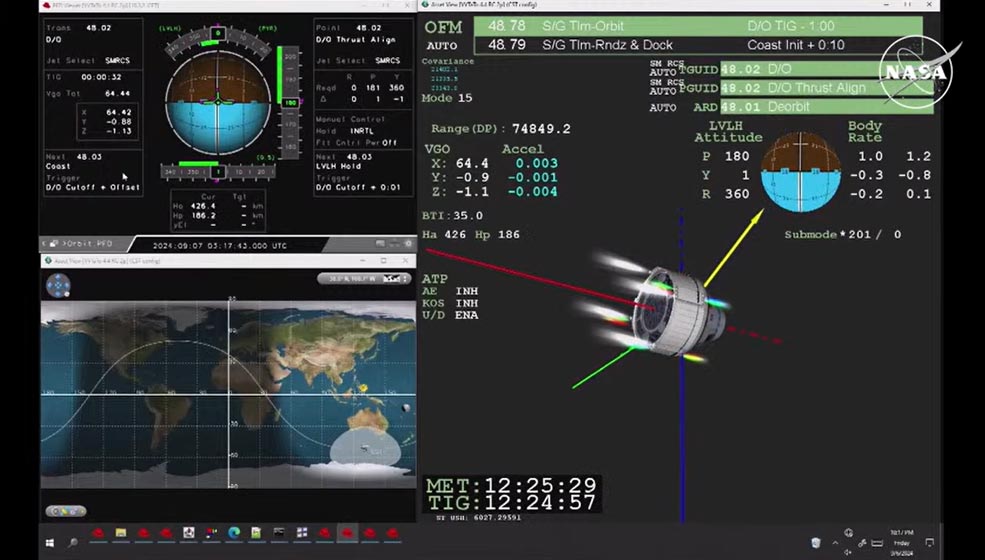
    Uncrewed Starliner Spacecraft Deorbit Burn
    A graphic depicting Boeing Starliner’s spacecraft conducting its deorbit burn as it returns to Earth as part of the agency’s Crew Flight Test on Friday, September 6, 2024. Credit: NASA

    The next milestone was about 15 minutes later with entry interface at 400,000 feet above Earth, when Starliner angled itself and its heat shield for re-entry. As the hottest part of re-entry, the spacecraft’s heat shield reached 3,000 degrees Fahrenheit as it entered the atmosphere.

    Starliner is equipped with an ablative heat shield containing a layer of plastic resin that will heat up to gas and carry the heat away from the crew capsule through convection. This process helps keep the temperature inside the capsule around 70 degrees Fahrenheit. Similar heat shields were used on Mercury, Gemini, and Apollo spacecrafts.
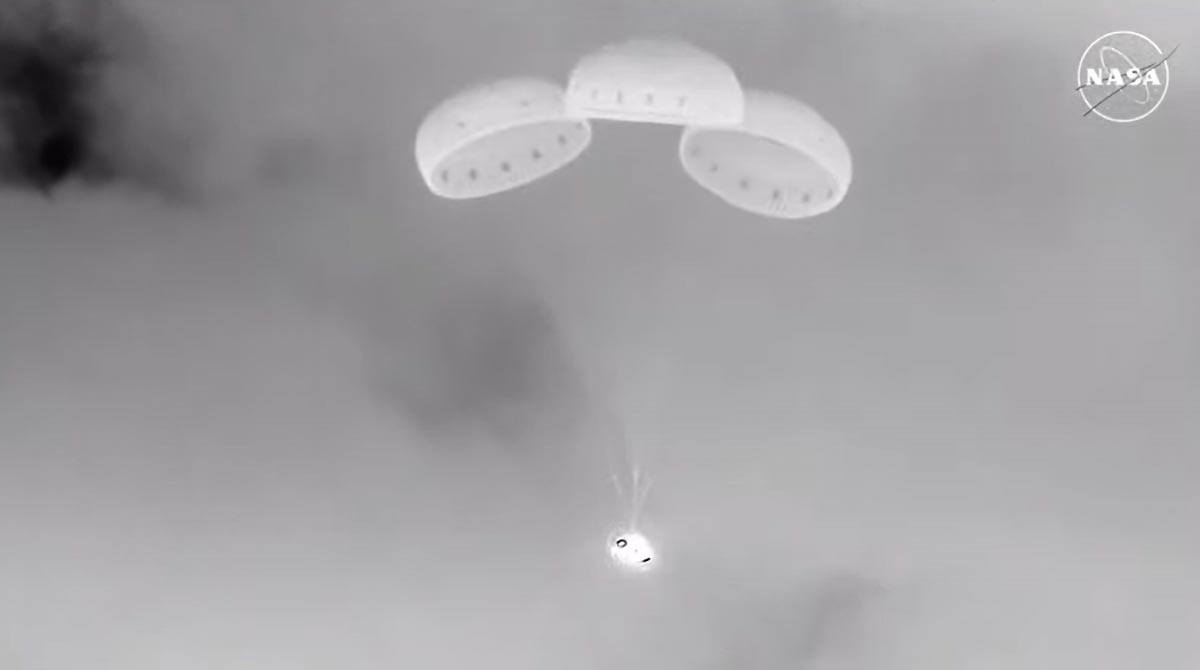
    Uncrewed Starliner Spacecraft Deploys Parachutes
    Boeing’s Starliner spacecraft descends under parachutes toward its landing site in New Mexico during its return to Earth on Friday, September 6, 2024. Photo credit: NASA

    Around 30,000 feet after atmospheric re-entry, the forward heat shield separated from the spacecraft and the drogue parachutes inflated to help slow down the uncrewed capsule.

    About 45 seconds later, at around 8,000 feet, the drogue parachutes separated to make way for three larger main parachutes to deploy, slow down Starliner to 4 miles per hour, and allow an airbag-assisted landing.

    Less than two minutes from landing on U.S. soil after spending three months at the International Space Station, inflated its airbags for landing. The airbags are filled with nitrogen to cushion Starliner’s landing.
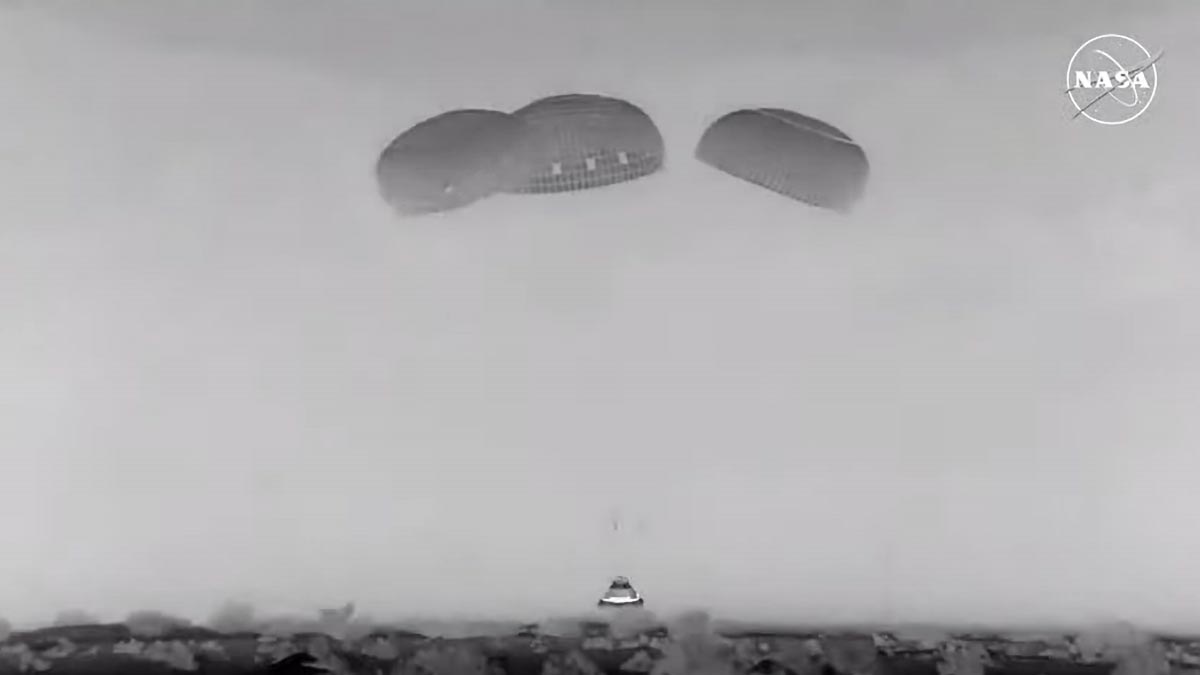
    Uncrewed Starliner Spacecraft Touches Down
    Boeing’s Starliner touches down at White Sands Space Harbor in New Mexico at 12:01 a.m. EDT Saturday, September 7, completing the agency’s Crew Flight Test. Credit: NASA

    At 12:01 a.m. EDT, Boeing’s uncrewed Starliner spacecraft landed at White Sands Space Harbor in New Mexico.

    The NASA and Boeing landing and recovery team was stationed at a holding zone near the landing site. After landing, technicians will use equipment to “sniff” the spacecraft for any lingering hypergolic fluids before approaching Starliner, opening the hatch, and unloading time-critical cargo. The spacecraft will then be transported to Boeing facilities at NASA’s Kennedy Space Center in Florida.

    Starliner is the first American-made orbital crew capsule designed to perform a ground landing as a reusable spacecraft.

    Never miss a breakthrough: Join the SciTechDaily newsletter.
    Follow us on Google and Google News.

    Boeing Starliner International Space Station NASA
    Share. Facebook Twitter Pinterest LinkedIn Email Reddit

    Related Articles

    NASA’s Crew-9 Returns After 286-Day Mission With a Spectacular Splashdown in the Gulf of America

    NASA’s SpaceX Crew-9 Splashes Down Off Coast of Florida

    Boeing’s Orbital Flight Test-2 Starliner and Atlas V Rocket Roll Out To Launch Pad

    Boeing Starliner Nears Launch As ISS Astronauts Work on Space Botany and Human Research

    Space Station Crew Preps for Boeing Starliner During Human Research and Robotics

    Human Research Underway as Space Station Awaits Boeing Starliner Mission

    Commercial Crew Shake-Up: NASA Reassigns Two Astronauts From Boeing Starliner to SpaceX Crew Dragon

    What You Need To Know About NASA’s Boeing Starliner Spacecraft Launch + How To Watch It Live

    Boeing’s Starliner Completes Full Space Station Mission Simulation

    2 Comments

    1. Gabriel on September 9, 2024 3:18 pm

      They are Aliens

      Reply
      • Guy Smith on September 10, 2024 7:12 pm

        Good news. The Starliner spacecraft’s first flight has proven that setting down safely on land after reentry can become the norm. The few problems that were noted do not sound like major problems.

        Reply
    Leave A Reply Cancel Reply

    • Facebook
    • Twitter
    • Pinterest
    • YouTube

    Don't Miss a Discovery

    Subscribe for the Latest in Science & Tech!

    Trending News

    Artificial Sweeteners May Harm Future Generations, Study Suggests

    Splashdown! NASA Artemis II Returns From Record-Breaking Moon Mission

    What If Consciousness Exists Beyond Your Brain

    Scientists Finally Crack the 100-Million-Year Evolutionary Mystery of Squid and Cuttlefish

    Beyond “Safe Levels”: Study Challenges What We Know About Pesticides and Cancer

    Researchers Have Found a Dietary Compound That Increases Longevity

    Scientists Baffled by Bizarre “Living Fossil” From 275 Million Years Ago

    Your IQ at 23 Could Predict Your Wealth at 27, Study Finds

    Follow SciTechDaily
    • Facebook
    • Twitter
    • YouTube
    • Pinterest
    • Newsletter
    • RSS
    SciTech News
    • Biology News
    • Chemistry News
    • Earth News
    • Health News
    • Physics News
    • Science News
    • Space News
    • Technology News
    Recent Posts
    • Geologists Reveal the Americas Collided Earlier Than We Thought
    • 20x Difference: Study Reveals True Source of Airborne Microplastics
    • Scientists Uncover Hidden Force Powering Yellowstone’s Supervolcano
    • This Metal Melts in Your Hand – and Scientists Just Discovered Something Strange
    • Why Losing Too Much Fat Can Be Just As Dangerous as Obesity
    Copyright © 1998 - 2026 SciTechDaily. All Rights Reserved.
    • Science News
    • About
    • Contact
    • Editorial Board
    • Privacy Policy
    • Terms of Use

    Type above and press Enter to search. Press Esc to cancel.