
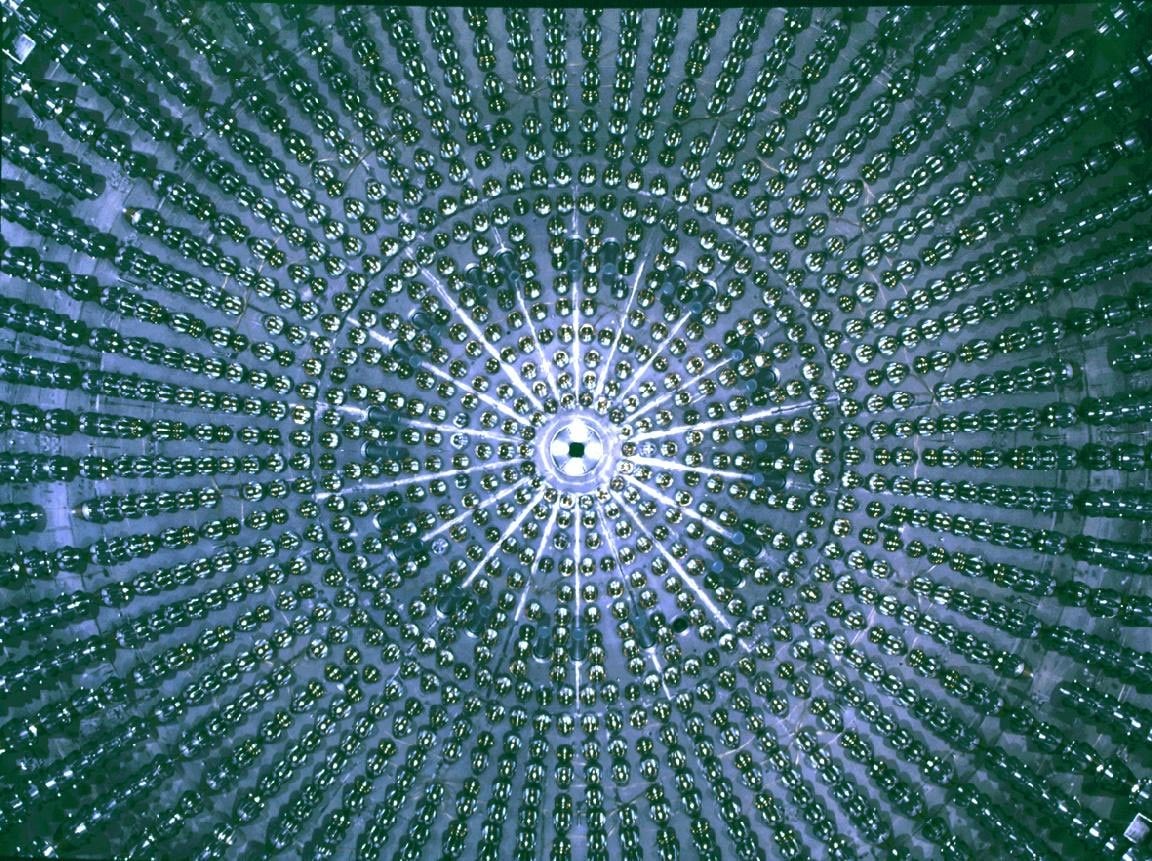
Scientists involved in the Borexino collaboration have presented new results for the measurement of neutrinos originating from the interior of the Earth. The elusive “ghost particles” rarely interact with matter, making their detection difficult. With this update, the researchers have now been able to access 53 events – almost twice as many as in the previous analysis of the data from the Borexino detector, which is located 1,400 meters (4,600 feet) below the Earth’s surface in the Gran Sasso massif near Rome. The results provide an exclusive insight into processes and conditions in the earth’s interior that remain puzzling to this day.
The earth is shining, even if it is not at all visible to the naked eye. The reason for this is geoneutrinos, which are produced in radioactive decay processes in the interior of the Earth. Every second, about one million of these elusive particles penetrate every square centimeter of our planet’s surface.
The Borexino detector, located in the world’s largest underground laboratory, the Laboratori Nazionali del Gran Sasso in Italy, is one of the few detectors in the world capable of observing these ghostly particles. Researchers have been using it to collect data on neutrinos since 2007, i.e. for over ten years. By 2019, they were able to register twice as many events as at the time of the last analysis in 2015 – and reduce the uncertainty of the measurements from 27 to 18 percent, which is also due to new analysis methods.

“Geoneutrinos are the only direct traces of the radioactive decays that occur inside the Earth, and which produce an as yet unknown portion of the energy driving all the dynamics of our planet,” explains Livia Ludhova, one of the two current scientific coordinators of Borexino and head of the neutrino group at the Nuclear Physics Institute (IKP) at Forschungszentrum Jülich.
The researchers in the Borexino collaboration have extracted with an improved statistical significance the signal of geoneutrinos coming from the Earth’s mantle which lies below the Earth’s crust by exploiting the well-known contribution from the Earth’s uppermost mantle and crust — the so-called lithosphere.
The intense magnetic field, the unceasing volcanic activity, the movement of the tectonic plates, and mantle convection: The conditions inside the Earth are in many ways unique in the entire solar system. Scientists have been discussing the question of where the Earth’s internal heat comes from for over 200 years.
“The hypothesis that there is no longer any radioactivity at depth in the mantle can now be excluded at 99% confidence level for the first time. This makes it possible to establish lower limits for uranium and thorium abundances in the Earth’s mantle,” says Livia Ludhova.
These values are of interest for many different Earth model calculations. For example, it is highly probable (85%) that radioactive decay processes inside the Earth generate more than half of the Earth’s internal heat, while the other half is still largely derived from the original formation of the Earth. Radioactive processes in the Earth therefore provide a non-negligible portion of the energy that feeds volcanoes, earthquakes, and the Earth’s magnetic field.
The latest publication in Phys. Rev. D not only presents the new results, but also explains the analysis in a comprehensive way from both the physics and geology perspectives, which will be helpful for next-generation liquid scintillator detectors that will measure geoneutrinos. The next challenge for research with geoneutrinos is now to be able to measure geoneutrinos from the Earth‘s mantle with greater precision, perhaps with detectors distributed at different positions on our planet. One such detector will be the JUNO detector in China where the IKP neutrino group is involved. The detector will be 70 times bigger than Borexino which helps in achieving higher statistical significance in a short time span.
Reference: “Comprehensive geoneutrino analysis with Borexino” by M. Agostini, K. Altenmüller, S. Appel, V. Atroshchenko, Z. Bagdasarian, D. Basilico, G. Bellini, J. Benziger, D. Bick, G. Bonfini, D. Bravo, B. Caccianiga, F. Calaprice, A. Caminata, L. Cappelli, P. Cavalcante, F. Cavanna, A. Chepurnov, K. Choi, D. D’Angelo, S. Davini, A. Derbin, A. Di Giacinto, V. Di Marcello, X.F. Ding,h,l, A. Di Ludovico, L. Di Noto, I. Drachnev, G. Fiorentini, A. Formozov, D. Franco, F. Gabriele, C. Galbiati, M. Gschwender, C. Ghiano, M. Giammarchi, A. Goretti, M. Gromov, D. Guanti, C. Hagner, E. Hungerford, Aldo Ianni, Andrea Ianni, A. Jany, D. Jeschke, S. Kumaran, V. Kobychev, G. Korga, T. Lachenmaier, T. Lasserre, M. Laubenstein, E. Litvinovich, P. Lombardi, I. Lomskaya, L. Ludhova, G. Lukyanchenko, L. Lukyanchenko, I. Machulin, F. Mantovani, G. Manuzio, S. Marcocci, J. Maricic, J. Martyn, E. Meroni, M. Meyer, L. Miramonti, M. Misiaszek, M. Montuschi, V. Muratova, B. Neumair, M. Nieslony, L. Oberauer, A. Onillon, V. Orekhov, F. Ortica, M. Pallavicini, L. Papp, Ö. Penek, L. Pietrofaccia, N. Pilipenko, A. Pocar, G. Raikov, M.T. Ranalli, G. Ranucci, A. Razeto, A. Re, M. Redchuk,w, B. Ricci, A. Romani, N. Rossi,1, S. Rottenanger, S. Schönert, D. Semenov, M. Skorokhvatov, O. Smirnov, A. Sotnikov, V. Strati, Y. Suvorov, R. Tartaglia, G. Testera, J. Thurn, E. Unzhakov, A. Vishneva, M. Vivier, R.B. Vogelaar, F. von Feilitzsch, M. Wojcik,M. Wurm, O. Zaimidoroga, S. Zavatarelli and K. Zuber, G. Zuzel, 21 January 2020, Physical Review D.
DOI: 10.1103/PhysRevD.101.012009
The results are a product of a big effort of the whole Borexino collaboration. A large part of the data analysis was done by Sindhujha Kumaran during her master’s (master thesis PDF) and the first part of Ph.D. thesis under the supervision of Livia Ludhova. In addition, there are 3 more co-authors, namely Zara Bagdasarian, Ömer Penek, and Mariia Redchuk who are also part of the neutrino group at the Jülich Nuclear Physics Institute (IKP).
Never miss a breakthrough: Join the SciTechDaily newsletter.
Follow us on Google and Google News.