
Close Menu
    Facebook X (Twitter) Instagram
    SciTechDaily
    • Biology
    • Chemistry
    • Earth
    • Health
    • Physics
    • Science
    • Space
    • Technology
    Facebook X (Twitter) Pinterest YouTube RSS
    SciTechDaily
    Home»Technology»Borophene Breakthrough Provides New Insight Into a Promising Material
    Technology

    Borophene Breakthrough Provides New Insight Into a Promising Material

    By Jon Atherton, Yale UniversityDecember 3, 2018No Comments3 Mins Read
    Facebook Twitter Pinterest Telegram LinkedIn WhatsApp Email Reddit
    Share
    Facebook Twitter LinkedIn Pinterest Telegram Email Reddit
    Scientists Make a Borophene Breakthrough
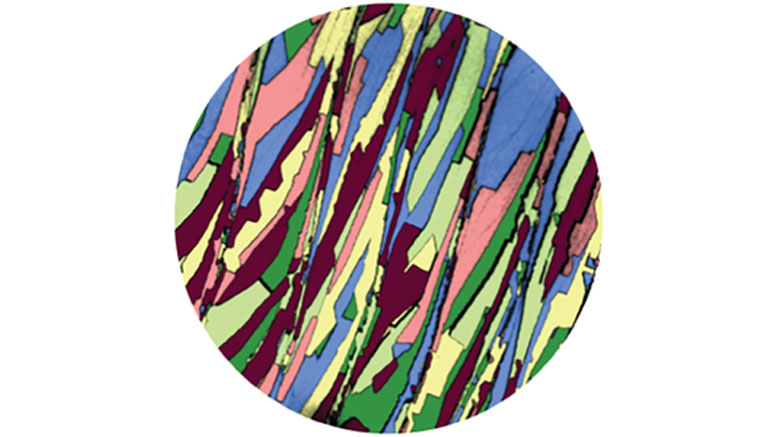
    Each color in this figure represents a possible orientation of borophene crystals with respect to the surface of the Cu substrate. There are six possible orientations of these domains. Credit: Rongting Wu

    The thinnest flake, just one atom thick, has provided scientists at Yale and the Brookhaven National Laboratory with new insight into a promising material for the next generation of high-speed electronics and a host of practical applications.

    Sheets of boron, or borophene — a close cousin of graphene, a material 200 times stronger than steel that promised to revolutionize electronics — were first theorized in the mid-1990s, but synthesizing the material has defied scientists for almost a decade.

    These composite materials, atomically thin with the greatest surface-to-mass ratios, are valuable for solar cells and energy storage, and are also accelerating the development of the fastest and smallest transistors, new touch screens, batteries, and water filters.

    The challenge has been how to turn these naturally abundant elements into technologically useful materials.

    While the potential electronic and elastic properties of two-dimensional (2D) boron crystals have excited the interest of scientists in the field, recent production of borophene flakes were too small for device fabrication, their “tunable” structure remaining unproven.

    In a study published December 3 in Nature Nanotechnology, scientists at Yale’s Energy Sciences Institute have taken the next step in modifying the crystal structure of borophene by growing large, device-size crystals up to 100 square micrometers in size on copper surfaces.

    “For most other known materials their structure is set. They are either impossible or very hard to morph from one stable structure into the other, rather like turning natural graphite into a diamond, even though they are both forms of carbon,” said Yale research scientist Adrian Gozar, the study’s senior author. “Borophene has exceptional properties that we can now think about stabilizing for literally numerous applications.”

    Theoretical calculations by graduate student Stephen Eltinge and professor of applied physics Sohrab Ismail-Beigi indicate a crystal structure consisting of a novel triangular network and an interaction between borophene and copper that is characterized by electronic charge transfer. Eltinge and Ismail-Beigi are co-authors of the new study.

    With the new material’s potential to outmatch graphene in its elasticity, strength, and conductivity, the work has set the stage for fabricating borophene-based devices and brings closer the idea of borophene as a model for artificial 2D materials development, said the scientists.

    Reference: “Large-area single-crystal sheets of borophene on Cu(111) surfaces” by Rongting Wu, Ilya K. Drozdov, Stephen Eltinge, Percy Zahl, Sohrab Ismail-Beigi, Ivan Božović and Adrian Gozar, 3 December 2018,  Nature Nanotechnology.
    DOI: 10.1038/s41565-018-0317-6  

    The study’s other authors are Yale’s Rongting Wu, Stephen Eltinge and Sohrab Ismail-Beigi, and Ivan Božović, Ilya K. Drozdov, and Percy Zahl of the Brookhaven National Laboratory.

    Never miss a breakthrough: Join the SciTechDaily newsletter.
    Follow us on Google and Google News.

    Electricity Nanoscience Nanotechnology Yale University
    Share. Facebook Twitter Pinterest LinkedIn Email Reddit

    Related Articles

    Yale Engineers Create a New Kind of Metallic Glass

    Yale Engineers Develop Plant-Derived Material to Purify Water

    DMSO Treatment Could Transform Solar Cells, Boosts Efficiency

    A New Design Strategy for Better Lithium Oxygen Batteries

    Yale Engineers Turn Wasted Heat Into Power

    Yale Engineers Devise Quantum Technology On A Chip

    Nanomaterials Give Immune Cells a Cancer-Fighting Boost

    New Carbon Films Pave the Way for the Next Generation of Solar Cells

    Automated System Has Promising Uses in Battery and Fuel Cell Production

    Leave A Reply Cancel Reply

    • Facebook
    • Twitter
    • Pinterest
    • YouTube

    Don't Miss a Discovery

    Subscribe for the Latest in Science & Tech!

    Trending News

    Scientists Discover Cheap, Natural Remedy for High Blood Pressure

    Earth’s Upper Atmosphere Is Cooling Fast and Scientists Finally Know Why

    32,000 Olympic Pools of Magma Nearly Erupted Beneath Atlantic Island

    Exercise Changes the Heart in a Way Researchers Never Expected

    Too Much Sleep May Age Your Body Faster, New Study Warns

    Scientists Uncover Promising New Strategy To Stop Parkinson’s in Its Tracks

    Experts Reveal the Surprising Cancer Link Behind a Common Vitamin

    This Strange “Golden Orb” Found 2 Miles Deep Stumped Scientists for Years

    Follow SciTechDaily
    • Facebook
    • Twitter
    • YouTube
    • Pinterest
    • Newsletter
    • RSS
    SciTech News
    • Biology News
    • Chemistry News
    • Earth News
    • Health News
    • Physics News
    • Science News
    • Space News
    • Technology News
    Recent Posts
    • Your Immune System Remembers Obesity for up to a Decade, Study Finds
    • Breakthrough Parkinson’s Drug Targets Disease at Its Genetic Roots
    • 10-Cent Pill Could Transform Heart Failure Treatment Worldwide
    • Just 4 Weeks of Simple Diet Changes Reversed Signs of Aging in Older Adults
    • Scientists May Have Finally Solved Why Humans Are Right-Handed
    Copyright © 1998 - 2026 SciTechDaily. All Rights Reserved.
    • Science News
    • About
    • Contact
    • Editorial Board
    • Privacy Policy
    • Terms of Use

    Type above and press Enter to search. Press Esc to cancel.