
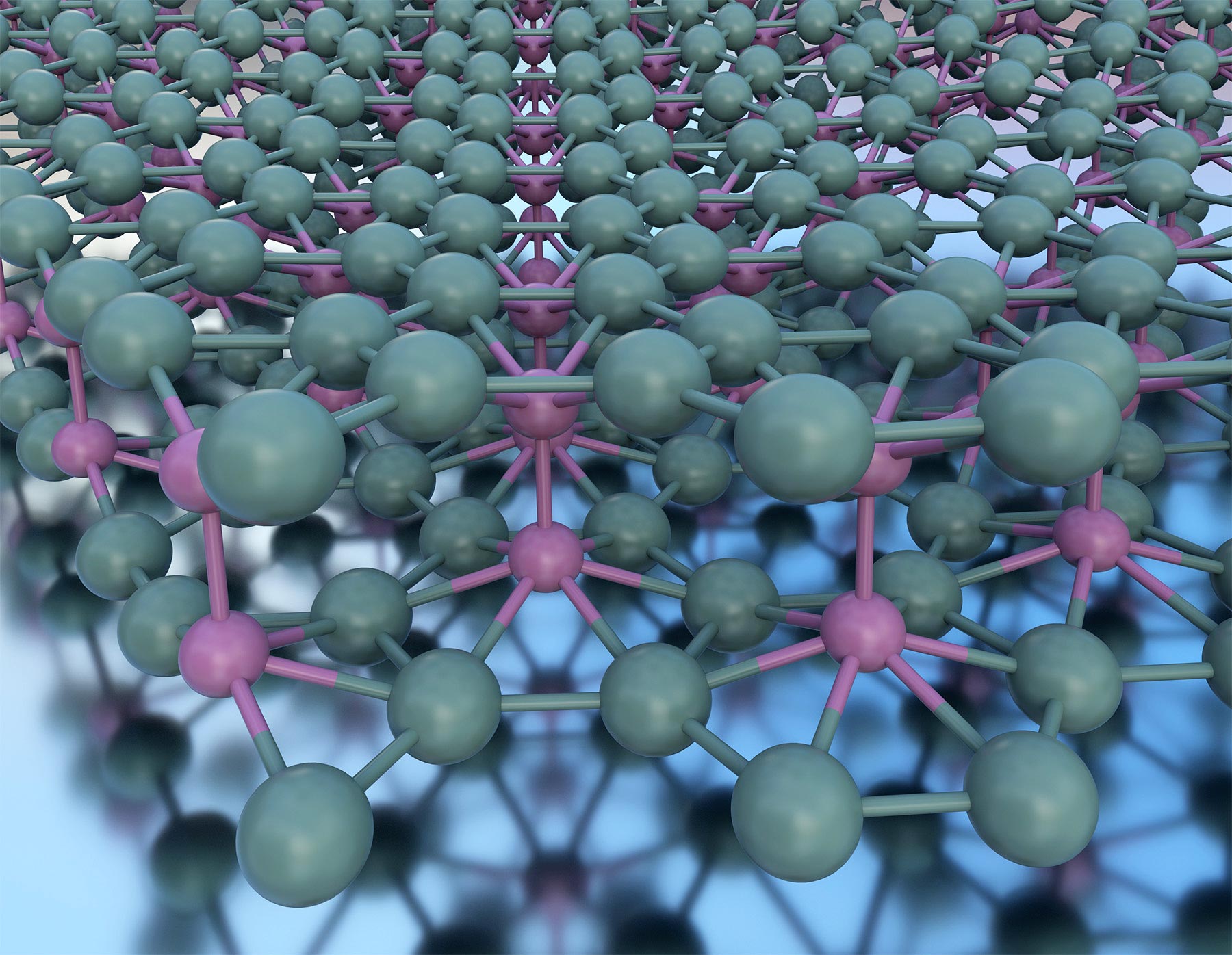
New material maintains borophene’s electronic properties, offers new advantages.
For the first time, Northwestern University engineers have created a double layer of atomically flat borophene, a feat that defies the natural tendency of boron to form non-planar clusters beyond the single-atomic-layer limit.
Although known for its promising electronic properties, borophene — a single-atom-layer-thick sheet of boron — is challenging to synthesize. Unlike its analog two-dimensional material graphene, which can be peeled away from innately layered graphite using something as simple as scotch tape, borophene cannot merely be peeled away from bulk boron. Instead, borophene must be grown directly onto a substrate.
And if growing one layer was difficult, growing multiple layers of atomically flat borophene seemed impossible. Because bulk boron is not layered like graphite, growing boron beyond single atomic layers leads to clustering rather than planar films.
Unlocking the Right Growth Conditions
“When you try to grow a thicker layer, the boron wants to adopt its bulk structure,” said Northwestern’s Mark C. Hersam, co-senior author of the study. “Rather than remaining atomically flat, thicker boron films form particles and clusters. The key was to find growth conditions that prevented the clusters from forming. Until now, we didn’t think you could go beyond one layer. Now we have moved into unexplored territory between the single atomic layer and the bulk, resulting in a new playground for discovery.”
The research was published on August 26, 2021, in the journal Nature Materials.
Hersam is the Walter P. Murphy Professor of Materials Science and Engineering at the McCormick School of Engineering and director of the Materials Research Science and Engineering Center. He also is a member of Northwestern’s International Institute for Nanotechnology and the Simpson Querrey Institute. Hersam co-led the work with Boris Yakobson, the Karl F. Hasselmann Chair in Engineering at Rice University.
Five years ago, Hersam and his collaborators created borophene for the first time. Stronger, lighter and more flexible than graphene, borophene has the potential to revolutionize batteries, electronics, sensors, solar cells and quantum computing. Although theoretical research predicted that a double layer of borophene was possible, many researchers, including Hersam, were not convinced.
“It is challenging to make a new material, even when theoretical work predicts its existence,” Hersam said. “Theory rarely tells you the synthetic conditions needed to achieve that new structure.”
Silver Substrate Enables Double Layer Formation
The key to the correct conditions, Hersam’s team discovered, was the substrate used for growing the material. In the study, Hersam and his colleagues grew borophene on a flat, silver substrate. When exposed to very high temperatures, the silver bunched to form exceptionally flat, large terraces between bunches of atomic-scale steps.
“When we grew borophene on these large, flat terraces, we saw a second layer forming,” Hersam said. “Following that serendipitous observation, we intentionally focused our effort in that direction. We weren’t looking for the second layer when we found it. Many materials discoveries occur in this manner, but you have to realize the opportunity when you stumble upon something unexpected.”
“We have moved into unexplored territory between the single atomic layer and the bulk, resulting in a new playground for discovery.”
Mark Hersam, materials scientist
Advantages of the Double-Layered Structure
The double-layered material maintained all of borophene’s desirable electronic properties, while offering new advantages. For example, the material comprises two atomic-layer-thick sheets bonded together with space between, which could be used for energy or chemical storage.
“There have been theoretical predictions that bilayer borophene is a promising material for batteries,” Hersam said. “Having space between the layers provides a place to hold lithium ions.”
Hersam’s team hopes other researchers now are inspired to keep growing even thicker layers of borophene or create double layers with different atomic geometries.
“Diamonds, graphite, graphene and carbon nanotubes are all based on one element (carbon) with different geometries,” Hersam said. “Boron appears to be just as rich in its possibilities, if not more so, than carbon. We believe that we are still in the early chapters of the two-dimensional boron saga.”
Reference: “Borophene synthesis beyond the single-atomic-layer limit” by Xiaolong Liu, Qiucheng Li, Qiyuan Ruan, Matthew S. Rahn, Boris I. Yakobson and Mark C. Hersam, 26 August 2021, Nature Materials.
DOI: 10.1038/s41563-021-01084-2
The study, “Borophene synthesis beyond the single-atomic-layer limit,” was supported by the Office of Naval Research (award number N00014-17-1-2993), the National Science Foundation (DMR-1720139), the U.S. Army Research Office (W911NF-16-1-0255) and the Robert Welch Foundation.
Never miss a breakthrough: Join the SciTechDaily newsletter.
Follow us on Google and Google News.