
Close Menu
    Facebook X (Twitter) Instagram
    SciTechDaily
    • Biology
    • Chemistry
    • Earth
    • Health
    • Physics
    • Science
    • Space
    • Technology
    Facebook X (Twitter) Pinterest YouTube RSS
    SciTechDaily
    Home»Health»Brain’s Role in Broken Heart Syndrome: How Stress-Related Brain Activity Can Temporarily Damage the Heart
    Health

    Brain’s Role in Broken Heart Syndrome: How Stress-Related Brain Activity Can Temporarily Damage the Heart

    By Massachusetts General HospitalApril 3, 2021No Comments3 Mins Read
    Facebook Twitter Pinterest Telegram LinkedIn WhatsApp Email Reddit
    Share
    Facebook Twitter LinkedIn Pinterest Telegram Email Reddit
    Brain Glitch Stress Disorder Concept
    New study provides insights on how stress-related brain activity can temporarily damage the heart.

    Stress-sensitive brain regions may forecast broken heart syndrome, offering new targets for prevention.

    A new study uncovers potential mechanisms that may contribute to “broken heart syndrome,” or Takotsubo syndrome (TTS), a temporary heart condition that is brought on by stressful situations and emotions. The research, which was led by investigators at Massachusetts General Hospital (MGH), indicates that a heart-brain connection likely plays a major role.

    Brain Imaging Sheds Light on Risk Factors

    For the study, published in the European Heart Journal, the team analyzed brain imaging scans from 104 patients (41 who subsequently developed TTS and 63 who did not) to determine whether increased stress-associated metabolic activity in the brain leads to an elevated risk of developing TTS. “Areas of the brain that have higher metabolic activity tend to be in greater use. Hence, higher activity in the stress-associated centers of the brain suggests that the individual has a more active response to stress,” explains senior author Ahmed Tawakol, MD, director of Nuclear Cardiology and co-director of the Cardiovascular Imaging Research Center at MGH.
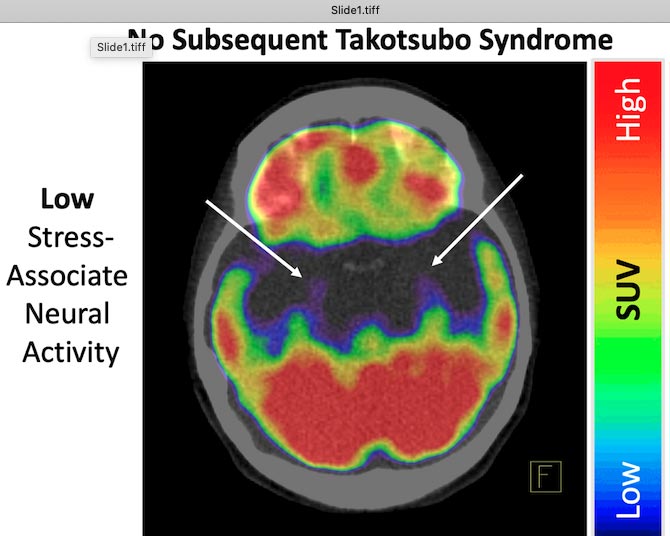
    Brain Scan No TTS
    Scan of the brain of someone who did not develop TTS. Credit: European Heart Journal

    The imaging tests, which were being conducted in patients for other medical reasons, revealed that heightened activity in the brain’s amygdala predicted the development of subsequent TTS, as well as the timing of the syndrome. For example, individuals who had the highest amygdalar activity developed TTS within a year after imaging, while those with intermediate values developed TTS several years later.

    “We show that TTS happens not only because one encounters a rare, dreadfully disturbing event — such as the death of a spouse or child, as the classic examples have it. Rather, individuals with high stress-related brain activity appear to be primed to develop TTS — and can develop the syndrome upon exposure to more common stressors, even a routine colonoscopy or a bone fracture,” says Tawakol.
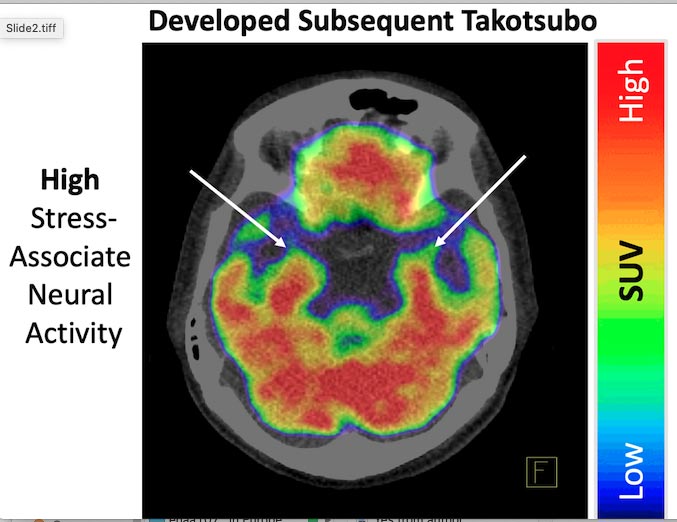
    Brain Scan TTS
    Scan of brain in a person who developed TTS. Credit: European Heart Journal

    Stress, Bone Marrow, and Cardiovascular Impact

    The scientists also identified a relationship between stress-related brain activity and bone marrow activity in individuals. Because bone marrow produces different types of blood cells involved with carrying oxygen, mounting immune responses, and clotting blood, stress-related brain activity may influence the activity of cells that affect cardiovascular health.

    In applying the results to the clinic, Tawakol hopes that interventions that lower stress-related brain activity will make it more difficult to develop TTS. “Studies should test whether such approaches to decrease stress-associated brain activity decrease the chance that TTS will recur among patients with prior episodes of TTS,” he says. He also underscores the need for more studies into the impact of stress reduction — or drug interventions targeting stress-related brain activity — on heart health.

    Read Stressed Brain Linked to “Broken Heart” Syndrome for more on this research.

    Reference: “Stress-associated neurobiological activity associates with the risk for and timing of subsequent Takotsubo syndrome” by Azar Radfar, Shady Abohashem, Michael T Osborne, Ying Wang, Tawseef Dar, Malek Z O Hassan, Ahmed Ghoneem, Nicki Naddaf, Tomas Patrich, Taimur Abbasi, Hadil Zureigat, James Jaffer, Parastou Ghazi, James A Scott, Lisa M Shin, Roger K Pitman, Tomas G Neilan, Malissa J Wood, Ahmed Tawakol, 26 March 2021, European Heart Journal.
    DOI: 10.1093/eurheartj/ehab029

    Never miss a breakthrough: Join the SciTechDaily newsletter.
    Follow us on Google and Google News.

    Brain Cardiology Heart Massachusetts General Hospital Neuroscience Stress
    Share. Facebook Twitter Pinterest LinkedIn Email Reddit

    Related Articles

    The Hidden Heart Problem Quietly Shrinking Your Brain

    Preventing Dementia: Unveiling the Heart-Brain Connection in Cognitive Decline

    Heart PET Scans: A Breakthrough Predictor of Parkinson’s and Lewy Body Dementia Years Before Symptoms

    Uncorking the Mystery: Researchers Discover Why Light-to-Moderate Drinking Is Linked to Better Heart Health

    Amazon Indigenous People May Hold a Key to Slowing Down Aging

    Surprising Discovery Could Lead to New Treatments for Strokes and Cardiac Arrest

    Stressed Brain Linked to “Broken Heart” Syndrome

    Specialized Scanning Reveals Brain Damage in COVID-19 Patients

    Watch a Brain Drown in Its Own Fluid After a Stroke

    Leave A Reply Cancel Reply

    • Facebook
    • Twitter
    • Pinterest
    • YouTube

    Don't Miss a Discovery

    Subscribe for the Latest in Science & Tech!

    Trending News

    Could Low Vitamin D Be Making Your Pain Worse?

    Scientists Discover Once-Weekly Workout That Melts Belly Fat Surprisingly Effectively

    Scientists Just Tested a Thruster Powerful Enough for Human Missions to Mars

    Doctors Say Your Ice Pack Might Be Making Injuries Worse

    Scientists Discover 43-Foot Sea Reptile Twice the Size of a Great White Shark

    Bees and Birds Are Drinking Alcohol From Flowers

    Scientists Discover How Obesity May Trigger Alzheimer’s Disease

    Scientists Confirm Alcohol Causes Widespread Health Damage

    Follow SciTechDaily
    • Facebook
    • Twitter
    • YouTube
    • Pinterest
    • Newsletter
    • RSS
    SciTech News
    • Biology News
    • Chemistry News
    • Earth News
    • Health News
    • Physics News
    • Science News
    • Space News
    • Technology News
    Recent Posts
    • A Tiny Bright-Blue Octopus Found in the Galápagos Is Completely New to Science
    • Scientists Stop Pancreatic Cancer Before It Starts in Landmark Preclinical Study
    • Scientists Discover Surprising Anti-Aging Power Hidden in Aged Garlic
    • Just Minutes of Intense Exercise Could Slash Disease Risk by 50%
    • People Who Stop Ozempic Often Don’t Gain the Weight Back
    Copyright © 1998 - 2026 SciTechDaily. All Rights Reserved.
    • Science News
    • About
    • Contact
    • Editorial Board
    • Privacy Policy
    • Terms of Use

    Type above and press Enter to search. Press Esc to cancel.