
Close Menu
    Facebook X (Twitter) Instagram
    SciTechDaily
    • Biology
    • Chemistry
    • Earth
    • Health
    • Physics
    • Science
    • Space
    • Technology
    Facebook X (Twitter) Pinterest YouTube RSS
    SciTechDaily
    Home»Space»Breakdown of Gyrochronology: Magnetic Fields Implicated in the Mysterious Midlife Crisis of Stars
    Space

    Breakdown of Gyrochronology: Magnetic Fields Implicated in the Mysterious Midlife Crisis of Stars

    By Royal Astronomical SocietyDecember 6, 2021No Comments4 Mins Read
    Facebook Twitter Pinterest Telegram LinkedIn WhatsApp Email Reddit
    Share
    Facebook Twitter LinkedIn Pinterest Telegram Email Reddit
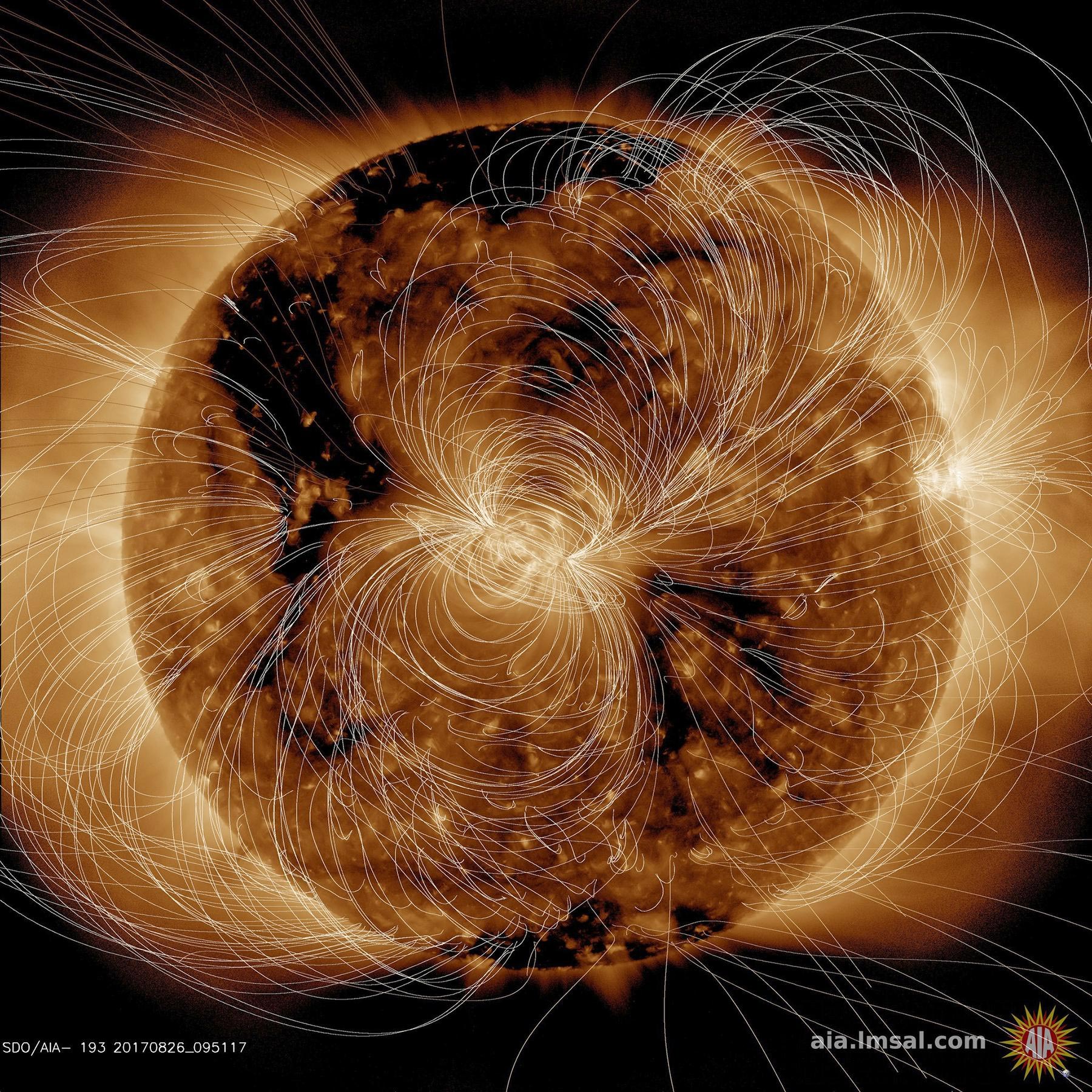
    Magnetic Fields Are Produced by Dynamo Mechanism Inside Stars
    Magnetic fields are produced by a dynamo mechanism inside stars and emerge through the surface to the outer atmosphere, where they generate stellar magnetic storms, energetic radiation fluxes, and govern the strength of escaping plasma winds. Studying these magnetic fields can shed light on the stellar midlife crisis – a sudden switch to a low activity phase and the existence of inactive phases such as the Maunder Minimum when hardly any sunspots are observed on the Sun. Credit: NASA / GSFC / Solar Dynamics Observatory

    Scientists propose that Sun-like stars undergo a midlife transition where their magnetic field generation weakens, disrupting predictable spin-down rates. This may explain why stellar gyrochronology fails beyond middle age and why the Sun has experienced quiet periods such as the Maunder Minimum.

    Middle-aged stars can experience their own kind of midlife crisis, experiencing dramatic breaks in their activity and rotation rates at about the same age as our Sun, according to new research published today in Monthly Notices of the Royal Astronomical Society: Letters. The study provides a new theoretical underpinning for the unexplained breakdown of established techniques for measuring ages of stars past their middle age, and the transition of solar-like stars to a magnetically inactive future.

    Astronomers have long known that stars experience a process known as ‘magnetic braking’: a steady stream of charged particles, known as the solar wind, escapes from the star over time, carrying away small amounts of the star’s angular momentum. This slow drain causes stars like our Sun to gradually slow down their rotation over billions of years.

    In turn, the slower rotation leads to altered magnetic fields and less stellar activity – the numbers of sunspots, flares, outbursts, and similar phenomena in the atmospheres of stars, which are intrinsically linked to the strengths of their magnetic fields.

    Gyrochronology Breaks Down

    This decrease in activity and rotation rate over time is expected to be smooth and predictable because of the gradual loss of angular momentum. The idea gave birth to the tool known as ‘stellar gyrochronology’, which has been widely used over the past two decades to estimate the age of a star from its rotation period.
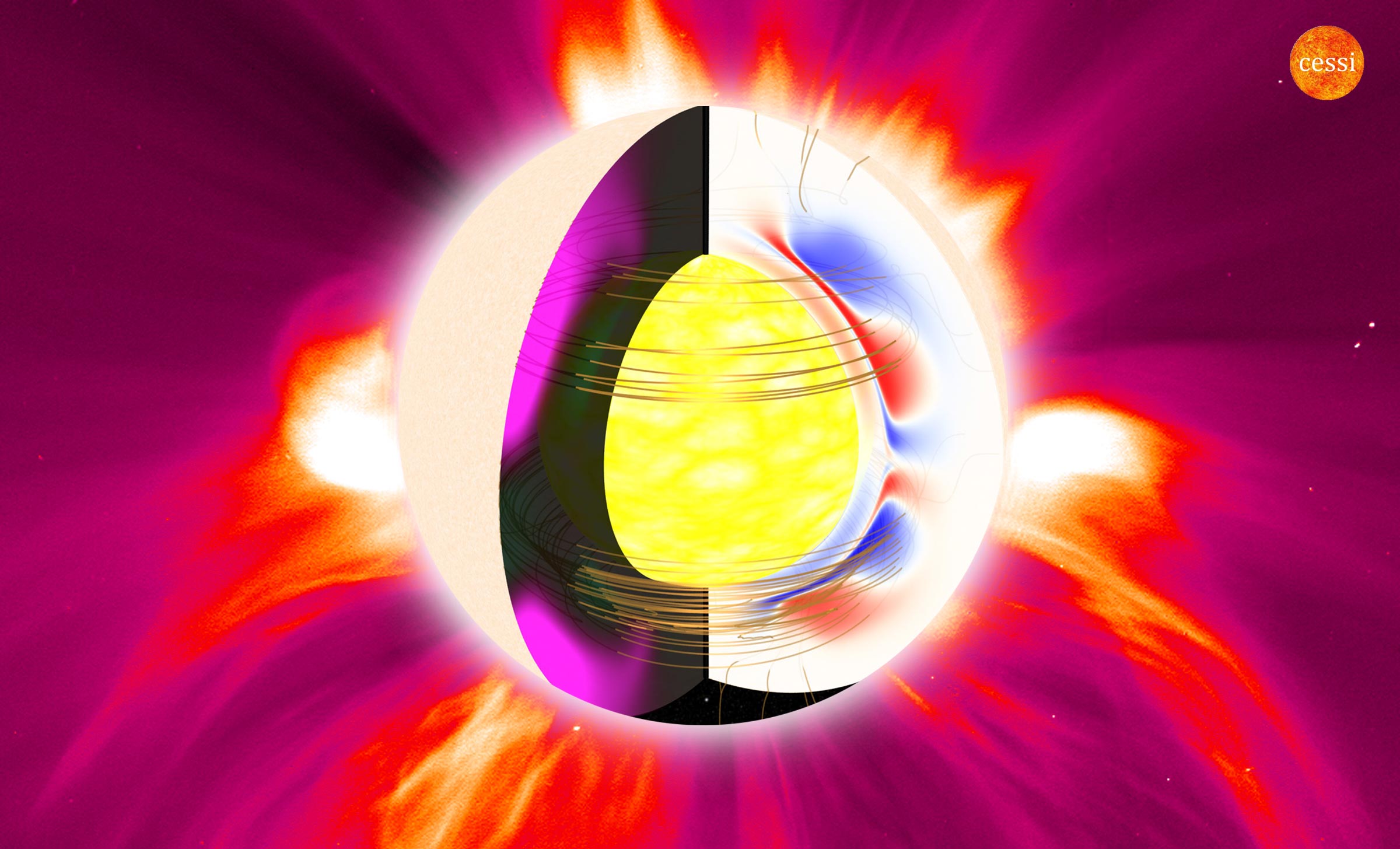
    Spinning Interior of a Star
    Artist’s impression of the spinning interior of a star, generating the stellar magnetic field. This image combines a dynamo simulation of the Sun’s interior with observations of the Sun’s outer atmosphere, where storms and plasma winds are generated. Credit: CESSI / IISER Kolkata / NASA-SVS / ESA / SOHO-LASCO

    However recent observations indicate that this intimate relationship breaks down around middle age. The new work, carried out by Bindesh Tripathi, Prof. Dibyendu Nandy, and Prof. Soumitro Banerjee at the Indian Institute of Science Education and Research (IISER) Kolkata, India, provides a novel explanation for this mysterious ailment.

    New Dynamo Model Explanation

    Using dynamo models of magnetic field generation in stars, the team show that at about the age of the Sun the magnetic field generation mechanism of stars suddenly becomes sub-critical or less efficient. This allows stars to exist in two distinct activity states – a low activity mode and an active mode. A middle aged star like the Sun can often switch to the low activity mode resulting in drastically reduced angular momentum losses by magnetized stellar winds.

    Prof. Nandy comments: “This hypothesis of sub-critical magnetic dynamos of solar-like stars provides a self-consistent, unifying physical basis for a diversity of solar-stellar phenomena, such as why stars beyond their midlife do not spin down as fast as in their youth, the breakdown of stellar gyrochronology relations, and recent findings suggesting that the Sun may be transitioning to a magnetically inactive future.”

    The new work provides key insights into the existence of low activity episodes in the recent history of the Sun known as grand minima – when hardly any sunspots are seen. The best known of these is perhaps the Maunder Minimum around 1645 to 1715, when very few sunspots were observed.

    The team hopes that it will also shed light on recent observations indicating that the Sun is comparatively inactive, with crucial implications for the potential long-term future of our own stellar neighbor.

    Reference: “Stellar mid-life crisis: subcritical magnetic dynamos of solar-like stars and the breakdown of gyrochronology” by Bindesh Tripathi, Dibyendu Nandy, Soumitro Banerjee, 28 July 2021, Monthly Notices of the Royal Astronomical Society: Letters.
    DOI: 10.1093/mnrasl/slab035

    Never miss a breakthrough: Join the SciTechDaily newsletter.
    Follow us on Google and Google News.

    Astronomy Astrophysics Royal Astronomical Society Stars
    Share. Facebook Twitter Pinterest LinkedIn Email Reddit

    Related Articles

    New Types of Stars – “Old Smokers” and Erupting Protostars – Discovered in the Milky Way

    Astronomers Discover a Strange New Type of Star Covered in Helium Burning Ashes

    Artificial Intelligence Helps Resolve Long-Running Astrophysics Debate on Supermassive Black Holes

    Planetary Shields Will Buckle Under Furious Stellar Winds From Their Dying Stars – Nearly Impossible for Life To Survive

    Mysterious Hydrogen-Free Supernova Sheds Light on Massive Stars’ Violent Death Throes

    Two Massive Stars with Magnetic Fields Discovered in Binary System Epsilon Lupi

    A Jet of Energetic Particles Reveals How Stars Begin Their Final Transformation

    Astronomers Discover Unusual Stars with Extremely High Concentrations of Lead in Their Atmospheres

    Ultramassive Stars of Cluster R136 Were Created from the Merger of Lighter Stars

    Leave A Reply Cancel Reply

    • Facebook
    • Twitter
    • Pinterest
    • YouTube

    Don't Miss a Discovery

    Subscribe for the Latest in Science & Tech!

    Trending News

    Your Blood Pressure Reading Could Be Wrong Because of One Simple Mistake

    Astronomers Stunned by Ancient Galaxy With No Spin

    Physicists May Be on the Verge of Discovering “New Physics” at CERN

    Scientists Solve 320-Million-Year Mystery of Reptile Skin Armor

    Scientists Say This Daily Walking Habit May Be the Secret to Keeping Weight Off After Dieting

    New Therapy Rewires the Brain To Restore Joy in Depression Patients

    Giant Squid Detected off Western Australia in Stunning Deep-Sea Discovery

    Popular Sugar-Free Sweetener Linked to Liver Disease, Study Warns

    Follow SciTechDaily
    • Facebook
    • Twitter
    • YouTube
    • Pinterest
    • Newsletter
    • RSS
    SciTech News
    • Biology News
    • Chemistry News
    • Earth News
    • Health News
    • Physics News
    • Science News
    • Space News
    • Technology News
    Recent Posts
    • Dante’s Inferno May Secretly Be About a Planet-Destroying Asteroid Strike
    • Mixing Edible Cannabis and Alcohol May Impair Driving More Than Scientists Expected
    • Scientists Reverse Stroke Damage Using Stem Cells in Breakthrough Study
    • Eating One Egg a Day Could Cut Alzheimer’s Risk by 27%
    • Hidden Warm Water Beneath Antarctica Could Rapidly Raise Global Sea Levels
    Copyright © 1998 - 2026 SciTechDaily. All Rights Reserved.
    • Science News
    • About
    • Contact
    • Editorial Board
    • Privacy Policy
    • Terms of Use

    Type above and press Enter to search. Press Esc to cancel.