
Close Menu
    Facebook X (Twitter) Instagram
    SciTechDaily
    • Biology
    • Chemistry
    • Earth
    • Health
    • Physics
    • Science
    • Space
    • Technology
    Facebook X (Twitter) Pinterest YouTube RSS
    SciTechDaily
    Home»Space»Astronomers Discover a Strange New Type of Star Covered in Helium Burning Ashes
    Space

    Astronomers Discover a Strange New Type of Star Covered in Helium Burning Ashes

    By Royal Astronomical SocietyFebruary 16, 2022No Comments3 Mins Read
    Facebook Twitter Pinterest Telegram LinkedIn WhatsApp Email Reddit
    Share
    Facebook Twitter LinkedIn Pinterest Telegram Email Reddit
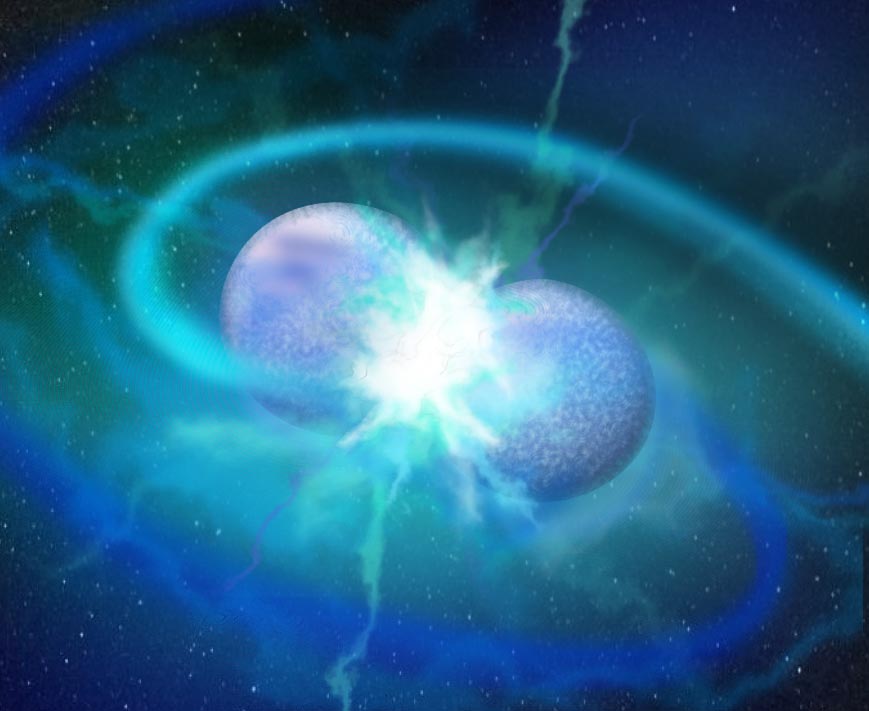
    Stellar Merger Event Between Two White Dwarf Stars
    Artist’s impression of a rare kind of stellar merger event between two white dwarf stars. Credit: Nicole Reindl

    Unusual stars with carbon-oxygen surfaces may stem from white dwarf mergers, but their existence challenges current models of stellar evolution.

    A team of German astronomers, led by Professor Klaus Werner of the University of Tübingen, has discovered a strange new type of star covered in the by-product of helium burning. It is possible that the stars might have been formed by a rare stellar merger event. The fascinating results are published in Monthly Notices of the Royal Astronomical Society.

    Unexpected Surface Composition and Ongoing Core Helium Burning

    While normal stars have surfaces composed of hydrogen and helium, the stars discovered by Werner and his colleagues have their surfaces covered with carbon and oxygen, the ashes of helium burning – an exotic composition for a star. The situation becomes more puzzling as the new stars have temperatures and radii that indicate they are still burning helium in their cores – a property typically seen in more evolved stars than those observed by Werner and his team in this study.

    Published alongside the work of Professor Werner and his team, a second paper from a group of astronomers from the University of La Plata and the Max Planck Institute for Astrophysics offers a possible explanation for their formation. “We believe the stars discovered by our German colleagues might have formed in a very rare kind of stellar merger event between two white dwarf stars,” says Dr. Miller Bertolami of the Institute for Astrophysics of La Plata, lead author of the second paper. White dwarfs are the remnants of larger stars that have exhausted their nuclear fuel, and are typically very small and dense.

    The Role of Stellar Mergers and Challenges to Existing Models

    Stellar mergers are known to happen between white dwarfs in close binary systems due to the shrinking of the orbit caused by the emission of gravitational waves. “Usually, white dwarf mergers do not lead to the formation of stars enriched in carbon and oxygen,” explains Miller Bertolami, “but we believe that, for binary systems formed with very specific masses, a carbon- and oxygen-rich white dwarf might be disrupted and end up on top of a helium-rich one, leading to the formation of these stars.”

    Yet no current stellar evolutionary models can fully explain the newly discovered stars. The team needs refined models in order to assess whether these mergers can actually happen. These models could not only help the team to better understand these stars, but could also provide a deeper insight into the late evolution of binary systems and how their stars exchange mass as they evolve. Until astronomers develop more refined models for the evolution of binary stars, the origin of the helium covered stars will be up for debate.

    “Normally we expect stars with these surface compositions to have already finished burning helium in their cores, and to be on their way to becoming white dwarfs. These new stars are a severe challenge to our understanding of stellar evolution,” explains Professor Werner.

    For more on this research, see Weird New Type of Stars Discovered by Astronomers.

    Reference: “Discovery of hot subdwarfs covered with helium-burning ash” by Klaus Werner, Nicole Reindl, Stephan Geier and Max Pritzkuleit, 12 February 2022, Monthly Notices of the Royal Astronomical Society: Letters.
    DOI: 10.1093/mnrasl/slac005

    Never miss a breakthrough: Join the SciTechDaily newsletter.
    Follow us on Google and Google News.

    Astronomy Astrophysics Popular Royal Astronomical Society Stars
    Share. Facebook Twitter Pinterest LinkedIn Email Reddit

    Related Articles

    New Types of Stars – “Old Smokers” and Erupting Protostars – Discovered in the Milky Way

    Artificial Intelligence Helps Resolve Long-Running Astrophysics Debate on Supermassive Black Holes

    Planetary Shields Will Buckle Under Furious Stellar Winds From Their Dying Stars – Nearly Impossible for Life To Survive

    Two Massive Stars with Magnetic Fields Discovered in Binary System Epsilon Lupi

    WISE Discovers Mystery Dust Around an Unusual Class of Interacting Binary Stars

    Star Formation in the Universe Has Decreased Drastically

    Ultramassive Stars of Cluster R136 Were Created from the Merger of Lighter Stars

    “Impossible” Discovery, Red Dwarf Binaries with Orbital Periods of 2.5 Hours

    NASA Data Reveals Significant Changes in Exoplanet’s Atmosphere

    Leave A Reply Cancel Reply

    • Facebook
    • Twitter
    • Pinterest
    • YouTube

    Don't Miss a Discovery

    Subscribe for the Latest in Science & Tech!

    Trending News

    Beyond Pain Relief: Scientists Discover a Protein That Could Stop Osteoarthritis in Its Tracks

    Scientists Discover Why Alcohol Prevents the Liver From Healing, Even After You Quit

    Scientists Stunned As Volcano Removes Methane From the Air

    Scientists Discover Signs Africa May Be Splitting Apart Beneath Zambia

    Common Blood Pressure Drug Supercharges Cancer Treatment in Surprising New Study

    540-Million-Year-Old Fossils Reveal a Huge Surprise About Early Life on Earth

    Scientists Reverse Stroke Damage Using Stem Cells in Breakthrough Study

    Eating One Egg a Day Could Cut Alzheimer’s Risk by 27%

    Follow SciTechDaily
    • Facebook
    • Twitter
    • YouTube
    • Pinterest
    • Newsletter
    • RSS
    SciTech News
    • Biology News
    • Chemistry News
    • Earth News
    • Health News
    • Physics News
    • Science News
    • Space News
    • Technology News
    Recent Posts
    • NASA’s Roman Space Telescope Could Finally Find the Milky Way’s Missing Neutron Stars
    • Strange “Worm Towers” Found in the Wild for the First Time May Be Hitchhiking on Beetles
    • Scientists Finally Solve the Mystery of South Africa’s Tiny Leopards
    • This Strange “Golden Orb” Found 2 Miles Deep Stumped Scientists for Years
    • Giant “Last Titan” Dinosaur Discovered in Thailand Was Bigger Than 9 Elephants
    Copyright © 1998 - 2026 SciTechDaily. All Rights Reserved.
    • Science News
    • About
    • Contact
    • Editorial Board
    • Privacy Policy
    • Terms of Use

    Type above and press Enter to search. Press Esc to cancel.