
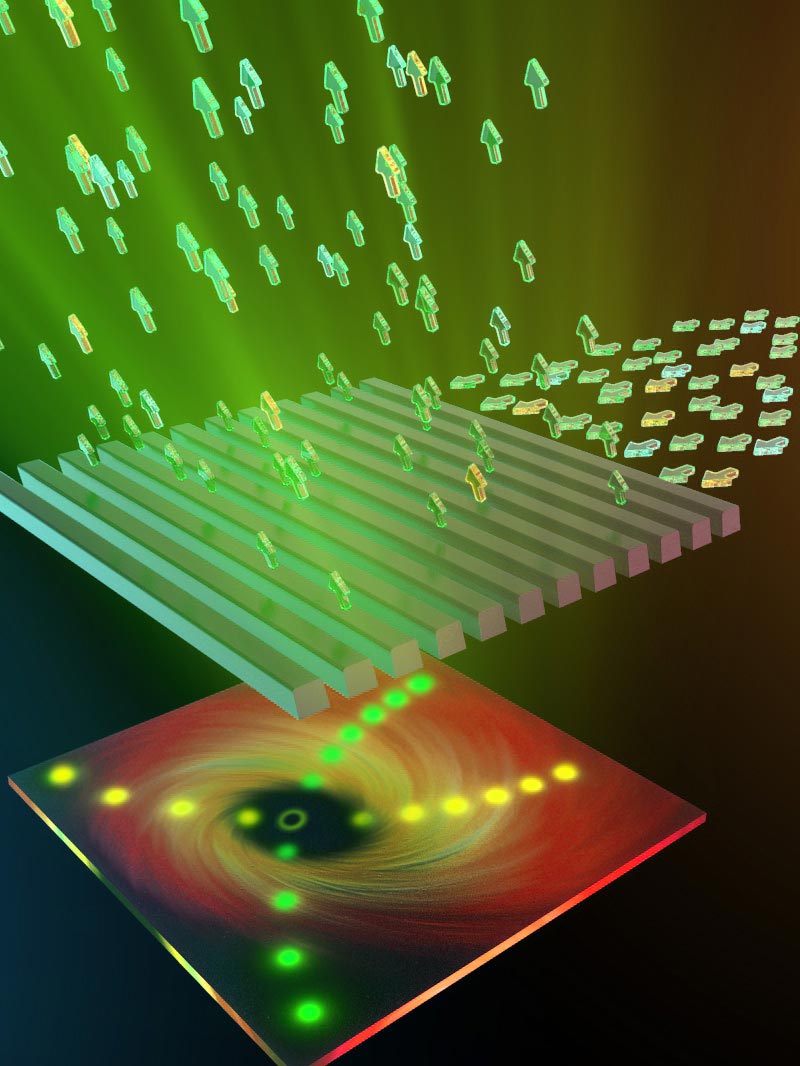
Researchers say a new discovery on a U.S. Army project for optoelectronic devices could help make optical fiber communications more energy efficient.
The University of Pennsylvania, Peking University, and Massachusetts Institute of Technology worked on a project funded, in part by the Army Research Office, which is an element of the U.S. Army Combat Capabilities Development Command’s Army Research Laboratory. The research sought to develop a new design of optical devices that radiate light in a single direction. This single-sided radiation channel for light can be used in a wide array of optoelectronic applications to reduce energy loss in optical fiber networks and data centers. The journal Nature published the findings.
Light tends to flow in optical fibers along one direction, like water flows through a pipe. On-chip couplers are used to connect fibers to chips, where light signals are generated, amplified, or detected. While most light going through the coupler continues through to the fiber, some of the light travels in the opposite direction, leaking out.
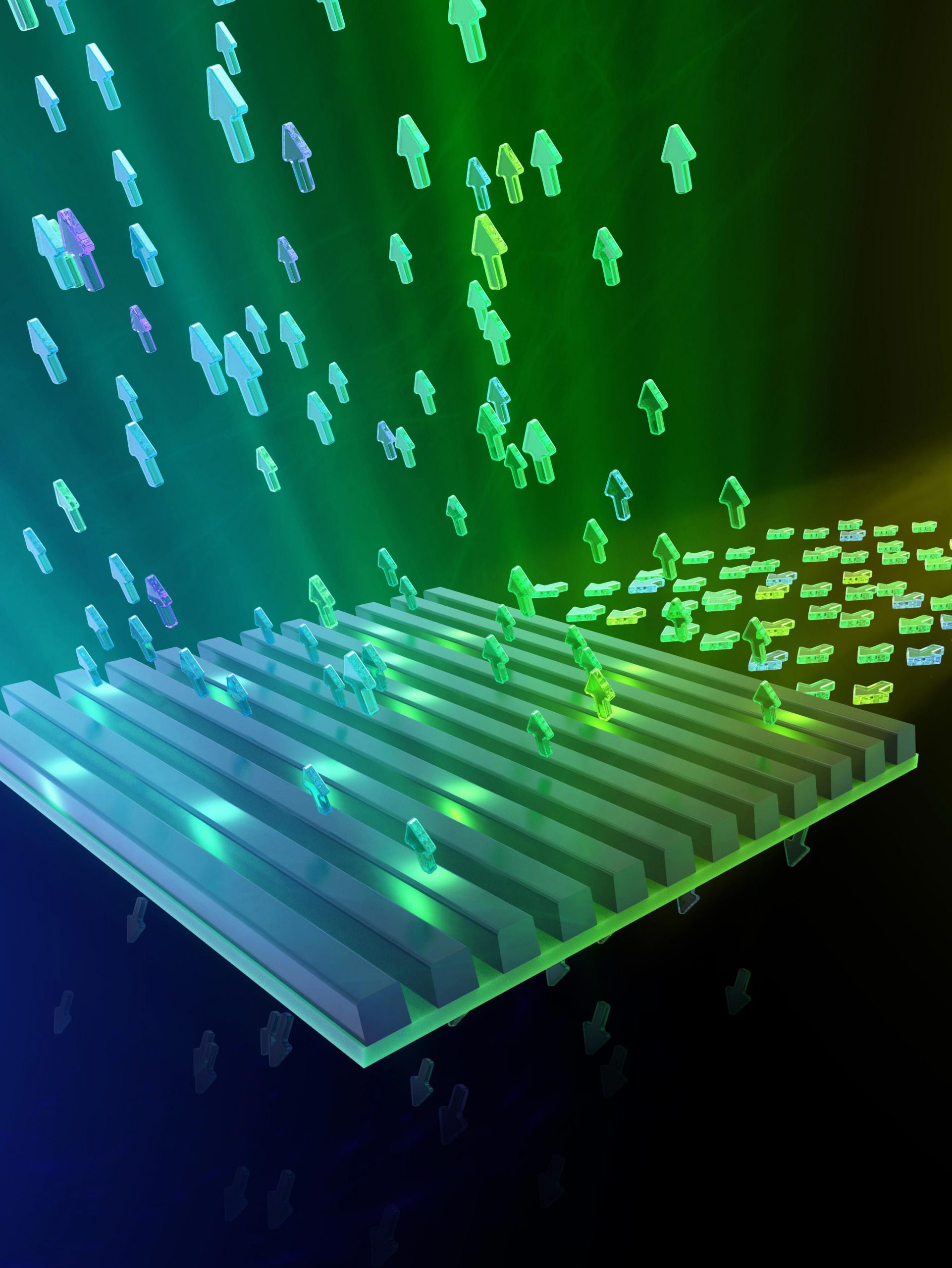
A large part of energy consumption in data traffic is due to this radiation loss. Total data center energy consumption is two percent of the global electricity demand, and demand increases every year.
Previous studies consistently suggested that a minimum loss of 25 percent at each interface between optical fibers and chips was a theoretical upper bound that could not be surpassed. Because data centers require complex and interwoven systems of nodes, that 25-percent loss quickly multiplies as light travels through a network.
“You may need to pass five nodes (10 interfaces) to communicate with another server in a typical medium-sized data center, leading to a total loss of 95 percent if you use existing devices,” said Jicheng Jin, University of Pennsylvania doctoral student. “In fact, extra energy and elements are needed to amplify and relay the signal again and again, which introduces noise, lowers signal-to-noise ratio, and, ultimately, reduces communication bandwidth.”
After studying the system in more detail, the research team discovered that breaking left-right symmetry in their device could reduce the loss to zero.
“These exciting results have the potential to spur new research investments for Army systems,” said Dr. Michael Gerhold, program manager, optoelectronics, Army Research Office. “Not only do the coupling efficiency advances have potential to improve data communications for commercial data centers, but the results carry huge impact for photonic systems where much lower intensity signals can be used for the same precision computation, making battery powered photonic computers possible.”

To better understand this phenomenon, the team developed a theory based on topological charges. Topological charges forbid radiation in a specific direction. For a coupler with both up-down and left-right symmetries, there is one charge on each side, forbidding the radiation in the vertical direction.
“Imagine it as two-part glue,” said Bo Zhen, assistant professor, department of physics and astronomy at University of Pennsylvania. “By breaking the left-right symmetry, the topological charge is split into two half charges – the two-part glue is separated so each part can flow. By breaking the up-down symmetry, each part flows differently on the top and the bottom, so the two-part glue combines only on the bottom, eliminating radiation in that direction. It’s like a leaky pipe has been fixed with a topological two-part glue.”
The team eventually settled on a design with a series of slanted bars, which break left-right and up-down symmetries at the same time. To fabricate such structures, they developed a novel etching method: silicon chips were placed on a wedge-like substrate, allowing etching to occur at a slanted angle. In comparison, standard etchers can only create vertical side walls. As a future step, the team hopes to further develop this etching technique to be compatible with existing foundry processes and also to come up with an even simpler design for etching.
The authors expect applications both in helping light travel more efficiently at short distances, such as between an optical fiber cable and a chip in a server, and over longer distances, such as long-range Lidar systems.
Reference: “Observation of topologically enabled unidirectional guided resonances” by Xuefan Yin, Jicheng Jin, Marin Soljačić, Chao Peng and Bo Zhen, 22 April 2020, Nature.
DOI: 10.1038/s41586-020-2181-4
This project also received funding from the Air Force Research Laboratory, MIT Lincoln Laboratory, Natural Science Foundation of China, and HPCP of Peking University.
Never miss a breakthrough: Join the SciTechDaily newsletter.
Follow us on Google and Google News.
3 Comments
Too many interesting things here, thanks for this great information. Love your page and I will save it to read the next information you update.
The comment about power consumption in data centers seems very misleading. The vast majority of the power consumption in a data center is directly related to the electronics and not the opto-electric interface. Certainly as we migrate to optical computing, the efficiency of the opto-electric interface would dominate, but at that point in time the portion of global power consumption attributed to data centers is unlikely to be 2%.
I think Larry Farmer is correct.