

Close Menu
    Facebook X (Twitter) Instagram
    SciTechDaily
    • Biology
    • Chemistry
    • Earth
    • Health
    • Physics
    • Science
    • Space
    • Technology
    Facebook X (Twitter) Pinterest YouTube RSS
    SciTechDaily
    Home»Health»Breakthrough Study Shows Sound Stimulation May Help Clear Alzheimer’s Plaques
    Health

    Breakthrough Study Shows Sound Stimulation May Help Clear Alzheimer’s Plaques

    By ZHANG Nannan, Chinese Academy of Sciences HeadquartersFebruary 24, 202614 Comments3 Mins Read
    Facebook Twitter Pinterest Telegram LinkedIn WhatsApp Email Reddit
    Share
    Facebook Twitter LinkedIn Pinterest Telegram Email Reddit
    Translucent Human Brain Energy Technology
    Could a low-cost sound-based therapy offer a safer alternative to current Alzheimer’s treatments? In aged monkeys that naturally develop Alzheimer’s-like pathology, scientists found that 40-Hz auditory stimulation produced long-lasting biological effects linked to amyloid dynamics. Credit: Shutterstock

    Forty-Hz auditory stimulation increased amyloid clearance markers in aged primates and produced lasting effects, supporting its potential as a non-invasive Alzheimer’s therapy.

    Scientists at the Kunming Institute of Zoology (KIZ) of the Chinese Academy of Sciences have shown for the first time in non-human primates that sound stimulation at 40-Hz can significantly increase β-amyloid levels in the cerebrospinal fluid (CSF) of aged rhesus monkeys. Notably, this effect lasted for more than five weeks after treatment ended.

    The findings, published in PNAS, provide the first experimental evidence in non-human primates that 40-Hz stimulation could serve as a non-invasive physical approach for Alzheimer’s disease (AD). The study also highlights important differences between primate and rodent models, which are often used in preclinical research.

    Led by Dr. Xintian Hu at KIZ, the research team worked with nine elderly rhesus macaques (Macaca mulatta) between 26 and 31 years old. These monkeys naturally developed widespread amyloid plaques in their brains, closely resembling the Aβ pathology seen in human AD. Because of this similarity, they offer a valuable model for testing potential therapies before moving to human trials.
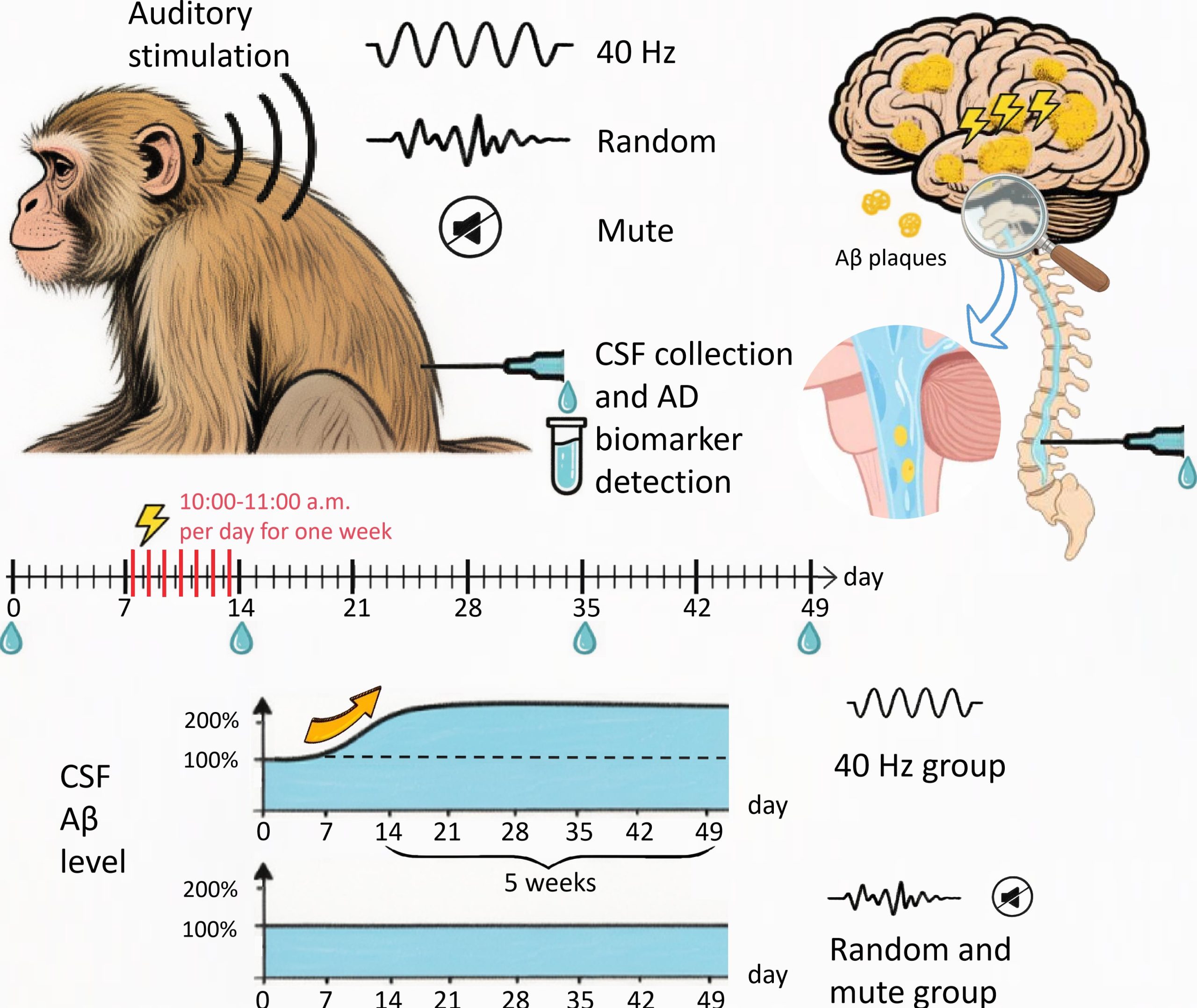
    Schematic of 40 Hz Auditory Stimulation Experiment
    40Hz auditory stimulation specifically caused a significant increase of over 200% in Aβ42 and Aβ40 protein levels in the CSF of aged monkeys, which persisted for more than 5 weeks. Credit: KIZ

    Auditory stimulation drives amyloid shift

    In a randomized controlled design, the experimental group received one hour of 40-Hz auditory stimulation using a 1-kHz pure tone each day for seven consecutive days. After this treatment period, concentrations of Aβ42 and Aβ40 in the monkeys’ CSF rose by 205.61% and 201.00%, respectively, with statistically significant differences compared to baseline. These changes align with earlier findings in mice and support the idea that 40-Hz stimulation may promote the movement of β-amyloid from brain tissue into the CSF, a process thought to reflect enhanced clearance.

    Importantly, when researchers measured CSF Aβ levels again 35 days after the stimulation ended, the concentrations remained elevated and did not significantly decline from the immediate post-treatment values. Such a prolonged effect has not been documented in mouse studies. This long-lasting response strengthens the case for 40-Hz stimulation as a potential non-invasive therapy for AD and emphasizes the relevance of aged rhesus monkeys in translational Alzheimer’s research.

    A non-invasive alternative to antibodies

    Currently approved anti-Aβ monoclonal antibody treatments can slow the progression of early-stage AD, but they carry risks such as cerebral edema and hemorrhage.

    By contrast, 40-Hz auditory stimulation is a low-cost, non-invasive intervention that may offer therapeutic benefits with fewer safety concerns. These results suggest it could be explored as a complementary or alternative strategy in the management of Alzheimer’s disease.

    Reference: “Long-term effects of forty-hertz auditory stimulation as a treatment of Alzheimer’s disease: Insights from an aged monkey model study” by Wenchao Wang, Rongyao Huang, Longbao Lv, Xia Ma, Zhenhui Li, Yuhua Zhang, Jing Wu, Shihao Wu, Jianglei Xu, Yingzhou Hu, Christoph W. Turck, Hao Li and Xintian Hu, 5 January 2026, Proceedings of the National Academy of Sciences.
    DOI: 10.1073/pnas.2529565123

    Never miss a breakthrough: Join the SciTechDaily newsletter.
    Follow us on Google and Google News.

    Alzheimer's Disease Amyloid-ß Brain Chinese Academy of Sciences Dementia
    Share. Facebook Twitter Pinterest LinkedIn Email Reddit

    Related Articles

    New Research Overturns Decades of Thinking on Fat’s Role in Alzheimer’s

    Lost Sleep May Leave Dangerous Toxins Lurking in the Brain

    Alzheimer’s Breakthrough: New Therapeutic Target Found

    Are We Wrong About Alzheimer’s? Researchers Question Prevailing Theory After New Discovery

    Statins Used to Lower Cholesterol Linked to Doubled Risk of Developing Dementia

    “Cognitive Clock” – Researchers Develop New Measure of Brain Health

    Eating Just One Serving of Processed Meat a Day Could Increase Dementia Risk by 44%

    Identifying “The Terrorist Inside My Husband’s Brain” – Living Brain Imaging Can Clearly Differentiate Between Types of Dementia

    Promising Dementia Vaccine Draws Closer

    14 Comments

    1. maher on February 24, 2026 11:06 pm

      Let’s find out with humans

      Reply
    2. Dj on February 24, 2026 11:32 pm

      Music has healing powers

      Reply
      • She Ra on February 26, 2026 10:39 am

        Much of the music today does NOT have ‘healing powers’.

        It almost has berserker powers.

        Reply
    3. Stephen Sebert on February 25, 2026 12:52 am

      Sounds about like Geezer Butler’s go to frequency. Good news I’d say

      Reply
      • Eric on February 25, 2026 1:47 pm

        Anyone have a 40 hz house mix to share?

        Reply
        • Smithy on February 25, 2026 7:32 pm

          great comment!

          Reply
        • Donna Mom Ice on February 26, 2026 3:10 am

          iTunes has several playlists

          Reply
      • Larry M on February 25, 2026 4:42 pm

        Indeed. The frequency of the lowest string on a 4 string bass is E1, 41.7 Hz

        Reply
    4. Q. Sandra Mlcolm on February 25, 2026 2:38 am

      Glad to see focus off of so much “drug fixes”.

      Reply
    5. Q. Sandra Mlcolm on February 25, 2026 2:38 am

      Glad to see focus off of so much “drug fixes”.

      Reply
      • Graziella Rocha on February 25, 2026 4:36 am

        Interesting my husband had Alzheimer’s but he was in his late 80s and died in his 90s. It only affected his speech

        Reply
      • James on February 27, 2026 3:37 am

        I’m pleased to see more research coming out of China. I’d first gotten acquainted through paleontology in the north and have friends there who occasionally provide me with reading material.
        Maybe chinese scientists will pick up where Americans are leaving off.

        Reply
    6. Q. Sandra Malcolm-Johnson on February 25, 2026 2:40 am

      Glad to see focus off of so much “drug fixes”.

      Reply
    7. Mel on February 26, 2026 9:37 am

      With my luck Ill go deaf then get AD

      Reply
    Leave A Reply Cancel Reply

    • Facebook
    • Twitter
    • Pinterest
    • YouTube

    Don't Miss a Discovery

    Subscribe for the Latest in Science & Tech!

    Trending News

    The Universe Is Expanding Too Fast and Scientists Can’t Explain Why

    “Like Liquid Metal”: Scientists Create Strange Shape-Shifting Material

    Early Warning Signals of Esophageal Cancer May Be Hiding in Plain Sight

    Common Blood Pressure Drug Shows Surprising Power Against Deadly Antibiotic-Resistant Superbug

    Scientists Uncover Dangerous Connection Between Serotonin and Heart Valve Disease

    Scientists Discover a “Protector” Protein That Could Help Reverse Hair Loss

    Bone-Strengthening Discovery Could Reverse Osteoporosis

    Scientists Uncover Hidden Trigger Behind Stem Cell Aging

    Follow SciTechDaily
    • Facebook
    • Twitter
    • YouTube
    • Pinterest
    • Newsletter
    • RSS
    SciTech News
    • Biology News
    • Chemistry News
    • Earth News
    • Health News
    • Physics News
    • Science News
    • Space News
    • Technology News
    Recent Posts
    • A Common Diabetes Drug May Hold the Key to Stopping HIV From Coming Back
    • Ancient “Syphilis-Like” Disease in Vietnam Challenges Key Scientific Assumptions
    • Drinking Alcohol To Cope in Your 20s Could Damage Your Brain for Life
    • Scientists Crack Alfalfa’s Chromosome Mystery After Decades of Debate
    • Ancient Ant-Plant Alliance Collapses As Predatory Wasps Move In
    Copyright © 1998 - 2026 SciTechDaily. All Rights Reserved.
    • Science News
    • About
    • Contact
    • Editorial Board
    • Privacy Policy
    • Terms of Use

    Type above and press Enter to search. Press Esc to cancel.