
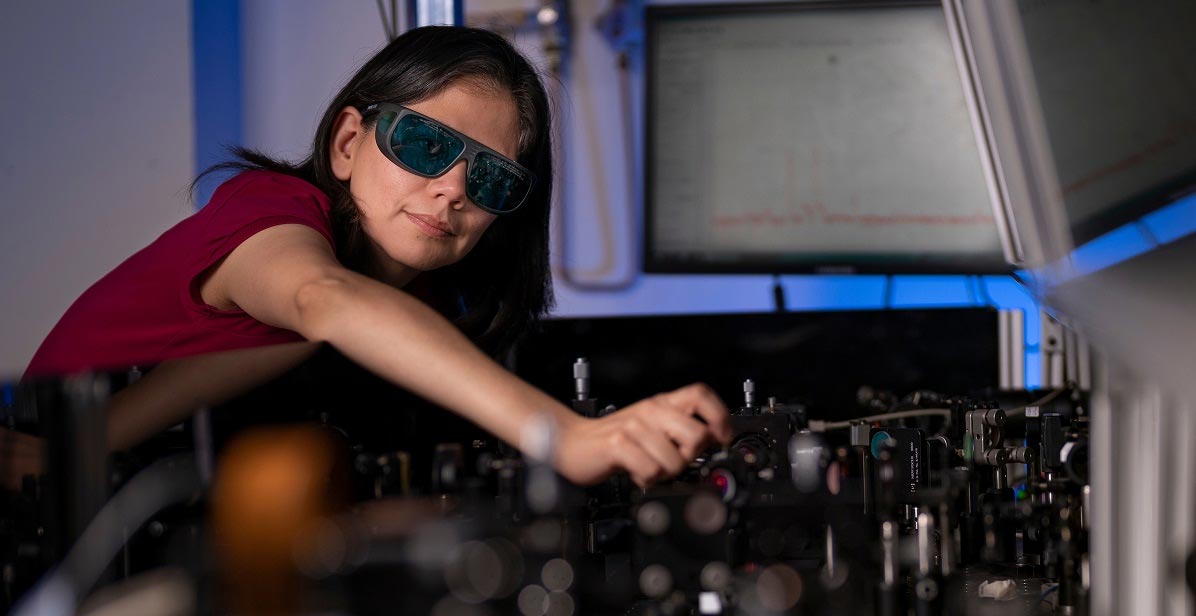
Let there be light! Ultra-thin film could one day be used on reading glasses.
Researchers from The Australian National University (ANU) have developed new technology that allows people to see clearly in the dark, revolutionizing night-vision.
The first-of-its-kind thin film, described in a new article published in Advanced Photonics, is ultra-compact and one day could work on standard glasses.
The researchers say the new prototype tech, based on nanoscale crystals, could be used for defense, as well as making it safer to drive at night and walking home after dark.
The team also say the work of police and security guards — who regularly employ night vision — will be easier and safer, reducing chronic neck injuries from currently bulk night-vision devices.
Crystal-Clear Vision Through Nanotechnology
“We have made the invisible visible,” lead researcher Dr. Rocio Camacho Morales said.
“Our technology is able to transform infrared light, normally invisible to the human eye, and turn this into images people can clearly see — even at distance.
“We’ve made a very thin film, consisting of nanometer-scale crystals, hundreds of times thinner than a human hair, that can be directly applied to glasses and acts as a filter, allowing you to see in the darkness of the night.”
The technology is extremely lightweight, cheap, and easy to mass-produce, making them accessible to everyday users.
Currently, high-end infrared imaging tech requires cryogenic freezing to work and is costly to produce. This new tech works at room temperatures.
Meta-Surfaces Unlock New Optical Capabilities
Dragomir Neshev, Director of the ARC Centre for Excellence in Transformative Meta-Optical Systems (TMOS) and ANU Professor in Physics, said the new tech used meta-surfaces, or thin films, to manipulate light in new ways.
“This is the first time anywhere in the world that infrared light has been successfully transformed into visible images in an ultra-thin screen,” Professor Neshev said.
“It’s a really exciting development and one that we know will change the landscape for night vision forever.”
The new tech has been developed by an international team of researchers from TMOS, ANU, Nottingham Trent University, UNSW, and European partners.
Mohsen Rahmani, the Leader of the Advanced Optics and Photonics Lab in Nottingham Trent University’s School of Science and Technology, led the development of the nanoscale crystal films.
“We previously demonstrated the potential of individual nanoscale crystals, but to exploit them in our everyday life we had to overcome enormous challenges to arrange the crystals in an array fashion,” he said.
“While this is the first proof-of-concept experiment, we are actively working to further advance the technology.”
Reference: “Infrared upconversion imaging in nonlinear metasurfaces” by Rocio Camacho-Morales, Davide Rocco, Lei Xu, Valerio Flavio Gili, Nikolay Dimitrov, Lyubomir Stoyanov, Zhonghua Ma, Andrei Komar, Mykhaylo Lysevych, Fouad Karouta, Alexander A. Dreischuh, Hark Hoe H. Tan, Giuseppe Leo, Costantino De Angelis, Chennupati Jagadish, Andrey E. Miroshnichenko, Mohsen Rahmani and Dragomir N. Neshev, 14 June 2021, Advanced Photonics.
DOI: 10.1117/1.AP.3.3.036002
Never miss a breakthrough: Join the SciTechDaily newsletter.
Follow us on Google and Google News.
2 Comments
Now you have something that is worth while
And the stupidity of this,
You will also be giving it to your enemies
Make sure they do not get it
WE do not need enemies with advanced vision
Keep them blind
Would you give your enemy a gun you are holding when he asks for it
Personally
Pull the trigger !
Learn from history
Justin Hall-Tipping had this before 2011…
https://www.ted.com/talks/justin_hall_tipping_freeing_energy_from_the_grid/transcript