
Thanks to new to ceramics nanotechnology, scientists now working with a device that can test you for biomarkers when you blow into it. Using a sensor chip that is able to detect minute amounts of chemical compounds in the breath, the Single Breath Disease Diagnostics Breathalyzer instantly measures your exhaled breath, giving you a green light for healthy and a red light for an indication that something may be off.
This invention could give new meaning to the term “bad breath!” It’s the Single Breath Disease Diagnostics Breathalyzer, and when you blow into it, you get tested for a biomarker—a sign of disease. As amazing as that sounds, the process is actually very simple thanks to ceramics nanotechnology. All it takes is a single exhale.
You blow into a small valve attached to a box that is about half the size of your typical shoebox and weighs less than one pound. Once you blow into it, the lights on top of the box will give you an instant readout. A green light means you pass (and your bad breath is not indicative of an underlying disease; perhaps it’s just a result of the raw onions you ingested recently); however, a red light means you might need to take a trip to the doctor’s office to check if something more serious is an issue.
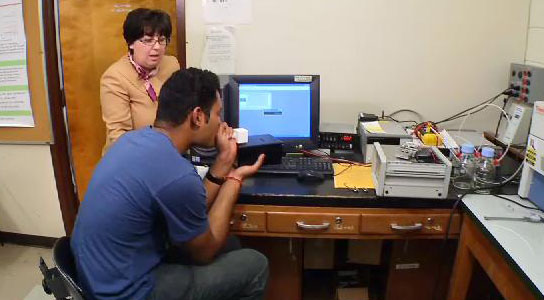
With support from the National Science Foundation (NSF), Professor Perena Gouma and her team at Stony Brook University in New York developed a sensor chip that you might say is the “brain” of the breathalyzer. It’s coated with tiny nanowires that look like microscopic spaghetti and are able to detect minute amounts of chemical compounds in the breath. “These nanowires enable the sensor to detect just a few molecules of the disease marker gas in a ‘sea’ of billions of molecules of other compounds that the breath consists of,” Gouma explains. This is what nanotechnology is all about.
You can’t buy this in the stores just yet–individual tests such as an acetone-detecting breathalyzer for monitoring diabetes and an ammonia-detecting breathalyzer to determine when to end a home-based hemodialysis treatment–are still being evaluated clinically. However, researchers envision developing the technology such that a number of these tests can be performed with a single device. Within a couple of years, you might be able to self-detect a whole range of diseases and disorders, including lung cancer, by just exhaling into a handheld breathalyzer.
Handheld breath tests to estimate blood alcohol content and nitric oxide detectors used in hospitals to monitor pulmonary infections have been around for a while, but there is no consumer-based technology like this currently available. The research team envisions the cost of the final product being under $20, just one of many reasons Gouma thinks the Single Breath Disease Diagnostics Breathalyzer has the potential to empower individuals to take care of their own health like never before. “People can get something over the counter and it’s going to be a first response or first detection type of device. This is really a nanomedicine application that is affordable because it is based on inexpensive ceramic materials that can be mass produced at low cost,” she notes.
The manufacturing process that creates the single crystal nanowires is called “electrospinning.” It starts with a liquid compound being shot from a syringe into an electrical field. The electric field crystallizes the inserted liquid into a tiny thread or “wire” that collects onto an aluminum backing. Gouma says enough nanowire can be produced in one syringe to stretch from her lab in Stony Brook, N.Y. to the moon and still be a single grain (monocrystal).
“There can be different types of nanowires, each with a tailored arrangement of metal and oxygen atoms along their configuration, so as to capture a particular compound,” explains Gouma. “For example, some nanowires might be able to capture ammonia molecules, while others capture just acetone and others just the nitric oxide. Each of these biomarkers signal a specific disease or metabolic malfunction so a distinct diagnostic breathalyzer can be designed.”
“This concept could not have been realized without a fundamental understanding of the material used to create the miniaturized gas detectors,” said Janice Hicks, a deputy division director in the Mathematical and Physical Sciences Directorate at NSF. “The research transcends traditional scientific and engineering disciplines and may lead to new applications or diagnostics.”
Gouma also says the nanowires can be rigged to detect infectious viruses and microbes like Salmonella, E. coli or even anthrax. “There will be so many other applications we haven’t envisioned. It’s very exciting; it’s a whole new world,” she says.
Never miss a breakthrough: Join the SciTechDaily newsletter.
Follow us on Google and Google News.