
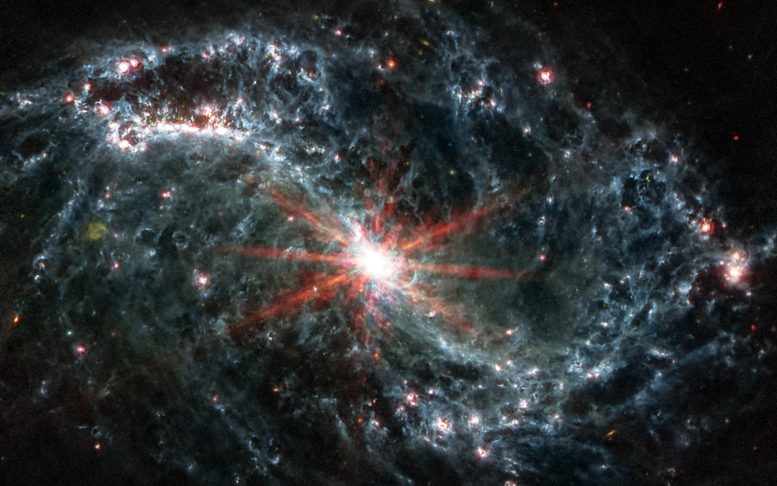
Webb space telescope’s mid-infrared capabilities allowed scientists to see past gas and dust clouds to observe previously obscured details in faraway galaxies.
A team of researchers has been able to see inside faraway spiral galaxies for the first time to study how they formed and how they change over time, thanks to the powerful capabilities of the James Webb Space Telescope.
“We’re studying 19 of our closest analogs to our own galaxy. In our own galaxy we can’t make a lot of these discoveries because we’re stuck inside it,” says Erik Rosolowsky, professor in the University of Alberta Department of Physics and co-author on a recent paper — published in The Astrophysical Journal Letters — analyzing data from the James Webb telescope.
Revolutionary Infrared Technology Unlocks Stellar Mysteries
Unlike previous observation tools, the telescope’s mid-infrared instrument can penetrate dust and gas clouds to provide critical information about how stars are forming in these galaxies, and consequently, how they are evolving.
“This is light that is longer wavelength and represents cooler objects than the light we see with our eyes,” says Rosolowsky.
“The infrared light is really key to tracing the cold and distant universe.”
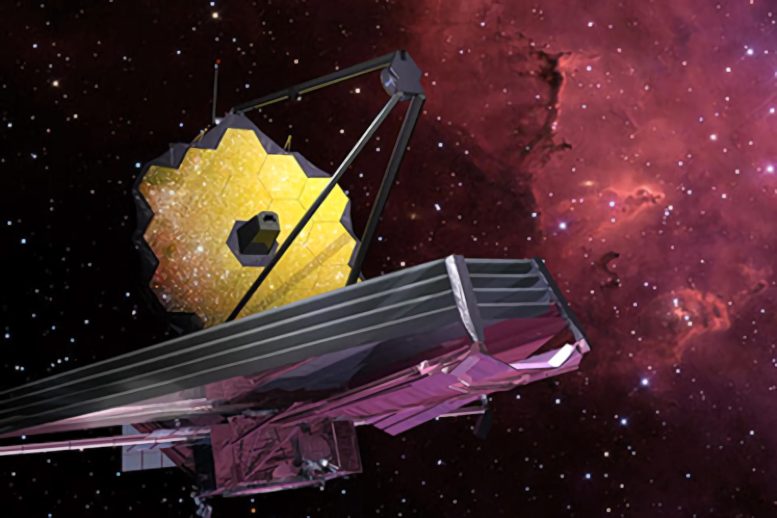
So far, the telescope has captured data from 15 of the 19 galaxies. Rosolowsky and Hamid Hassani, a PhD student and lead author on the paper, examined the infrared light emitted from dust grains at different wavelengths to help categorize what they were seeing, such as whether an image showcased regular stars, massive star-forming complexes or background galaxies.
“At 21 micrometers [the infrared wavelength used for the images collected], if you look at a galaxy you will see all of those dust grains heated with light from the stars,” explains Hassani.
Discovering Young Stars and Star Formation Processes
From the collected images, they were able to determine the age of the stars. They discovered they were observing young stars which “erupt[ed] onto the scene practically instantaneously, far faster than a lot of models had predicted,” says Rosolowsky.
“The age of these [stellar] populations is very young. They’re really just starting to produce new stars and they are really active in the formation of stars,” says Hassani.
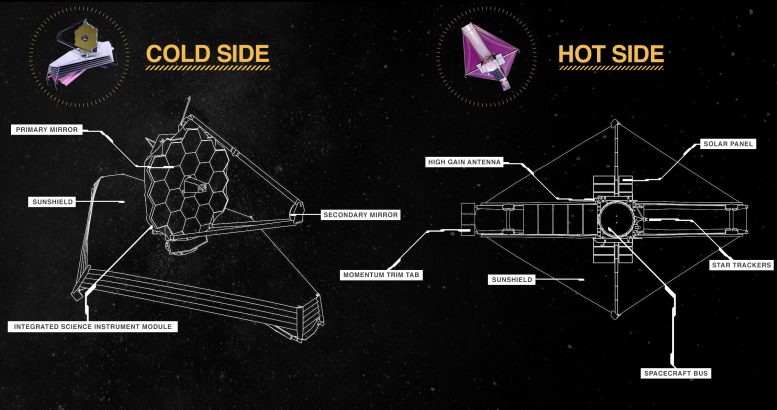
The researchers also found a close relationship between the mass of stars in a region and how bright they were. “It turns out this was a brilliant way to find high-mass stars,” says Rosolowsky.
High-Mass Stars and Their Role in Galaxy Evolution
Rosolowsky terms high-mass stars “rock stars” because “they live fast, they die young and they really shape the galaxy around them.” When they’re forming, he explains, they release huge amounts of solar wind and gas bubbles, which halts star formation in that particular area while simultaneously stirring up the galaxy and sparking star formation in other areas.
“We’ve discovered this is actually really key for the long-term life of a galaxy, this kind of bubbling froth, because it keeps the galaxy from going through its fuel too quickly,” says Rosolowsky.
It’s a complex process, with each new star formation playing a larger role in how the galaxy changes over time, adds Hassani.
“If you have a star forming, that galaxy is still active. You have a lot of dust and gas and all of these emissions from the galaxy that trigger the next generation of the next massive star forming and just keep the galaxy alive.”
The more images scientists have that document these processes, the better they are able to infer what is going on in distant galaxies that have similarities to our own. Rather than looking at just one galaxy in depth, Rosolowsky and Hassani want to create what Rosolowsky calls a “galaxy atlas” of sorts by capturing images using as many methods as possible.
“Through the collection of all this data, in creating this great atlas, we’d be able to sort out what’s special about one galaxy versus the unifying themes that shape galaxies as a whole,” says Rosolowsky.
Reference: “PHANGS–JWST First Results: The 21 µm Compact Source Population” by Hamid Hassani, Erik Rosolowsky, Adam K. Leroy, Médéric Boquien, Janice C. Lee, Ashley T. Barnes, Francesco Belfiore, F. Bigiel, Yixian Cao, Mélanie Chevance, Daniel A. Dale, Oleg V. Egorov, Eric Emsellem, Christopher M. Faesi, Kathryn Grasha, Jaeyeon Kim, Ralf S. Klessen, Kathryn Kreckel, J. M. Diederik Kruijssen, Kirsten L. Larson, Sharon E. Meidt, Karin M. Sandstrom, Eva Schinnerer, David A. Thilker, Elizabeth J. Watkins, Bradley C. Whitmore and Thomas G. Williams, 16 February 2023, The Astrophysical Journal Letters.
DOI: 10.3847/2041-8213/aca8ab
Their paper was one of 21 research papers on the initial findings from the Physics at High Angular resolution in Nearby Galaxies (PHANGS) collaboration, published in a special focus issue of The Astrophysical Journal Letters.
Never miss a breakthrough: Join the SciTechDaily newsletter.
Follow us on Google and Google News.