

ESA’s BepiColombo spacecraft is currently undertaking a series of gravity-assisted maneuvers around Mercury, capturing increasingly close-up images of this enigmatic planet.
With each flyby, the probe edges closer to its final orbit in 2026, providing unprecedented views and data from the nearest planet to the Sun.
Exciting Journey to Mercury
Space probes often rely on gravitational flybys to adjust their trajectories during long journeys. However, it’s less common for a probe to perform flybys around its destination planet. ESA’s BepiColombo spacecraft is doing just that as it maneuvers around Mercury to achieve its final orbit. With each pass, the spacecraft moves closer to being fully captured by Mercury’s gravity, a milestone expected in 2026.
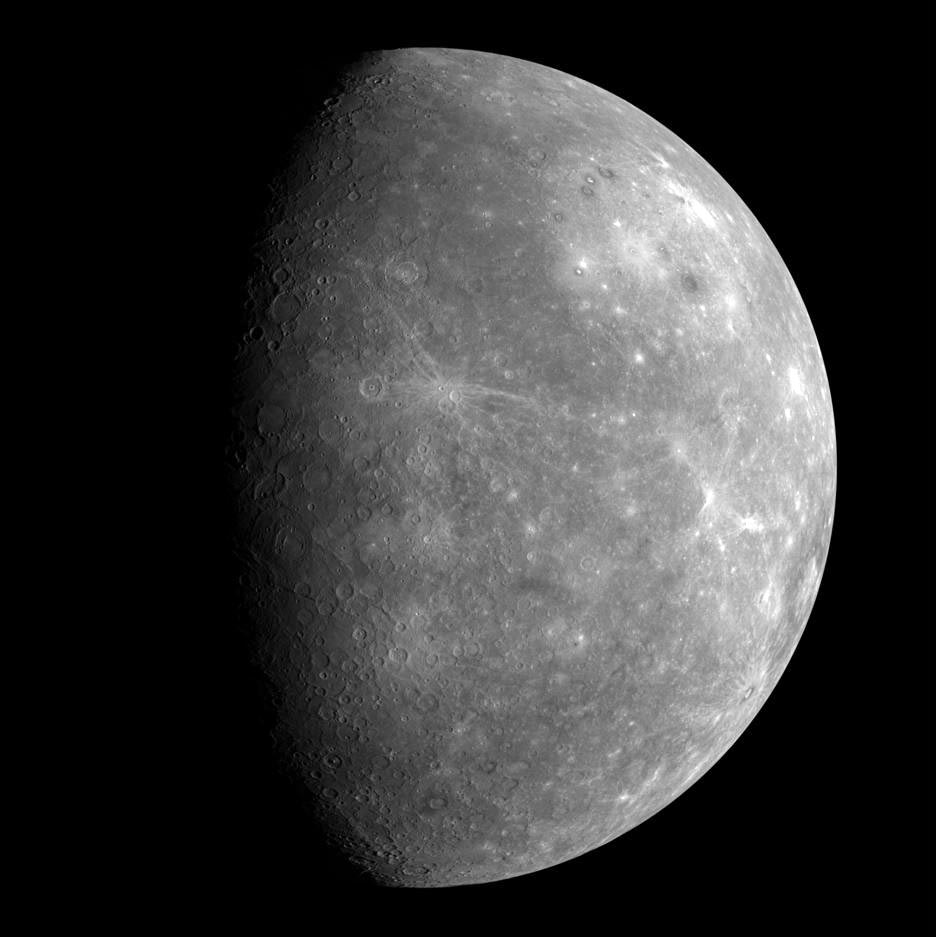
During its latest flyby, BepiColombo captured stunning images of the Solar System’s innermost planet, taken from just a few hundred kilometers away. These images offer the most detailed and breathtaking views of Mercury yet.
Mercury’s Extreme Environment
Mercury, the smallest planet in the Solar System and the closest to the Sun, is a rocky, desolate world. Its surface, scarred by craters, resembles the Moon. With no atmosphere to regulate temperature, Mercury experiences extreme conditions: daytime highs soar to a scorching 472°C, while nighttime lows drop to a frigid -200°C. The planet’s highly elliptical orbit takes just 88 Earth days to complete. From Earth, Mercury remains difficult to observe, as it never strays far from the Sun’s glare in the twilight sky.
BepiColombo’s Historic Mission
To date, only two spacecraft have visited Mercury; Mariner 10 and Messenger. There is now another on the way, BepiColombo. It was launched on October 20, 2018, when it began its journey to the innermost planet. Led by ESA, this joint mission with Japan Aerospace Exploration Agency (JAXA.) is made up of two orbiters; ESA’s Mercury Planetary Orbiter and JAXA’s Mercury Magnetospheric Orbiter. On arrival, the two orbiters will maneuver into their dedicated polar orbits, beginning their operations in early 2027.

Stunning Discoveries from BepiColombo
During a press briefing on January 9, 2025, ESA Director General Josef Aschbacher revealed the first images from the spacecraft’s monitoring cameras (M-CAMs) and the results did not disappoint.
In this first image, BepiColombo passed over Mercury’s terminator, the line between the day and night hemispheres, allowing M-CAM 1 to peer into the permanently shadowed craters of the north pole. The craters Prokofiev, Kandinsky, Tolkien, and Gordimer can be seen with their permanently dark floors. Despite Mercury’s proximity to the Sun, the floors of the craters are some of the coldest places in the Sun. In these dark, shadowy places there is even evidence of frozen water!

The second image captures the volcanic plane known as Borealis Planitia. The large smooth plains on Mercury, rather like those on the Moon, formed billions of years ago. In the case of Mercury, it’s thought the plains formed 3.7 billion years ago when volcanic eruptions flooded the surface with molten lava. Any craters that were in the area, such as Henri and Lismer got filled with lava and as the planet cooled, wrinkles formed in the plains much like the wrinkling of an apple skin.
Many of the smaller craters in this region have been wiped out by the lava but the rim of Mendelssohn crater is still visible along with Caloris Basin, a large impact crater with a diameter of 1,500 km.

The final image was taken by M-CAM 2 and shows more evidence of volcanic activity and impact events. There is a bright region toward the upper limb and this is known as Nathair Facula. It’s the result of the largest volcanic explosion on Mercury with a central vent 40km across. Evidence has been found for at least 3 major eruptions that have deposited lava over 150km away. In stark contrast, to the left is the much younger Fonteyn Crater, just 300 million years old!

Adapted from an article originally published on Universe Today.
Never miss a breakthrough: Join the SciTechDaily newsletter.
Follow us on Google and Google News.