
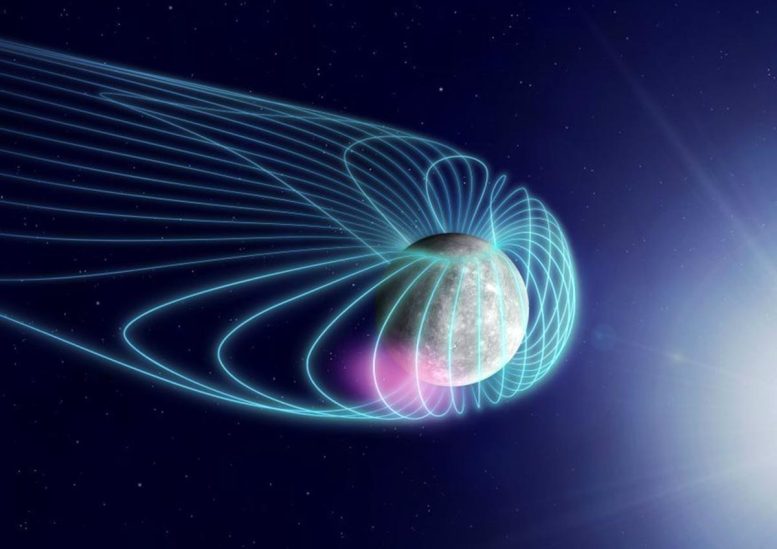
Mercury’s exploration by the Mio spacecraft revealed localized chorus waves in its magnetosphere. International research utilized advanced theories and simulations to understand these waves, emphasizing the magnetosphere’s vital role in shielding planets from cosmic radiation.
Since Mercury is the closest planet to the Sun among the solar system planets, it is strongly influenced by the solar wind, a high-speed (several hundred km/s) stream of plasma blowing from the Sun.
Explorations of Mercury were first carried out by the Mariner 10 spacecraft in 1974 and 1975, which revealed that Mercury has a magnetic field, and thus a magnetosphere, similar to that of Earth.
In the 2000s, the MESSENGER spacecraft provided a detailed picture of Mercury’s magnetic field and magnetosphere, and revealed that Mercury’s magnetic field center is shifted northward from the planet’s center by approximately 0.2 RM (RM is Mercury’s radius of 2,439.7 km).
The third exploration of Mercury is currently being made by the BepiColombo International Mercury Exploration Project[1] thanks to the Mio spacecraft (Project Scientist, Dr. Murakami) and the Mercury Planetary Orbiter (MPO). In particular, unlike Mariner 10 and MESSENGER, the Mio spacecraft is equipped with a full suite of plasma wave instrument (PWI, Principal Investigator Prof. Kasaba) designed specifically to investigate for the first time the electromagnetic environment around Mercury. Electromagnetic waves can efficiently accelerate plasma particles (electrons, protons, heavier ions); as such, they play an important role in Mercury’s magnetospheric dynamics.
Results of Current Study
The current study was performed by an international joint research team consisting of scientists from Kanazawa University, Tohoku University, Kyoto University, MagneDesign Corporation, Laboratoire de Physique des Plasmas, France with support from CNES (French Space Agency), and the Institute of Space and Astronautical Science, the Japan Aerospace Exploration Agency (JAXA).
The Mio spacecraft, launched on October 20, 2018, is currently on its way to Mercury, with a final insertion in orbit around the planet scheduled for December 2025. Although getting Mio into Mercury’s orbit is technically extremely difficult due to the strong gravity of the Sun as compared to that of Mercury, it is scheduled to enter into orbit around Mercury in 2025 after several flybys[2] of Earth, Venus, and Mercury for gravity assist maneuvers.
During the Mercury flybys that occurred on October 1, 2021, and June 23, 2022, the Mio spacecraft approached the planet at an altitude of approximately 200 km. The stowed configuration of the spacecraft during the journey to Mercury is not optimal for measuring electromagnetic waves because of the interference noise coming from the spacecraft itself. However, the Mio spacecraft was developed to lower as much as possible its electromagnetic noise level, and thus has been certified as an electromagnetically clean spacecraft through EMC tests.[3]
Alternating current magnetic field sensors that can cope with the scorching environment of Mercury have been developed jointly by Japan and France and have allowed the first electromagnetic wave observations around Mercury without being contaminated by the noise from the spacecraft itself. This has revealed the local generation of chorus waves, such as those that are frequently detected in the magnetosphere of Earth.
The existence of chorus waves in the magnetosphere of Mercury, which is now confirmed, was predicted (frequency range, intensity, etc.) since the 2000s when the plasma wave instrument (PWI) of the Mio spacecraft was designed. What most surprised the international joint research team, including Dr. Ozaki of Kanazawa University, was the ”spatial locality” of the chorus waves, which were detected only in an extremely limited region in the dawn sector of the Mercury’s magnetosphere during the two flybys. This means that there is a physical mechanism that tends to generate chorus waves only in the dawn sector of the magnetosphere of Mercury.
In order to investigate the cause of the generation of chorus waves in the dawn sector, the international joint research team used the nonlinear growth theory of chorus waves established by Prof. Omura, Kyoto University, to evaluate the effect of curvature of the magnetic field of Mercury, which is strongly distorted by the solar wind. The magnetic field lines in the night sector are stretched by the solar wind pressure, while the magnetic field lines in the dawn sector are less affected resulting in a smaller curvature.
Based on the characteristics of the magnetic field lines and the nonlinear growth theory, it is revealed that in the dawn sector, energy is efficiently transferred from electrons to electromagnetic waves along magnetic field lines, creating conditions that favor chorus wave generation. The effect is also confirmed in a numerical simulation of the Mercury environment using a high-performance computer.
In this study, the team has revealed the importance of the planetary magnetic field lines, which are strongly affected by the solar wind, on the locality of chorus wave generation thanks to a strong synergy between “spacecraft observation,” “theory,” and “simulation.”
Future Prospects
In the Mercury flyby observations, the team prepared for the comprehensive electromagnetic environment survey using the planned Mio spacecraft probe in orbit around Mercury. Chorus waves, which were expected to be detected at the time of planning, are observed in a quite local manner, i.e. in the dawn sector of Mercury, which was not expected, and the results show various fluctuations in the magnetosphere of Mercury.
The data demonstrate the existence of energetic electrons on Mercury that can generate chorus waves, the possibility of generating active electrons efficiently accelerated by chorus waves, and the generation of X-ray auroras by electrons forcibly precipitating from Mercury’s magnetosphere to the surface of Mercury driven by chorus waves. These observations will have a wide impact on the scientific understanding of Mercury’s environment.
The Mio spacecraft is on its way to carry out a comprehensive exploration of Mercury. Based on flyby observations we have found that magnetic field distortion is responsible for the local (i.e. dawn sector) generation of the chorus waves. The comprehensive exploration of the electromagnetic environment by the Mio spacecraft in Mercury’s orbit will contribute not only to understanding the plasma environment of the entire Mercury’s magnetosphere but also to a deep understanding of the magnetospheric dynamics in general.
The magnetosphere acts as a barrier preventing life-threatening cosmic radiations on the planets of the solar system. Comparison of data from Mercury and Earth will strengthen our understanding of this important natural shielding of our home planet.
Glossary
- BepiColombo International Mercury Exploration Project: Comprehensive exploration project for Mercury using two spacecraft probes (Mio and MPO) by Japan-Europe cooperation. In particular, Japan is in charge of the Mercury magnetosphere probe Mio, equipped with electromagnetic wave observation instruments, etc.
- Flyby: With a spacecraft probe passing in proximity to a planet. The orbit of the spacecraft probe is to be changed in a desired manner by using the gravity of the planet.
- EMC (electromagnetic compatibility) test: Evaluation test to check whether unnecessary electromagnetic noise is emitted and whether the equipment is designed and manufactured in such a way that it will not malfunction even if it receives unwanted electromagnetic noise.
Evaluation test to check whether unnecessary electromagnetic noise is emitted and whether the equipment is designed and manufactured in such a way that it will not malfunction even if it receives unwanted electromagnetic noise.
Reference: “Whistler-mode waves in Mercury’s magnetosphere observed by BepiColombo/Mio” by Mitsunori Ozaki, Satoshi Yagitani, Yasumasa Kasaba, Yoshiya Kasahara, Shoya Matsuda, Yoshiharu Omura, Mitsuru Hikishima, Fouad Sahraoui, Laurent Mirioni, Gérard Chanteur, Satoshi Kurita, Satoru Nakazawa and Go Murakami, 14 September 2023, Nature Astronomy.
DOI: 10.1038/s41550-023-02055-0
Never miss a breakthrough: Join the SciTechDaily newsletter.
Follow us on Google and Google News.