
An international team of scientists has shown that glycine, the simplest amino acid and an important building block of life, can form under the harsh conditions that govern chemistry in space.
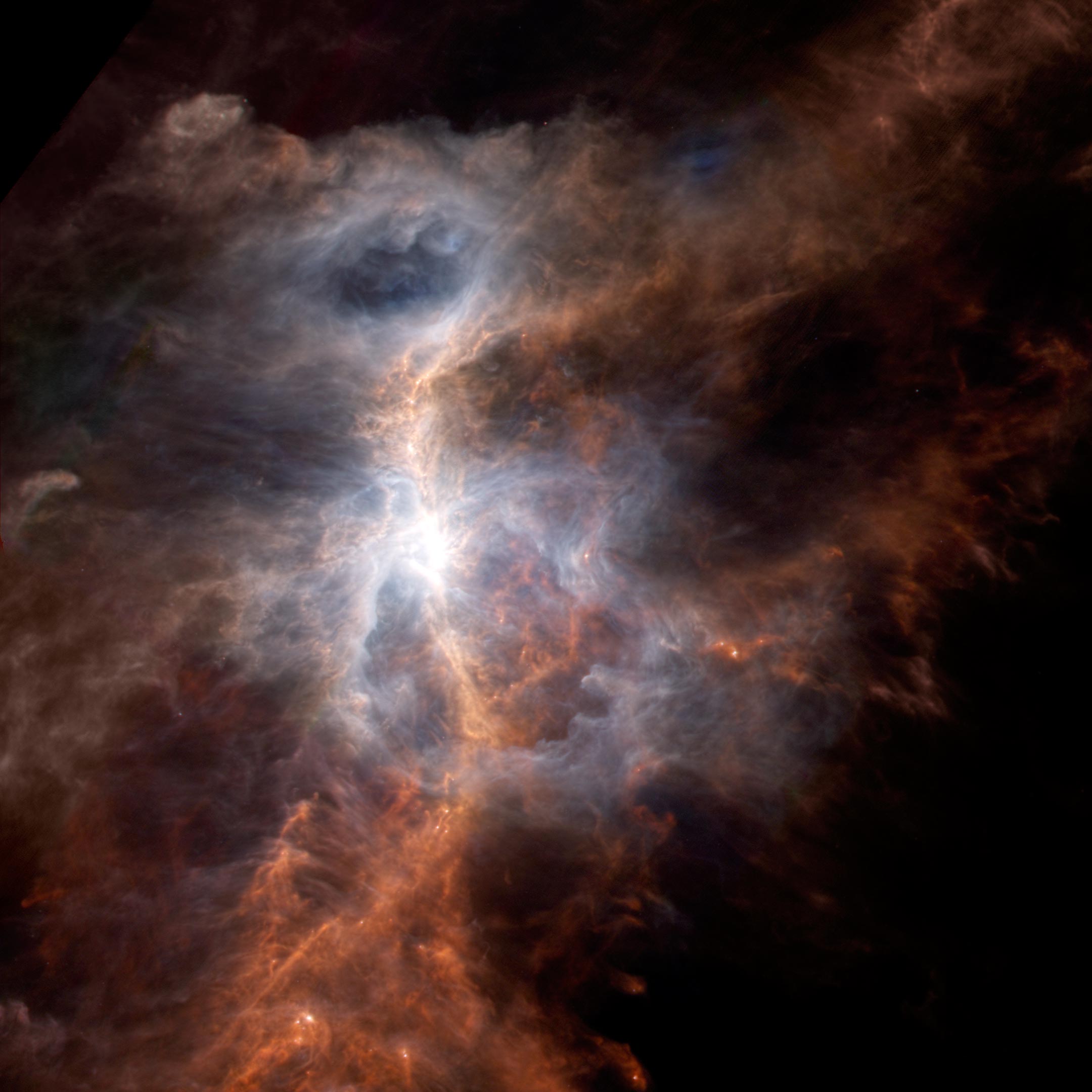
The results, published in Nature Astronomy, suggest that glycine, and very likely other amino acids, form in dense interstellar clouds well before they transform into new stars and planets.
Comets are the most pristine material in our Solar System and reflect the molecular composition present at the time our Sun and planets were just about to form. The detection of glycine in the coma of comet 67P/Churyumov-Gerasimenko and in samples returned to Earth from the Stardust mission suggests that amino acids, such as glycine, form long before stars. However, until recently, it was thought that glycine formation required energy, setting clear constraints to the environment in which it can be formed.
In the new study the international team of astrophysicists and astrochemical modelers, mostly based at the Laboratory for Astrophysics at Leiden Observatory, the Netherlands, have shown that it is possible for glycine to form on the surface of icy dust grains, in the absence of energy, through ‘dark chemistry’. The findings contradict previous studies that have suggested UV radiation was required to produce this molecule.
Dr. Sergio Ioppolo, from Queen Mary University of London and lead author of the article, said: “Dark chemistry refers to chemistry without the need of energetic radiation. In the laboratory, we were able to simulate the conditions in dark interstellar clouds where cold dust particles are covered by thin layers of ice and subsequently processed by impacting atoms causing precursor species to fragment and reactive intermediates to recombine.”
The scientists first showed methylamine, the precursor species of glycine that was detected in the coma of the comet 67P, could form. Then, using a unique ultra-high vacuum setup, equipped with a series of atomic beam lines and accurate diagnostic tools, they were able to confirm glycine could also be formed, and that the presence of water ice was essential in this process.
Further investigation using astrochemical models confirmed the experimental results and allowed the researchers to extrapolate data obtained on a typical laboratory timescale of just one day to interstellar conditions, bridging millions of years. “From this we find that low but substantial amounts of glycine can be formed in space with time,” said Professor Herma Cuppen from Radboud University, Nijmegen, who was responsible for some of the modeling studies within the paper.
“The important conclusion from this work is that molecules that are considered building blocks of life already form at a stage that is well before the start of star and planet formation,” said Harold Linnartz, Director of the Laboratory for Astrophysics at Leiden Observatory. “Such an early formation of glycine in the evolution of star-forming regions implies that this amino acid can be formed more ubiquitously in space and is preserved in the bulk of ice before inclusion in comets and planetesimals that make up the material from which ultimately planets are made.”
“Once formed, glycine can also become a precursor to other complex organic molecules,” concluded Dr. Ioppolo. “Following the same mechanism, in principle, other functional groups can be added to the glycine backbone, resulting in the formation of other amino acids, such as alanine and serine in dark clouds in space. In the end, this enriched organic molecular inventory is included in celestial bodies, like comets, and delivered to young planets, as happened to our Earth and many other planets.”
Reference: “A non-energetic mechanism for glycine formation in the interstellar medium” by S. Ioppolo, G. Fedoseev, K.-J. Chuang, H.M. Cuppen, A.R. Clements, M. Jin, R.T. Garrod, D. Qasim, V. Kofman, E.F. van Dishoeck and H. Linnartz, 16 November 2020, Nature Astronomy.
DOI:10.1038/s41550-020-01249-0
Never miss a breakthrough: Join the SciTechDaily newsletter.
Follow us on Google and Google News.
1 Comment
There are no building blocks to life! Scientists, through all their efforts, have failed to even come close to creating life in a “test tube.” A simple amino acid is a very far cry from life, just as a penny is nothing when compared to a trillion dollars. If one found a penny, would they then say that they are on the way to becoming a trillionaire? Hardly. So there is no big news in this article.