
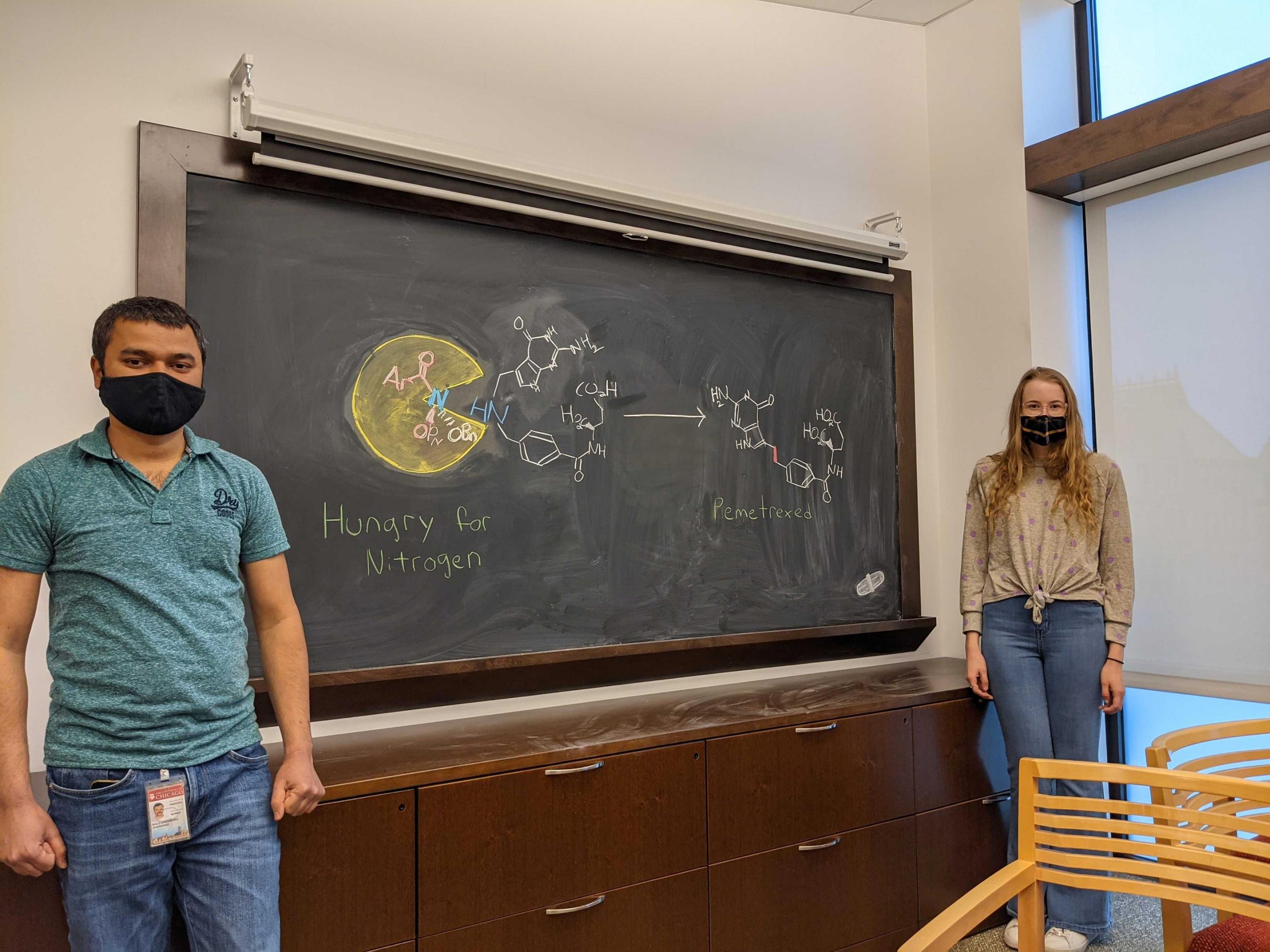
University of Chicago chemists aim to transform the field of chemical discovery.
Molecules are the building blocks for our modern world, from phones to cars to Doritos. But coming up with new ones is still an incredibly costly and time-consuming process. A group of University of Chicago chemists wants to find a better way.
“If you look at a diagram of a molecule, it seems like you should be able to just snap them together like Tinkertoys, but you can’t,” said Asst. Prof. Mark Levin. “We’d like to change that.”
Their new discovery, published on May 12, 2021, in Nature, represents a first step towards that transformation: a way to easily cut nitrogen atoms from molecules.
Despite decades of experiments, chemistry remains an art in many ways because molecules are built in a long, iterative process: attaching some parts, then breaking others so that you can patch new parts in. Every molecule we use, from the fibers in your rug to the dyes that colored it to the detergents you use to clean it, is built this way. But sometimes, the molecules created in the intermediate steps or as byproducts are very toxic, or the whole process takes a lot of time and electricity.
This process becomes even more laborious when scientists or drugmakers are looking for a new chemical, Levin said, since they have to create so many options to test.
“Say you want to make a new drug that targets a part of the cell that biologists have identified as important for heart disease,” he said. “Typically, you screen thousands of molecules just to find a few that latch on to that part of the cell. Then you go about modifying them, to make the molecules easier for the body to absorb or to avoid side effects. Every time that you think, say, ‘Would it work better with a carbon atom on one side instead of a nitrogen?’ you have to go back to the beginning and start over with how to build it.”
Despite decades of experiments, chemistry remains an art in many ways because molecules are built in a long, iterative process.
Levin’s group wants to transform the field by introducing ways to directly edit the molecule of interest. There are a few ways to make minor edits around the edges, Levin said, but scientists are still searching for techniques to make major changes to the skeletons of molecules.
Cutting Nitrogen Without Toxic Byproducts
The UChicago chemists made a breakthrough in this quest, finding a way to “delete” a nitrogen atom from a molecule. Similar processes currently in use generate a very toxic molecule—but Levin’s group instead adds a key reagent, or reactive chemical, which bypasses the intermediate step. The nitrogen is released as N2, and two carbon atoms forge a bond in its place.
As a new foundational method, the discovery opens up avenues for constructing molecules.
“One thing it lets you do is think about making rings in a new way, with potentially fewer steps. That lets you change the logic of how you make things,” Levin said. (Rings of molecules are a frequent ingredient in chemicals.)
The process doesn’t work for every single molecule, but it does for many important ones. For example, Levin’s group tested the method on lapatinib, a molecule approved by the FDA as a cancer drug, and was able to edit its composition quickly and easily.
“One side of this discovery is being able to actually work with a class of reactions that was largely underused because they’re just awful to work with,” Levin said. “But more broadly speaking, we hope it represents a transformation in thinking about how you optimize a molecule.”
Reference: “Skeletal editing through direct nitrogen deletion of secondary amines” by Sean H. Kennedy, Balu D. Dherange, Kathleen J. Berger and Mark D. Levin, 12 May 2021, Nature.
DOI: 10.1038/s41586-021-03448-9
The first author on the paper was Sean Kennedy, a former UChicago postdoctoral researcher now at Johnson Matthey. The other authors on the paper are graduate student Kathleen Berger and postdoctoral researcher Balu Dherange.
Never miss a breakthrough: Join the SciTechDaily newsletter.
Follow us on Google and Google News.
1 Comment
… hungry for the Nitrogen can eat the one produced by cow and lower the pollution…