
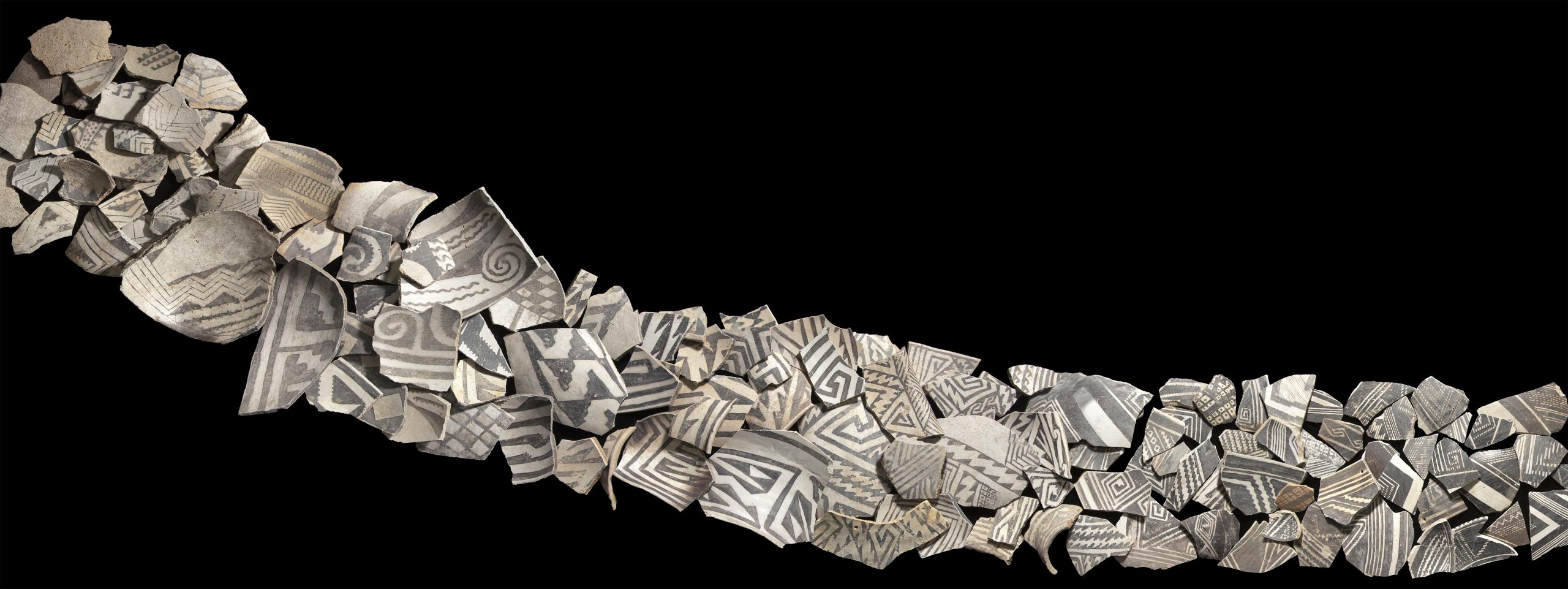
AI now rivals archaeologists in pottery classification, rapidly identifying sherd types and tracing design similarities with visual clarity and unprecedented efficiency.
Archaeologists at Northern Arizona University are hoping a new technology they helped pioneer will change the way scientists study the broken pieces left behind by ancient societies.
The team from NAU’s Department of Anthropology have succeeded in teaching computers to perform a complex task many scientists who study ancient societies have long dreamt of: rapidly and consistently sorting thousands of pottery designs into multiple stylistic categories. By using a form of machine learning known as Convolutional Neural Networks (CNNs), the archaeologists created a computerized method that roughly emulates the thought processes of the human mind in analyzing visual information.
“Now, using digital photographs of pottery, computers can accomplish what used to involve hundreds of hours of tedious, painstaking and eye-straining work by archaeologists who physically sorted pieces of broken pottery into groups, in a fraction of the time and with greater consistency,” said Leszek Pawlowicz, adjunct faculty in the Department of Anthropology. He and anthropology professor Chris Downum began researching the feasibility of using a computer to accurately classify broken pieces of pottery, known as sherds, into known pottery types in 2016. Results of their research are reported in the June issue of the peer-reviewed publication Journal of Archaeological Science.
“On many of the thousands of archaeological sites scattered across the American Southwest, archaeologists will often find broken fragments of pottery known as sherds. Many of these sherds will have designs that can be sorted into previously-defined stylistic categories, called ‘types,’ that have been correlated with both the general time period they were manufactured and the locations where they were made” Downum said. “These provide archaeologists with critical information about the time a site was occupied, the cultural group with which it was associated and other groups with whom they interacted.”
Borrowing from Broader AI Success
The research relied on recent breakthroughs in the use of machine learning to classify images by type, specifically CNNs. CNNs are now a mainstay in computer image recognition, being used for everything from X-ray images for medical conditions and matching images in search engines to self-driving cars. Pawlowicz and Downum reasoned that if CNNs can be used to identify things like breeds of dogs and products a consumer might like, why not apply this approach to the analysis of ancient pottery?
Until now, the process of recognizing diagnostic design features on pottery has been difficult and time-consuming. It could involve months or years of training to master and correctly apply the design categories to tiny pieces of a broken pot. Worse, the process was prone to human error because expert archaeologists often disagree over which type is represented by a sherd, and might find it difficult to express their decision-making process in words. An anonymous peer reviewer of the article called this “the dirty secret in archaeology that no one talks about enough.”
Determined to create a more efficient process, Pawlowicz and Downum gathered thousands of pictures of pottery fragments with a specific set of identifying physical characteristics, known as Tusayan White Ware, common across much of northeast Arizona and nearby states. They then recruited four of the Southwest’s top pottery experts to identify the pottery design type for every sherd and create a ‘training set’ of sherds from which the machine can learn. Finally, they trained the machine to learn pottery types by focusing on the pottery specimens the archaeologists agreed on.
Outperforms Human Experts
“The results were remarkable,” Pawlowicz said. “In a relatively short period of time, the computer trained itself to identify pottery with an accuracy comparable to, and sometimes better than, the human experts.”
For the four archaeologists with decades of experience sorting tens of thousands of actual potsherds, the machine outperformed two of them and was comparable with the other two. Even more impressive, the machine was able to do what many archaeologists can have difficulty with: describing why it made the classification decisions that it did. Using color-coded heat maps of sherds, the machine pointed out the design features that it used to make its classification decisions, thereby providing a visual record of its “thoughts.”
“An exciting spinoff of this process was the ability of the computer to find nearly exact matches of particular snippets of pottery designs represented on individual sherds,” Downum said. “Using CNN-derived similarity measures for designs, the machine was able to search through thousands of images to find the most similar counterpart of an individual pottery design.”
Pawlowicz and Downum believe this ability could allow a computer to find scattered pieces of a single broken pot in a multitude of similar sherds from an ancient trash dump or conduct a region-wide analysis of stylistic similarities and differences across multiple ancient communities. The approach might also be better able to associate particular pottery designs from excavated structures which have been dated using the tree-ring method.
Their research is already receiving high praise.
“I fervently hope that Southwestern archaeologists will adopt this approach and do so quickly. It just makes so much sense,” said Stephen Plog, emeritus professor of archaeology at the University of Virginia and author of the book “Stylistic Variation In Prehistoric Ceramics.” “We learned a ton from the old system, but it has lasted beyond its usefulness, and it’s time to transform how we analyze ceramic designs.”
The researchers are exploring practical applications of the CNN model’s classification expertise and are working on additional journal articles to share the technology with other archaeologists. They hope this new approach to archaeological analysis of pottery can be applied to other types of ancient artifacts, and that archaeology can enter a new phase of machine classification that results in greater efficiency of archaeological efforts and more effective methods of teaching pottery designs to new generations of students.
Reference: Journal of Archaeological Science.
Never miss a breakthrough: Join the SciTechDaily newsletter.
Follow us on Google and Google News.