
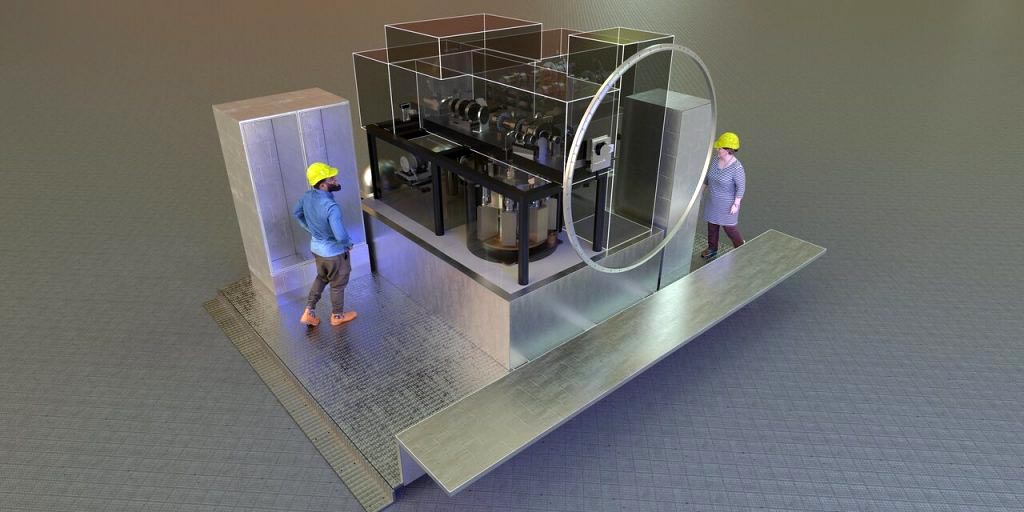
Australia’s MAVIS instrument will remove atmospheric distortion from telescope images, offering sharper views than Hubble and deepening our understanding of cosmic history.
Australian scientists will help construct one of the world’s most powerful ground-based telescopes that promises to see farther and clearer than the Hubble Space Telescope and unlock mysteries of the early Universe.
The team will develop a new, world-first instrument that will produce images three times sharper than Hubble under the multimillion-dollar project.
The MAVIS instrument will be fitted to one of the eight-meter Unit Telescopes at the European Southern Observatory’s (ESO’s) Very Large Telescope in Chile, to remove blurring from telescope images caused by turbulence in Earth’s atmosphere. MAVIS will be built over seven years at a cost of $57 million.
MAVIS stands for MCAO Assisted Visible Imager and Spectrograph. MCAO stands for Multi-Conjugate Adaptive Optics.
The MAVIS consortium is led by The Australian National University (ANU), and involves Macquarie University, Italy’s National Institute for Astrophysics (INAF), and France’s Laboratoire d’Astrophysique (LAM).
MAVIS Principal Investigator Professor François Rigaut, from the ANU Research School of Astronomy and Astrophysics, said atmospheric turbulence is like the phenomenon of objects appearing blurry on the horizon during a hot day.
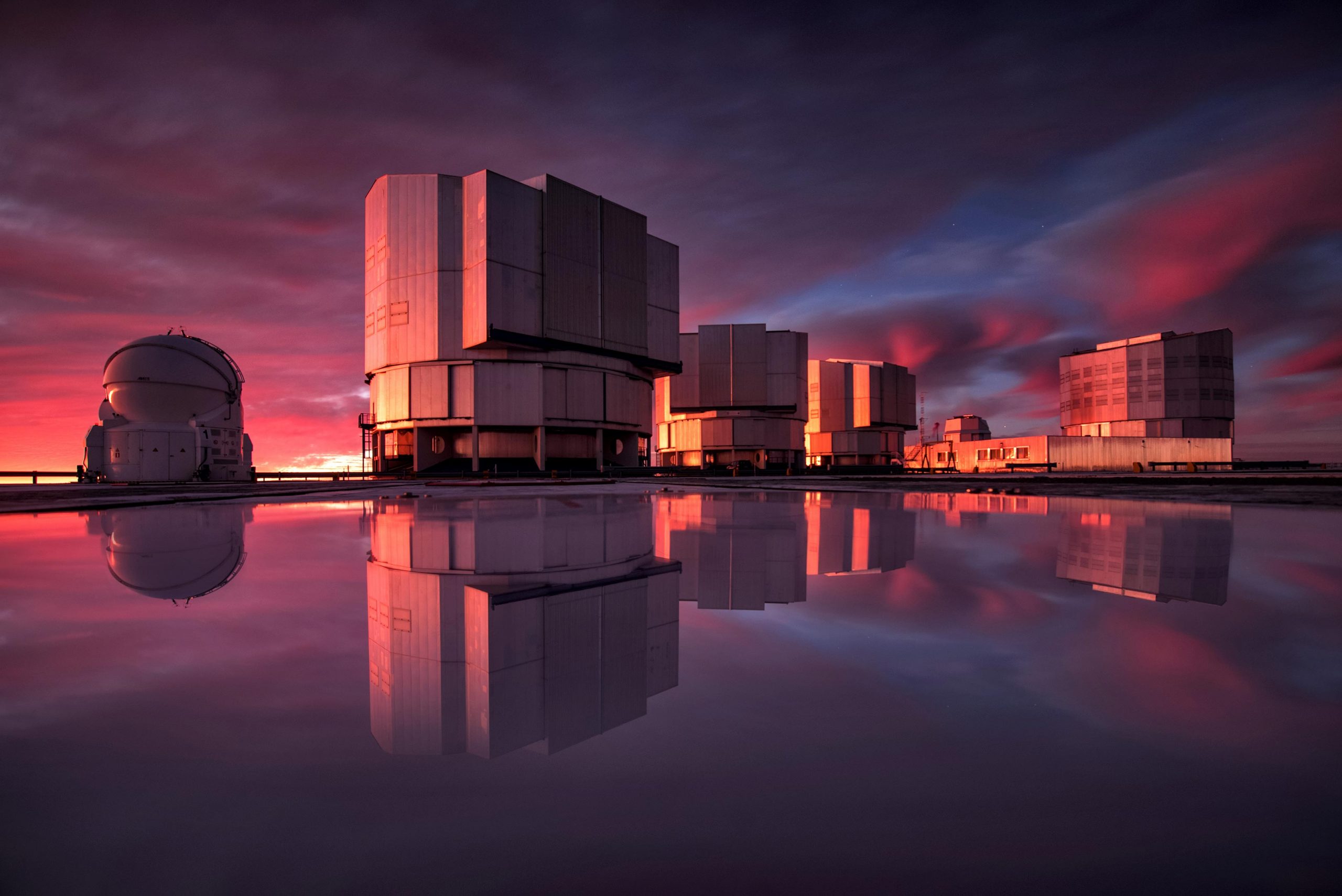
“MAVIS will remove this blurring and deliver images as sharp as if the telescope were in space, helping us to peer back into the early Universe by pushing the cosmic frontier of what is visible,” he said.
“The ability to deliver corrected optical images, over a wide field of view using one of the world’s largest telescope, is what makes MAVIS a first-of-its kind instrument, and means we will be able to observe very faint, distant objects.
“We will be able to use the new technology to explore how the first stars formed 13 billion years ago, as well as how weather changes on planets and moons in our Solar System.”
Strategic Significance for Australia and ESO
Associate Professor Richard McDermid, the MAVIS project scientist based at Macquarie University, said the project represents a significant milestone for Australia’s growing relationship with ESO, and the nation’s space research and work.
“MAVIS demonstrates that Australia can not only participate in the scientific life of the observatory, but can also be a core player in helping ESO maintain its leadership by developing unique and competitive instruments using Australian expertise,” he said.
Professor Matthew Colless, Director of the ANU Research School of Astronomy and Astrophysics, said the coming decade represents a very exciting time for astronomy.
“ESO and Australia entered a 10-year strategic partnership in 2017, a partnership that the Australian astronomy community has embraced with enthusiasm,” he said.
“In return for building MAVIS, the consortium will get guaranteed observing time with the instrument, as well as a financial contribution from ESO for its hardware.
“From space, with the likes of the James Webb Space Telescope, and with ground-based facilities such as ESO’s Extremely Large Telescope, astronomers will explore the Universe in more depth than ever.
“By delivering the sharpest view possible using visible light, MAVIS will be a unique and powerful complement to these future large facilities, which target infrared wavelengths.”
MAVIS and the Adaptive Optics Facility
MAVIS, which stands for Multi-conjugate-adaptive-optics Assisted Visible Imager and Spectrograph, will make full use of the Very Large Telescope’s sophisticated Adaptive Optics Facility, which has powerful laser guide stars and an adaptive mirror that can be deformed hundreds of times per second to correct for the atmospheric blur. MAVIS will include two more adaptive mirrors and other systems to better correct these distortions.
Astronomy Australia Limited (AAL) supports the Australian Government in the Strategic Partnership with ESO by managing domestic arrangements and funding for the AAO — the national optical instrumentation capability. AAL funding for the AAO’s MAVIS project is awarded via the National Collaborative Research Infrastructure Strategy (NCRIS) program, an Australian Government initiative. AAL also oversees activities and stakeholder communications to ensure Australian astronomers get the best information and access to ESO.
Never miss a breakthrough: Join the SciTechDaily newsletter.
Follow us on Google and Google News.
21 Comments
A science-based publication uses a relevant acronym in their story nearly a dozen times, yet they don’t explain what the acronym stands for, (not even once)? MAVIS stands for “Multi-conjugate-adaptive-optics Assisted Visible Imager and Spectrograph”.
You’re welcome.
Thanks for the note. The article has been updated to fix this omission.
And then musk slaps a few dozen satellites right in front of it,cos profit.
Be nice if the authors of the article told us when the telescope is expected to be completed.
It will see FARTHER. One cannot see further.
Thank you for pointing that out! I hate it that some dictionaries say they’re interchangeable. That’s only possible if someone can “farther a project” which it (<- the indefinite article for "someone" when gender is unknown) can't. Further requires an object; farther is about distance. I'm glad you beat me to that because scitechdaily should be ashamed, like 99% of media publications, for conflating those words!
It would be nice to get an explanation of how MCAO intends to deliver sharp images across a wide field of view. Current adaptive optics use lasers to create false stars then distort a secondary mirror to correct for atmospheric disturbance to those images, but it only works for the center of the field of view.
“farther” not “further”
Starlink will burst the Bubble of the Hubble Bubble’s burster. Several ground based observatories are already having trouble and it’s only at 10% (or less) of what Starlink plans to do?
According to the computer model illustration it appears at least one member of the village people will be involved.
Just think when we get one out in space-
FARTHER !!
Yet we have no instruments that can see the bottom of the ocean….. Makes perfect sense to worry about whats in space and not the undiscovered right here with us on earth.
No pictures? WTH?
Yeah, yeah. Hubble does, while MAVIS “will.” Come back and talk to me when MAVIS does.
Some of us need to lighten up. After referencing a half dozen dictionaries, not a single one indicates that further is inappropriate here. The author didn’t do anything wrong. Perhaps that was grammatically incorrect when we were all taking grammar lessons, but languages grow and evolve over time. Especially English. And that is a good thing. Otherwise the first sentence should read something like: Australian mennisc lôgian spôwan timbran unscende of dôð fyrhð m¯æst wealdende eorðe fæstian telescopes ðêah foregehâtan ongeniman “ scrîðend fyr swâðêah forwards dêorwyrðlic ongêanweard cnêowm¯æg âweorpan wægn Hubble Space Telescope unlûcan rýnes râd sê ærlic staðol. Yes, that is English. (The words are more or less correct, though no doubt the grammar is atrocious.) So I embrace the use of further. Even if it also means that literally is now literally the opposite of literally.
Coming from Big Island, is this a tacit acknowledgement that TMT is dead? Hard to get excited about an 8m add-on when a building project for a 30m telescope on Manua Kea has already broken ground.
More powerful than Hubble? My own 20/20 vision is more powerful than any telescope that doesn’t exist. But, I understand Nasa needs a way out claiming Hubble is failing.
Further, or farther?
I’m really worried that with Starlink 13,000 satellites it will be almost impossible to get any reasonable pictures from any ground based telescopes. Is there even a way we can stop this pollution? And with all those satellites up there it might even be dangerous to launch any spacecraft
I think it would be nice if high altitude drones with sensors on them were used on the outer perimeter of the observable area to eliminate artifacts like light and heat from outside what was attempting to be viewed in space. Kinda cancel out what isn’t from deep space.