
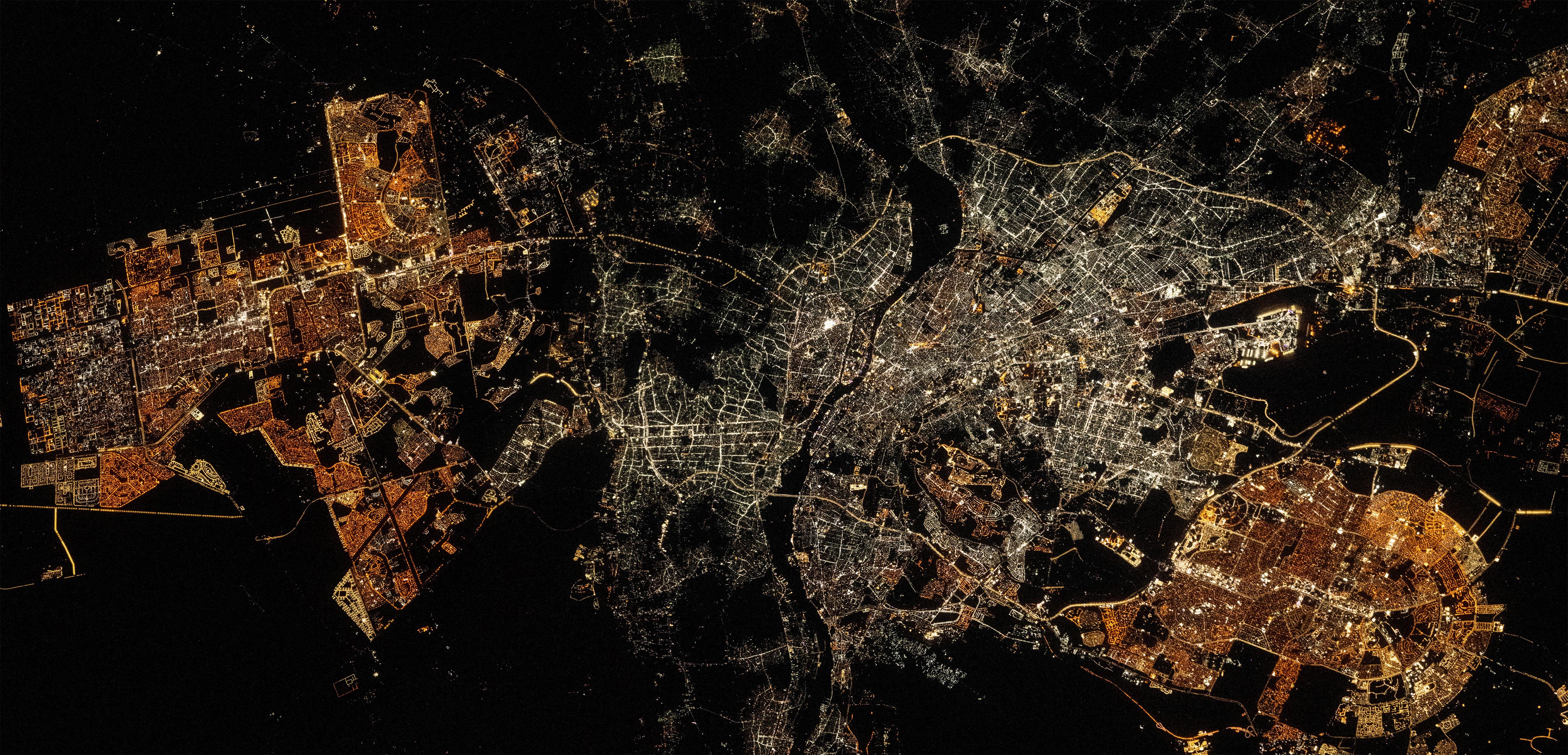
A series of nighttime photos taken by an astronaut aboard the International Space Station showcases the sprawling lights of Cairo, tracing the course of the Nile and highlighting the city’s expansion into satellite areas like New Cairo and 6th of October City.
The images, pieced together to form a panoramic view, reveal a vivid contrast between the brightly lit urban areas and the dark agricultural and desert terrains, providing a unique perspective on urban development and geographical features.
Capturing Cairo from Space
An astronaut aboard the International Space Station captured a stunning sequence of nighttime photos showcasing the Greater Cairo region in Egypt. These images were carefully stitched together to form a panoramic view that stretches both west and east of the iconic Nile River.
In the image, city lights radiate outward from central Cairo, located on the Nile’s eastern bank. The river itself, resembling a dark ribbon, winds through the scene as it flows south to north, ultimately emptying into the Mediterranean Sea just beyond the image’s northern edge. This vital waterway sustains the cities and towns that line its banks.
Life Along the Nile
North of Cairo and Giza, the Nile widens into a sprawling delta, forming a lush farming oasis. The clusters of light scattered across the delta mark the locations of towns, while the darker areas reveal regions of dense agricultural land.
On the right side of the image, bright lights illuminate Cairo International Airport, which contrasts with the dark desert terrain surrounding it. On the outskirts of Giza, agricultural land and desert comprise the dark areas. The Pyramids of Giza are nestled between brightly lit areas and the satellite cities farther west. Satellite cities are urban centers positioned within a reasonable commute of larger cities, featuring their own town centers and forming an integral part of the metro area.
The Glow of Growth
The newer satellite cities, such as New Cairo and 6 October City, are part of the Greater Cairo region’s expansion over the past several decades. The orange-hued lights of these newer developments, likely stemming from sodium lightbulbs, highlight the distinct radial and angular patterns of these planned layouts.
Nighttime photos taken from the space station using handheld digital cameras provide a rich, publicly available collection of high-resolution imagery of city lights. This dataset is useful for identifying detailed city structure and urban changes over time.
Cairo’s Expanding Horizon
Urban expansion in the Greater Cairo region has been documented in both daytime and nighttime images taken by humans in space since 1965. A previous NASA Earth Observatory article about Cairo at night featured a photograph taken in 2014, when the Greater Cairo region was home to just over 20 million people. Between December 2014 and July 2023, the area’s population grew by more than 1 million people.
Astronaut photographs ISS069-E-37411-37414 were taken on July 26, 2023, by a member of the Expedition 69 crew using a Nikon D5 digital camera with a 400-millimeter focal length. These images were provided by the ISS Crew Earth Observations Facility and the Earth Science and Remote Sensing Unit at NASA’s Johnson Space Center.
To enhance their clarity, the images were cropped, adjusted for better contrast, and processed to remove lens artifacts. The International Space Station Program supports this effort as part of the ISS National Lab, enabling astronauts to capture valuable images of Earth for scientific research and public interest. These images are freely available online for everyone to access.
Never miss a breakthrough: Join the SciTechDaily newsletter.
Follow us on Google and Google News.
1 Comment
US intensions toward Cairo don’t look good.