

Cambridge scientists have uncovered a hidden quantum mechanism in an organic semiconductor that could revolutionize solar energy.
In a finding that connects modern research with ideas from a century ago, scientists have identified in an organic semiconductor a behavior that was long believed to occur only in inorganic metal oxides. The team led by the University of Cambridge reports a previously unrecognized way to convert light into electrical energy. This advance could reshape solar power and electronics by enabling lighter, cheaper, and simpler solar panels built from a single material.
The research centers on a spin-radical organic semiconductor called P3TTM. A single unpaired electron sits at its core and gives the molecule distinctive magnetic and electronic properties. The project combines the synthetic chemistry group of Professor Hugo Bronstein in the Yusuf Hamied Department of Chemistry with the semiconductor physics group led by Professor Sir Richard Friend in the Department of Physics.
They have developed this class of molecules to give very efficient luminescence, as exploited in organic LEDs, but the new study, published in Nature Materials, reveals their hidden talent: when brought into close contact, their unpaired electrons interact in a manner strikingly similar to a Mott-Hubbard insulator.
Quantum Interactions at Work
“This is the real magic,” explained Biwen Li, the lead researcher at the Cavendish Laboratory. “In most organic materials, electrons are paired up and don’t interact with their neighbors. But in our system, when the molecules pack together, the interaction between the unpaired electrons on neighboring sites encourages them to align themselves alternately up and down, a hallmark of Mott-Hubbard behavior. Upon absorbing light, one of these electrons hops onto its nearest neighbor, creating positive and negative charges which can be extracted to give a photocurrent (electricity).”
The team demonstrated this by creating a solar cell from a P3TTM film. When light hit the device, it achieved a remarkable close-to-unity charge collection efficiency, meaning almost every photon of light was converted into a usable electrical charge. In conventional molecular semiconductor solar cells, the conversion of an absorbed photon into electrons and holes (electricity) can only happen at the interface between two different materials where one acts an electron donor and the other as an electron acceptor, and this compromises overall efficiency.
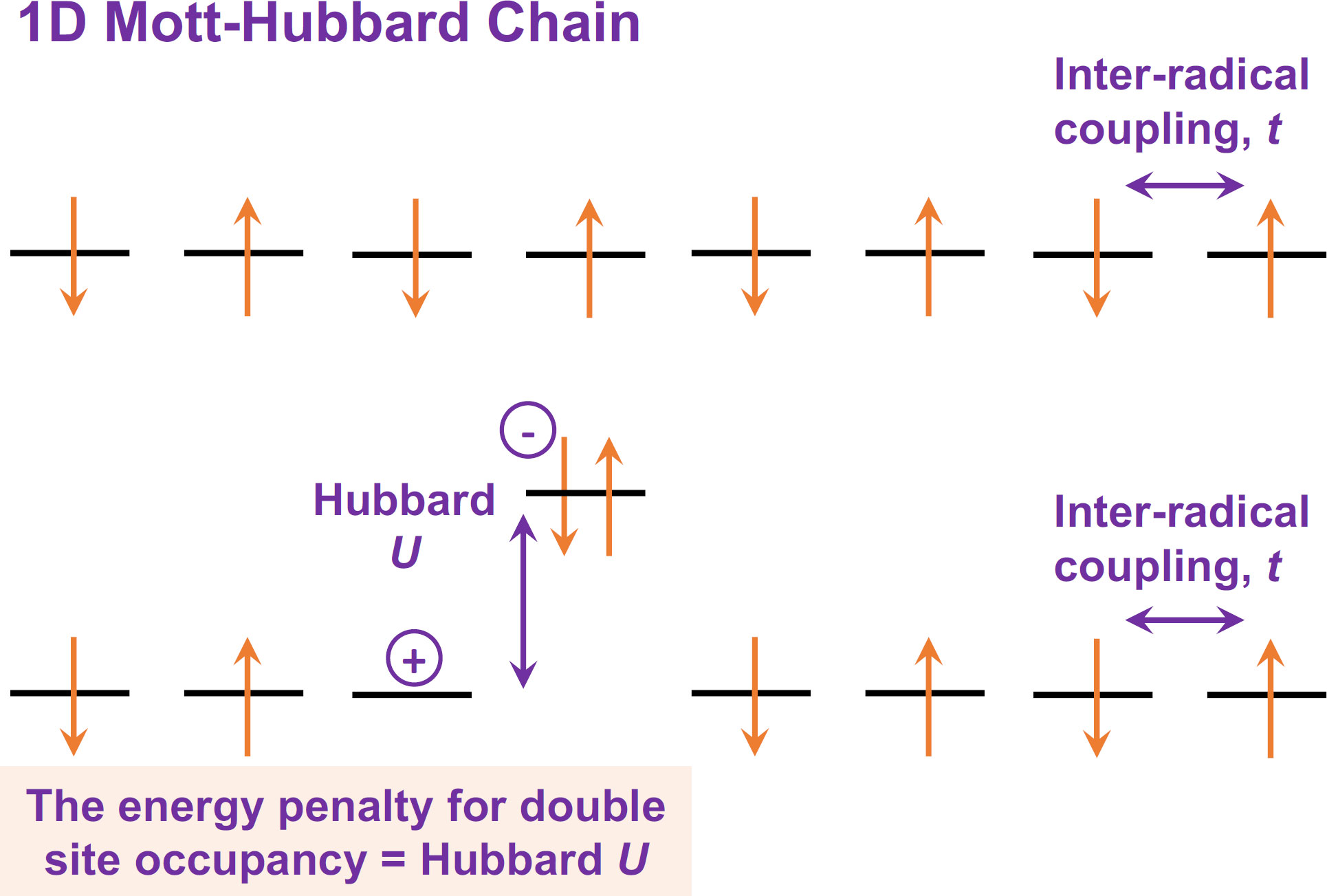
In contrast, for these new materials, after a photon is absorbed, it is energetically “downhill” to move an electron from one molecule to an identical neighboring molecule, thus creating electrical charges. The energy required for this, often termed the “Hubbard U” is the electrostatic charging energy for double electron occupancy of the molecule that has become negatively charged.
Designing Molecules for Efficiency
Dr Petri Murto in the Yusuf Hamied Department of Chemistry developed molecular structures that allow tuning of the molecule-to-molecule contact and the energy balance governed by Mott-Hubbard physics needed to achieve charge separation. This breakthrough means that it might be possible to fabricate solar cells from a single, low-cost, lightweight material.
The discovery carries profound historical significance. The paper’s senior author, Professor Sir Richard Friend, interacted with Sir Nevill Mott early in his career. This finding emerges in the same year as the 120th anniversary of Mott’s birth, paying a fitting tribute to the legendary physicist whose work on electron interactions in disordered systems laid the groundwork for modern condensed matter physics.
“It feels like coming full circle,” said Prof. Friend. “Mott’s insights were foundational for my own career and for our understanding of semiconductors. To now see these profound quantum mechanical rules manifesting in a completely new class of organic materials, and to harness them for light harvesting, is truly special.”
“We are not just improving old designs,” said Prof. Bronstein. “We are writing a new chapter in the textbook, showing that organic materials are able to generate charges all by themselves.”
Reference: “Intrinsic intermolecular photoinduced charge separation in organic radical semiconductors” by Biwen Li, Petri Murto, Rituparno Chowdhury, Laura Brown, Yutong Han, Giacomo Londi, David Beljonne, Hugo Bronstein and Richard H. Friend, 30 September 2025, Nature Materials.
DOI: 10.1038/s41563-025-02362-z
Funding: European Research Council
Never miss a breakthrough: Join the SciTechDaily newsletter.
Follow us on Google and Google News.
5 Comments
I suggest,
iso-Ferrosilicate or
Copper bi-Phosphate.
Right?
Well did they just not “hear” YOUR reply or was it something in YOUR suggested materials for use?
Interested simply because your background knowledge appears to support your complete or better understanding than I and that is not “just” because YOUR suggestion sounds “Greek” to me – so unless I “look up” and get those words defined for my somewhat & simple “ape” brain – can ya run that by me one time- if you mind, as this level of “smallness” is completely intriguing & awe inspiring (tho not or never enough to label or call it a “GOD particle” – as if our GOD can be stuck at just ONE particle atom or scale is quite, wheel blasphemous to say the least, CERN)
Sorry, just to get that off my chest – but with all of the satanic rituals one can see why I slammed them.
Anyway, ok back to SUNLIGHT & how to make “thee SUPA” efficient solar plate or piece as I don’t think this new pathway allows for it to be called or referred to as a “panel”?
Your thoughts???
They are writing a new chapter in the textbook, showing that organic materials are able to generate charges all by themselves.
wery good!
Based on the Topological Vortex Theory (TVT), space is an incompressible physical entity, and space-time vortices are the products of topological phase transitions at critical points in space. They create all things and shape the world through spin and self-organization.
In today’s physics, some so-called peer-reviewed journals—including Physical Review Letters, Nature, Science, and others—stubbornly insist on and promote the following:
1. Even though θ and τ particles exhibit differences in experiments, physics can claim they are the same particle. This is science.
2. Even though topological vortices and antivortices have identical structures and opposite rotational directions, physics can define their structures and directions as entirely different. This is science.
3. Even though two sets of cobalt-60 rotate in opposite directions and experiments reveal asymmetry, physics can still define them as mirror images of each other. This is science.
4. Even though vortex structures are ubiquitous—from cosmic accretion disks to particle spins—physics must insist that vortex structures do not exist and require verification. Only the particles that like God, Demonic, or Angelic are the most fundamental structures of the universe. This is science.
5. Even though everything occupies space and maintains its existence in time, physics must still debate and insist on whether space exists and whether time is a figment of the human mind. This is science.
6. Even though space, with its non-stick, incompressible, and isotropic characteristics, provides a solid foundation for the development of physics, physics must still insist that the ideal fluid properties of space do not exist. This is science.
and go on.
Is this the counterintuitive science they widely promote? What are the shames? Contemporary physics and so-called peer-reviewed publications (including Physical Review Letters, Science, Nature, etc.) stubbornly believe that two sets of counter rotating cobalt-60 are two mirror images of each other, constructing a more shocking pseudoscientific theoretical framework in the history of science than the “geocentric model”. This pseudo scientific framework and system have seriously hindered scientific progress and social development.
For nearly a century, physics has been manipulated by this pseudo scientific theoretical system and the interest groups behind it, wasting a lot of manpower, funds, and time. A large amount of pseudo scientific research has been conducted, and countless pseudo scientific papers have been published, causing serious negative impacts on scientific and social progress, as well as humanistic development.
Fortunately, not every member of the public is gullible. Topology is reconfiguring the cognitive framework of modern civilization. With the gradual refinement of artificial intelligence (AI), we are no longer entirely reliant on mediated deception by some so-called peer-reviewed publications (including Physical Review Letters, Science, Nature, etc.). We now possess the means to leverage AI’s efficiency to enhance scientific rigor and productivity.
Ok so other then being at odds with the mathematical models of science & theoretical or otherwise, your statement helps the efficiency of or for human personal energy generation via OUR Sun in what way?
So I now assume, that your follow up statement will is going to be much more “productive” or let’s say “helpful. Correct? Jes? Noooo?? Maype so…..
(BE careful now what you say, that GOD an lessers you spoke of are watching!)
using stones with a lighted pattern to have the pattern ionize in said pattern would work with a LED. using sunlight would change said pattern as it is always adapting. If you had a light or said fusion of light as the sun in an encaseing you could utilize accordingly. fusion of the sun is easily stablizewd if you use properties of iodine pressurized as long as there is a substantial heat source with it. So to pressurize an LED with said iodine you could find the pattern used as the cut stone used as the base and have inexpensive electricity