
An analysis of observational data and a large climate model finds Earth’s 11-year cycle is out of sync with solar fluctuations.
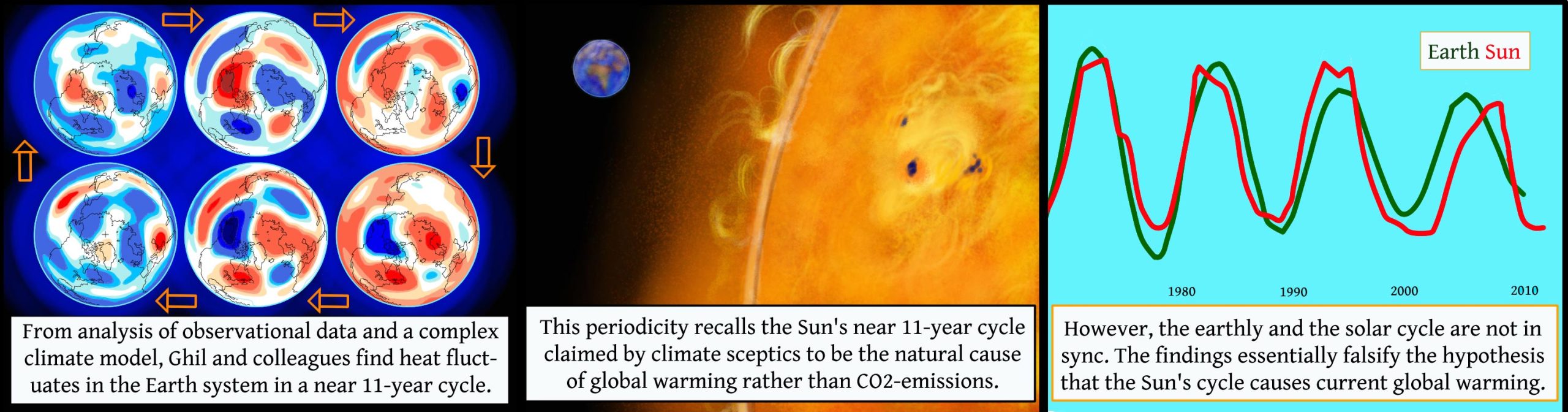
The Earth’s global climate system fluctuates in 11-year and 3.5-year cycles, according to Yizhak Feliks, Justin Small, and Michael Ghil. The study was published in Climate Dynamics on July 15th. The 11-year near-periodicity recalls that of the solar cycle, which climate-skeptics for decades have argued plays a major role in global warming. But the fluctuations between the Earth’s climate system and the sun are out of sync, the study finds. The work, which is part of the European TiPES project coordinated from the University of Copenhagen thus refutes the climate skeptics’ claim of major solar effects on recent climate evolution.
A Search for Climate Tipping
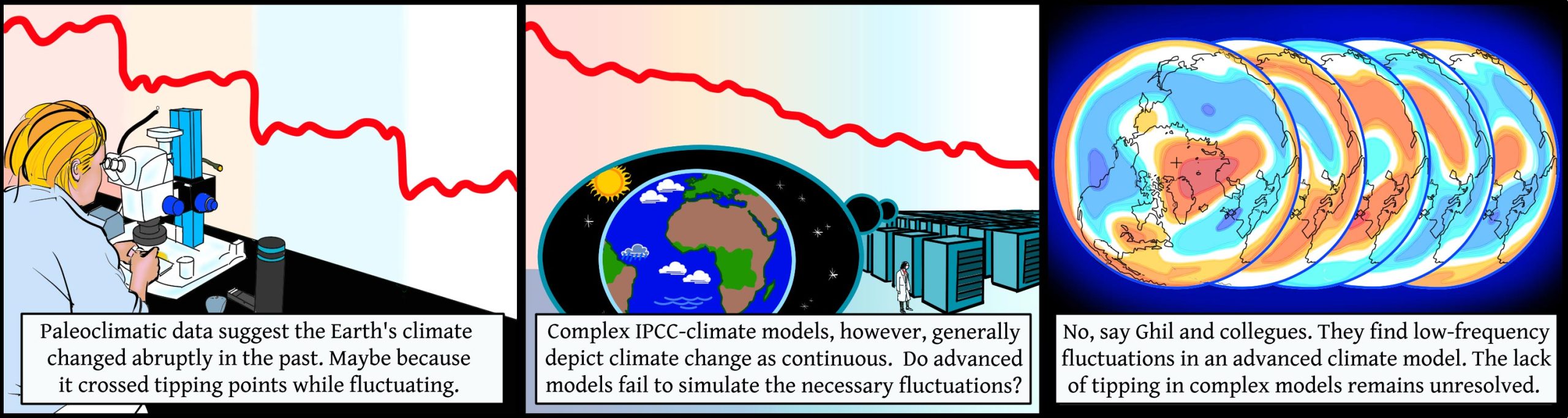
The main goal of the study was to address the debate about whether large and complex climate models can warn us about climate tipping. Climate tipping might have taken place in past climates. But current large state-of-the-art IPCC climate models seem to not capture intrinsic low-frequency fluctuations which lead to climate tipping. If correct, our models might not be able to predict upcoming tipping in the climate system due to the current global warming.
To search for low-frequency fluctuations, multichannel singular spectrum analysis was used. This method makes it possible to identify signals in noisy environments – like picking out and isolating the sound of a single musical instrument from a large symphonic orchestra.
Two Frequencies
The analysis of two large observational data sets and an advanced state-of-the-art climate model, CESM showed that large climate models are capable of capturing low-frequency oscillations. The model agrees with observations in simulating the Earth’s two distinct low-frequency modes: One with a period of approximately 11 years, and another one lasting around 3,5 years.
This result, therefore, makes it less likely that the lack of climate tipping in complex climate models should be explained by the absence of low-frequency oscillations.
“It’s great to find a decadal cycle in an IPCC-class model like CESM. The failure so far of finding intrinsic decadal variability in the high-end IPCC climate models cast doubts on their reliability. Our work with Yizhak Feliks and Justin Small indicates that these doubts are on their way to being resolved,” says Michael Ghil, Ecole Normale Supérieure, Paris, France and UCLA, Los Angeles, USA.
Curves Do Not Fit
The finding of the controversial near 11-year cycle prompted comparison between the cycles of the climate system and the Sun which climate sceptics have long argued can explain global warming.
The near 11-year cycles found in the large climate model and the two observational data sets in this study, however, are clearly out of sync with the Sun. The curves don’t fit. As such, the present study indicates the Sun’s fluctuations play little if any role in the current global warming.
“Solar-cycle effects on climate in general and global warming, in particular, have generated literally hundreds of articles in the scientific literature. No single paper, whether pro or con, will settle the debate for good. But our paper brings both a new point of view, from the synchronization theory of chaotic oscillators, and a possible resolution: Yes, there is a decadal climate cycle,” says Michael Ghil.
“But it is intrinsic to the climate system and out of sync with the actual solar cycle. This lack of synchronicity argues quite vigorously for the physical effects of the solar cycle on climate being quite weak, and thus of no real consequence for global warming,” states Ghil.
Reference: “Global oscillatory modes in high-end climate modeling and reanalyses” by Yizhak Feliks, Justin Small and Michael Ghil, 15 July 2021, Climate Dynamics.
DOI: 10.1007/s00382-021-05872-z
The TiPES project is an EU Horizon 2020 interdisciplinary climate science project on tipping points in the Earth system. 18 partner institutions work together in more than 10 countries. TiPES is coordinated and led by The Niels Bohr Institute at the University of Copenhagen, Denmark and the Potsdam Institute for Climate Impact Research, Germany. The TiPES project has received funding from the European Horizon 2020 research and innovation program, grant agreement number 820970.
Never miss a breakthrough: Join the SciTechDaily newsletter.
Follow us on Google and Google News.
23 Comments
Um…you didn’t prove anything did you? fewkin losers.
Science doesn’t “prove” anything. Science works by testing whether a hypothesis is false. Every hypothesis in science must be falsifiable – ie. when stating the hypothesis, you must provide conditions, which if observed, would render the hypothesis false.
In this case, the hypothesis tested was that solar cycles can explain the observed changes in the climate. The falsification clause states that if the observations do not sync with the solar cycles, the hypothesis is false.
The study showed that while there is an 11 year cycle in the observations, there is no correlation to the solar cycle. Thus, they exposed that the hypothesis fails the falsification test.
“The 11-year near-periodicity recalls that of the solar cycle, which climate-skeptics for decades have argued plays a major role in global warming.”
This is a strawman argument. Few if any skeptics actually claim Earth temperatures are so closely coupled to sun spots that temperatures follow the sun spots in lock step. What is of greater interest is the curve fitted to the peak amplitudes of the sun spots for the last couple of hundred years.
We know the spectral composition of the light from the sun varies with the sun spot cycle, providing more UV near the peaks. While they mention that UV might impact the troposphere, they don’t mention its variation.
In reading the actual article, all the measurements are relatively low precision, with 2 or 3 significant figures. Nowhere is there even a mention, let alone discussion, of the uncertainties associated with the measurements and how they might propagate both through the models and in the data analysis of the observational data sets.
It is interesting that they found a nominal 11-year period, although they can’t explain it. I think that they are too quick to dismiss it as not being related because there are many things that affect weather, and can cause the phase relationship to vary over time.
One of the falsification criteria for the hypothesis is that the response curve of the Earth cannot be earlier than the stimulation curve of the sun (ie. there can be no cause without effect). If you read the paper, you’d find that in some cases the earth response followed the sun stimulus, in other cases, it preceded the stimulus. That means, the response had nothing to do with that stimulus.
Your statement would be true if one were dealing with a simple, closely coupled system of a dependent and independent variable with high accuracy. However, weather and climate are very complex systems with numerous feedback loops. There are huge quantities of heat in the ocean.
Secondly, as I remarked initially, the authors and you assume that the numbers in the graph are exact, when they actually have unstated uncertainties. The apparent shift between cause and effect could be the result of those uncertainties. They don’t explore that possibility, and you accept the graph at face value. Let that sink in for several minutes.
“Over the duration of each reanalysis product, the changing observation mix can produce artificial variability and spurious trends. Still, the various reanalysis products have proven to be quite useful when used with appropriate care.”
https://climatedataguide.ucar.edu/climate-data/atmospheric-reanalysis-overview-comparison-tables
I would say it’s possible that global warming isn’t due to ghg from human activity but from a Bayesian analysis that doesn’t seem tenable, much less so from a response consideration.
Care to explain why? What would be the parameters in such an analysis? Or are you just stringing intelligent sounding words together?
I’m still trying to work out what “3,5” years means. Does anybody ever edit these articles before publishing them?
Europeans use a comma instead of a period for a decimal point.
What they don’t take into account is dark matter circulation in the solar system with respect to the solar systems geocenter and the position of the earth relative to the geocenter.
For the same reason that don’t take dark matter in to account when launching deep space probes. The density of dark matter in the solar system is too small to affect anything.
The effects of dark matter only become measurable at galactic scales.
Wait how about the very high correlation to which league wins the world series? Let’s just settle with the plain truth – climate change is the greatest threat to humanity in history, it is accelerating and it has been directly caused by humanity’s total lack of any understanding of sustainability and the hugely subsidized use of fossil fuels for a century.
“… climate change is the greatest threat to humanity in history,…”
You consider a warming of less than 2 deg per century (where about 1/2 is natural), where we are approaching the salubrious warmth of the Medieval and Roman warm periods, to be a greater existential threat than the Black Death, which killed 30-60% of the people in Europe? What might the consequences be if another volcano of the violence of Tambora, Krakatoa, or Yellowstone were to erupt today, reducing crop yields significantly for two or three years? In the case of Yellowstone, it would bury the corn belt of the US!
Either you are unacquainted with history, or have strange definitions for what constitutes a “greatest threat.”
The “salubrious climes” did bring us the black death, didn’t it? So the spectre of tropical diseases crawling north doesn’t concern you? Massive crop failures in the tropics resulting in famines and mass migration don’t concern you?
During those “salubrious climes” there were about 380 million people on Earth, and nearly 75 million people perished from the plague alone (almost 1/3 of the population of Europe was wiped out during the “salubrious climes”).
Today, there are 20 times more people on Earth. 20 times more mouths to feed. 20 times more people to prevent from dying from pandemics. Let that sink in. Oh, and who said the climate change will stop at your “salubrious climes”? What happens when the average global temperature climbs even higher?
Let that sink in for a second.
“The ‘salubrious climes’ did bring us the black death, didn’t it?”
No. The Black Death occurred at the trailing edge of the Medieval Warm Period and leading edge of the Little Ice Age. That is, it had been cooling for about 150 years. In other words, it was a transition period where there were crop failures because of frosts earlier than they were used to. Their nutrition was probably reduced from the restricted and possibly changing diet.
Let that sink in for a second.
Waiting for a major volcanic eruption to spew copious quantities of ash into the atmosphere which will generate a summer of winter. That should cool things down a bit.
We would need to have a Tombora eruption every 5 years… And if it ever stops, we will wake up to scorching winters.
Science proves and or disproves almost everything. If one includes the general ideal of the thumbal theory. Which loosely states unproven/undiscovered information may alter, change, disprove, confirm etc all scientific Discovery’s. 😁
I believe Ben Davidson would eat this for lunch!
There are many cycles that may effect our weather to take into effect as this article points out. It also points out that none are absolutely proven that they solely are the cause of global warming. I absolutely believe that we are all stewards of this world and need to be nurturing it instead of damaging it as we have been. But there are still and always will be cycles to our weather.
http://agron-www.agron.iastate.edu/courses/Agron541/classes/541/lesson10b/10b.4.html
How does observational science justify a “refutation” of a theory when the refutation does not identify all material factors affecting climate, their variation over the solar cycle and whether those material factors put upward or downward pressure on temperature?
Climate changes, primarily as some years are drier, while others are wetter than the average or somewhere in the middle. There are known signals at 11 yrs and 3-5 yrs? All things weather often involve a little lag to help dismiss the inconsistency apparent to disassociation, such as a hurricane in November with the “warm water to cool” lag. We have el Nino or la Nina to help us keep track of the drier part, but not necessarily the warmer or cooler part, which varies everywhere for either.
We are in a three-peat la Nina, no big deal right? No, it is as it’s been drier now for a third coming winter (rainy season) and already barges cannot navigate down the Mississippi River, which has happened before. Guess when? Three-peat la Nina’s. Turns out that the sun has a 22 year magnetic cycle: 11yrs north polarity and 11yrs south.
The decadal data of SST, which defines the oscillation beginning in 1950 supports such occurrences around ’55, ’77, ’99 and ’21, or every other (odd) solar cycle start-up. The sun’s strength in the magnetic cycle drives production of solar flares which, get this, ramps up for around 3-5 years and then back down with some time spent at a maximum and also time near zero in the 11 year cycle. Are there more spots (warming) in one polarity versus the other, perhaps and there may be some times we see cooling within the 22 year cycle. It is complex due to the lag among other known factors, but this robust correlation for three-peats and the fact that we are headed into another grand solar minimum all have a role in extremes we see in the temperature record.
Extremes that are barely broken today, were established long long ago, before our huge carbon foot print came alongside to potentially sink our ship. It’s all about the sun, which is 99.8% of the mass in our solar system. It’s not rocket science, just observations in what we know; you are welcome.
Captain, the fog is lifting off the sea and we can see the horizon, but the swells remain. Actual weather occurring at this writing…