
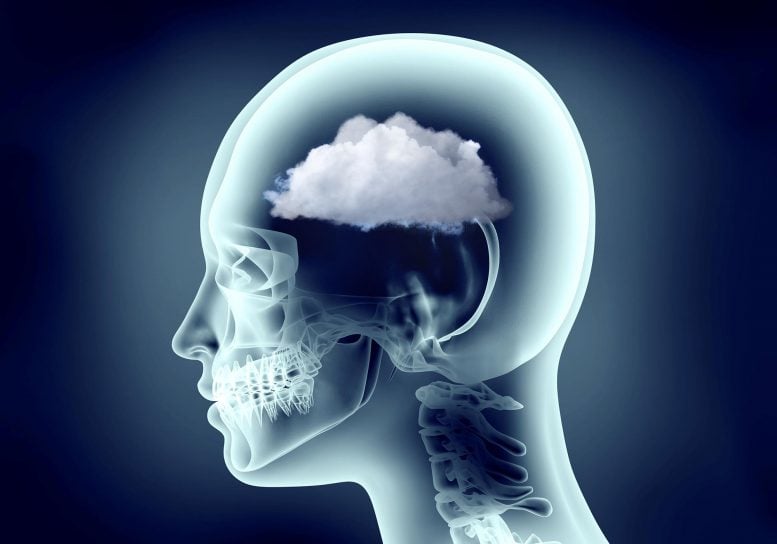
A unique collaboration among experts from several areas within MSK leads to findings about how inflammation appears to be driving the neurologic effects seen in some COVID-19 patients.
One of the dozens of unusual symptoms that have emerged in COVID-19 patients is a condition that’s informally called “COVID brain” or “brain fog.” It’s characterized by confusion, headaches, and loss of short-term memory. In severe cases, it can lead to psychosis and even seizures. It usually emerges weeks after someone first becomes sick with COVID-19.
In the February 8, 2021, issue of the journal Cancer Cell, a multidisciplinary team from Memorial Sloan Kettering reports an underlying cause of COVID brain: the presence of inflammatory molecules in the liquid surrounding the brain and spinal cord (called the cerebrospinal fluid). The findings suggest that anti-inflammatory drugs, such as steroids, may be useful for treating the condition, but more research is needed.
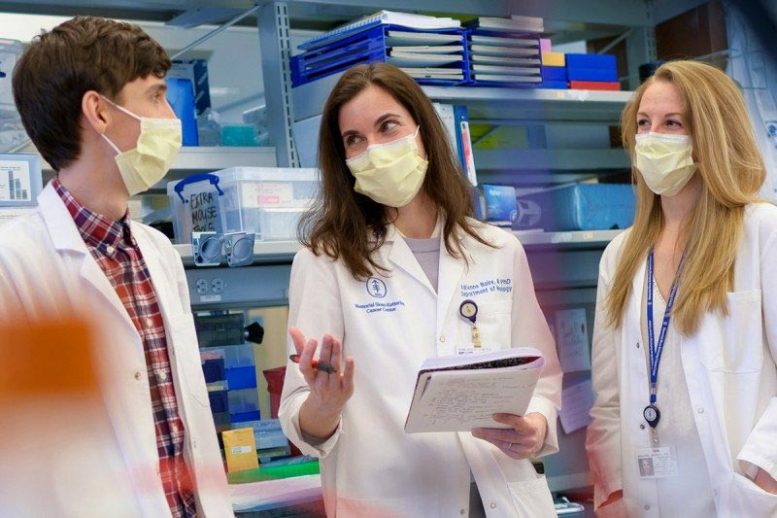
“We were initially approached by our colleagues in critical care medicine who had observed severe delirium in many patients who were hospitalized with COVID-19,” says Jessica Wilcox, the Chief Fellow in neuro-oncology at MSK and one of the first authors of the new study. “That meeting turned into a tremendous collaboration between neurology, critical care, microbiology, and neuroradiology to learn what was going on and to see how we could better help our patients.”
Recognizing a Familiar Symptom
The medical term for COVID brain is encephalopathy. Members of MSK’s Department of Neurology felt well-poised to study it, Dr. Wilcox says, because they are already used to treating the condition in other systemic inflammatory syndromes. It is a side effect in patients who are receiving a type of immunotherapy called chimeric antibody receptor (CAR) T cell therapy, a treatment for blood cancer. When CAR T cell therapy is given, it causes immune cells to release molecules called cytokines, which help the body to kill the cancer. But cytokines can seep into the area around the brain and cause inflammation.
When the MSK team first began studying COVID brain, though, they didn’t know that cytokines were the cause. They first suspected that the virus itself was having an effect on the brain. The study in the Cancer Cell paper focused on 18 patients who were hospitalized at MSK with COVID-19 and were experiencing severe neurologic problems. The patients were given a full neurology workup, including brain scans like MRIs and CTs and electroencephalogram (EEG) monitoring, to try to find the cause of their delirium. When nothing was found in the scans that would explain their condition, the researchers thought the answer might lie in the cerebrospinal fluid.
MSK’s microbiology team devised a test to detect the COVID-19 virus in the fluid. Thirteen of the 18 patients had spinal taps to look for the virus, but it was not found. At that point, the rest of the fluid was taken to the lab of MSK physician-scientist Adrienne Boire for further study.
Using Science to Ask Clinical Questions
Jan Remsik, a research fellow in Dr. Boire’s lab in the Human Oncology and Pathogenesis Program and the paper’s other first author, led the analysis of the fluid. “We found that these patients had persistent inflammation and high levels of cytokines in their cerebrospinal fluid, which explained the symptoms they were having,” Dr. Remsik says. He adds that some smaller case studies with only a few patients had reported similar findings, but this study is the largest one so far to look at this effect.
“We used to think that the nervous system was an immune-privileged organ, meaning that it didn’t have any kind of relationship at all with the immune system,” Dr. Boire says. “But the more we look, the more we find connections between the two.” One focus of Dr. Boire’s lab is studying how immune cells are able to cross the blood-brain barrier and enter this space, an area of research that’s also important for learning how cancer cells are able to spread from other parts of the body to the brain.
“One thing that was really unique about Jan’s approach is that he was able to do a really broad molecular screen to learn what was going on,” Dr. Boire adds. “He took the tools that we use in cancer biology and applied them to COVID-19.”
The inflammatory markers found in the COVID-19 patients were similar, but not identical, to those seen in people who have received CAR T cell therapy. And as with CAR T cell therapy, the neurologic effects are sometimes delayed. The initial inflammatory response with CAR T cell treatment is very similar to the reaction called cytokine storm that’s often reported in people with COVID-19, Dr. Wilcox explains. With both COVID-19 and CAR T cell therapy, the neurologic effects come days or weeks later. In CAR T cell patients, neurologic symptoms are treated with steroids, but doctors don’t yet know the role of anti-inflammatory treatments for people with neurologic symptoms of COVID-19. “Many of them are already getting steroids, and it’s possible they may be benefitting,” Dr. Wilcox says.
“This kind of research speaks to the cooperation across the departments at MSK and the interdisciplinary work that we’re able to do,” Dr. Boire concludes. “We saw people getting sick, and we were able to use our observations to ask big clinical questions and then take these questions into the lab to answer them.”
Reference: “Inflammatory Leptomeningeal Cytokines Mediate COVID-19 Neurologic Symptoms in Cancer Patients” by Jan Remsik, Jessica A. Wilcox, N. Esther Babady, Tracy A. McMillen, Behroze A. Vachha, Neil A. Halpern, Vikram Dhawan, Marc Rosenblum, Christine A. Iacobuzio-Donahue, Edward K. Avila, Bianca Santomasso and Adrienne Boire, 16 January 2021, Cancer Cell.
DOI: 10.1016/j.ccell.2021.01.007
Dr. Boire is an inventor on a patent related to modulating the permeability of the blood-brain barrier and is an unpaid member of the scientific advisory board of EVREN Technologies.
This work was funded by National Institutes of Health grant P30 CA008748, the Pew Charitable Trusts, the Damon Runyon Cancer Research Foundation, and the Pershing Square Sohn Cancer Research Alliance GC239280. It was also supported by the American Brain Tumor Association Basic Research Fellowship, the Terri Brodeur Breast Cancer Foundation Fellowship, and the Druckenmiller Center for Lung Cancer Research.
Never miss a breakthrough: Join the SciTechDaily newsletter.
Follow us on Google and Google News.