
Close Menu
    Facebook X (Twitter) Instagram
    SciTechDaily
    • Biology
    • Chemistry
    • Earth
    • Health
    • Physics
    • Science
    • Space
    • Technology
    Facebook X (Twitter) Pinterest YouTube RSS
    SciTechDaily
    Home»Space»Cassini Spots a Bright Feature in Titan’s Largest Sea, Kraken Mare
    Space

    Cassini Spots a Bright Feature in Titan’s Largest Sea, Kraken Mare

    By Preston Dyches, Jet Propulsion LaboratoryNovember 11, 2014No Comments3 Mins Read
    Facebook Twitter Pinterest Telegram LinkedIn WhatsApp Email Reddit
    Share
    Facebook Twitter LinkedIn Pinterest Telegram Email Reddit
    Cassini Observes New Features in the Seas of Titan
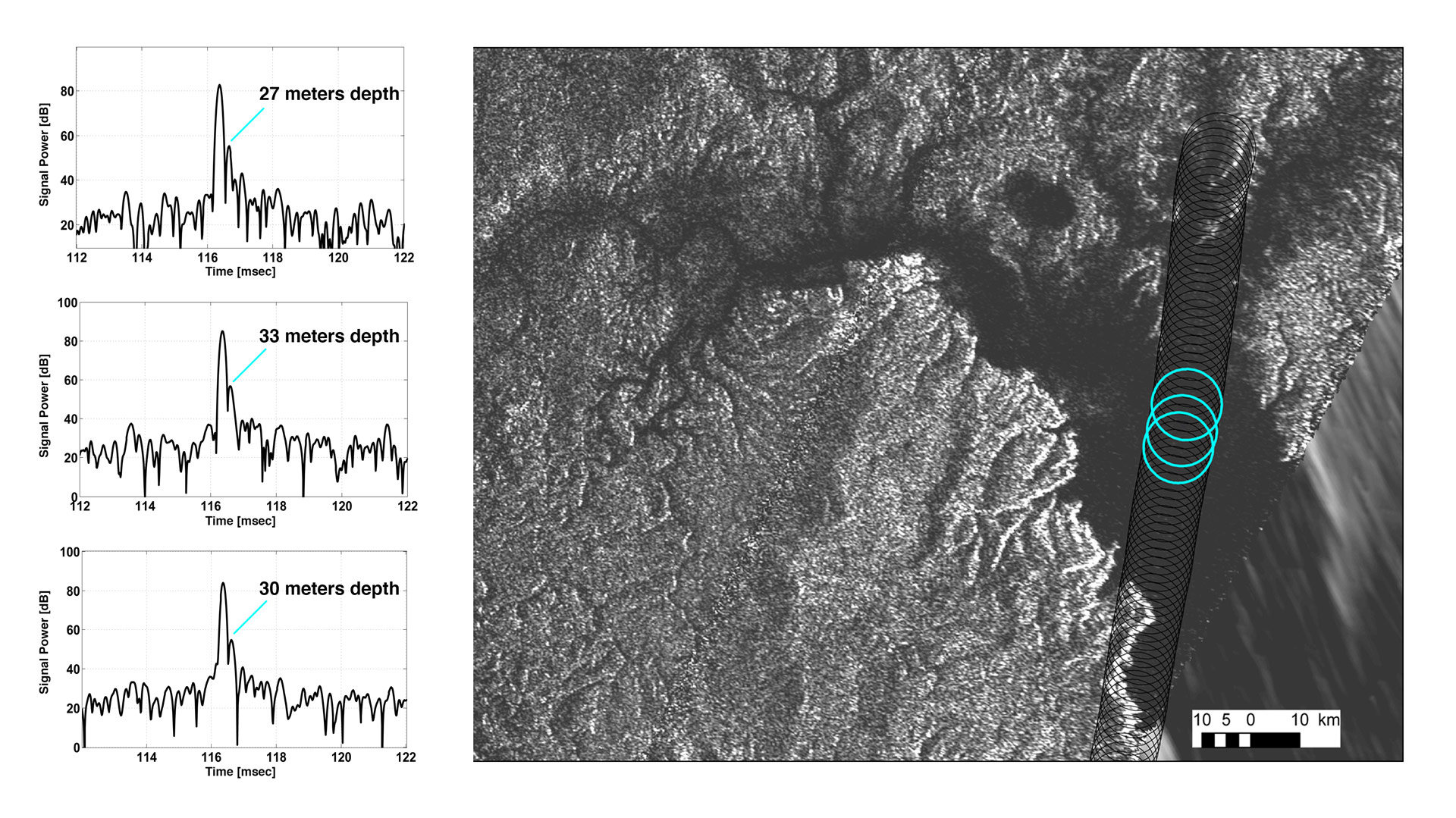
    Cassini radar data reveal the depth of a liquid methane/ethane sea on Saturn’s moon Titan near the mouth of a large, flooded river valley. Credit: NASA/JPL-Caltech/ASI/Cornell

    During a recent flyby, the Cassini spacecraft observed new, bright features in the seas that might be related to the mysterious feature that researchers dubbed the “magic island.”

    NASA’s Cassini mission continues its adventures in extraterrestrial oceanography with new findings about the hydrocarbon seas on Saturn’s moon Titan.

    The findings are being presented this week at the Division for Planetary Sciences Meeting of the American Astronomical Society held in Tucson, Arizona.

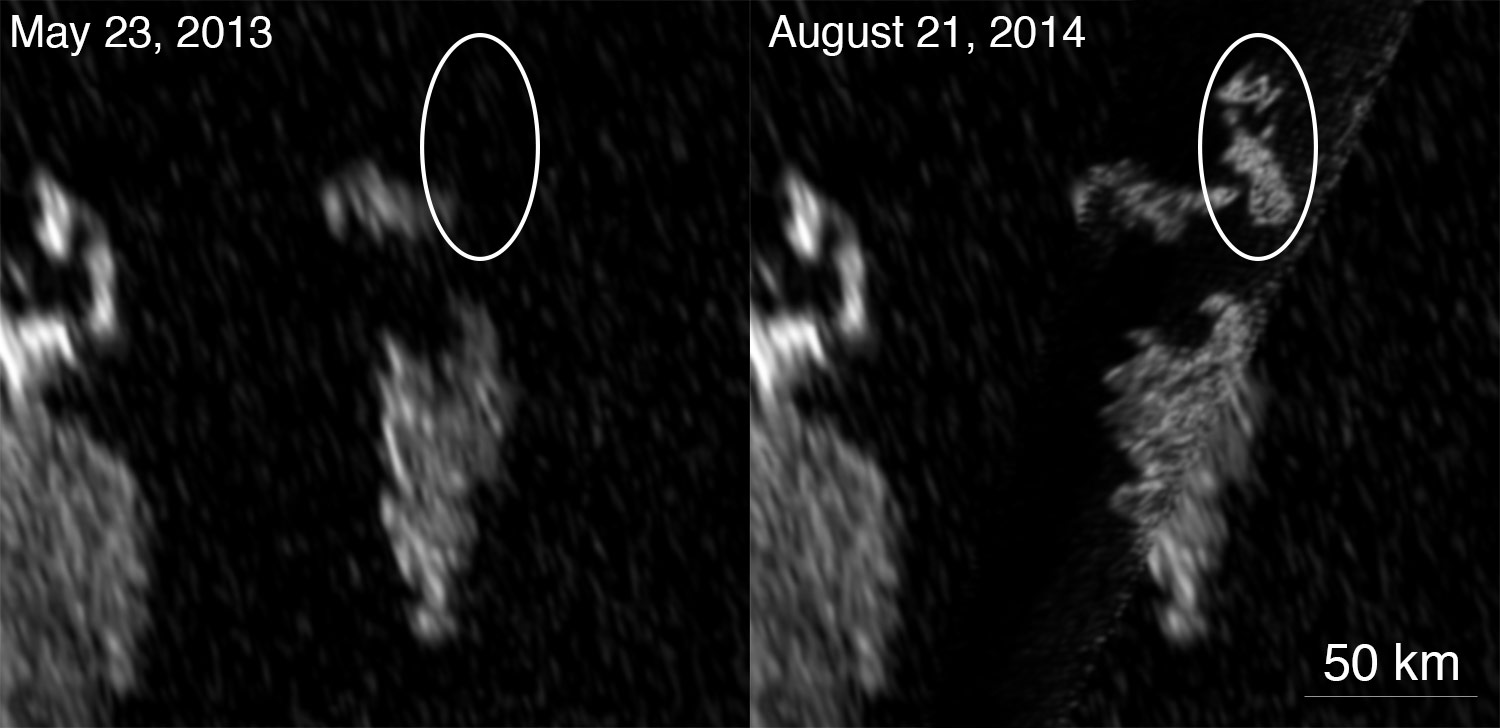
    To the delight of Cassini scientists, two new bright features appeared in Titan’s largest sea, Kraken Mare, during the August 21 flyby. In contrast to a previously reported bright, mystery feature in another of Titan’s large seas, Ligeia Mare, the new features in Kraken Mare were observed in both radar data and images from Cassini’s Visible and Infrared Mapping Spectrometer (VIMS). Having observations at two different wavelengths provides researchers with important clues to the nature of these enigmatic objects

    The VIMS data suggest the new features might have similarities to places in and around the seas that the Cassini team has interpreted as waves or wet ground. The observations support two of the possible explanations the team thinks are most likely – that the features might be waves or floating debris.
    Cassini Spots a Bright Feature in Kraken Mare
    Cassini’s radar instrument images show that a bright feature appeared in Kraken Mare, Titan’s largest sea. Credit: NASA/JPL-Caltech/ASI/Cornell

    Unfortunately for mystery lovers, the August Titan flyby marked the final opportunity for Cassini’s radar to observe Kraken Mare. However, the spacecraft is scheduled to observe the original “magic island” feature in Ligeia Mare once more, in January 2015.

    The August Titan flyby also included a segment designed to collect altimetry (or height) data, using the spacecraft’s radar instrument along a 120-mile (200-kilometer) shore-to-shore track of Kraken Mare. For a 25-mile (40-kilometer) segment of this data along the sea’s eastern shoreline, Cassini’s radar beam bounced off the sea bottom and back to the spacecraft, revealing the sea’s depth in that area. This region, which is near the mouth of a large, flooded river valley, showed depths of 66 to 115 feet (20 to 35 meters). Cassini will perform this experiment one last time in January 2015, to try to measure the depth of Punga Mare. Punga Mare is the smallest of three large seas in Titan’s far north, and the only sea whose depth has not been observed by Cassini.

    Scientists think that, for the areas in which Cassini did not observe a radar echo from the seafloor, Kraken Mare might be too deep for the radar beam to penetrate. Alternatively, the signal over this region might simply have been absorbed by the liquid, which is mostly methane and ethane. The altimetry data for the area in and around Kraken Mare also showed relatively steep slopes leading down to the sea, which also suggests the Kraken Mare might indeed be quite deep.

    The Cassini-Huygens mission is a cooperative project of NASA, the European Space Agency, and the Italian Space Agency. JPL, a division of the California Institute of Technology, Pasadena, manages the mission for NASA’s Science Mission Directorate in Washington. The VIMS team is based at the University of Arizona in Tucson. The radar instrument was built by JPL and the Italian Space Agency, working with team members from the US and several European countries.

    Never miss a breakthrough: Join the SciTechDaily newsletter.
    Follow us on Google and Google News.

    Astronomy Cassini-Huygens Mission Planetary Science Titan
    Share. Facebook Twitter Pinterest LinkedIn Email Reddit

    Related Articles

    Cassini Reveals Clues about Saturn’s Moon Titan

    New Cassini Images of Titan’s Hydrocarbon Seas and Lakes

    NASA’s Cassini Detects Propylene on Titan for the First Time

    Cassini Reveals a Rigid and Weathered Ice Shell on Titan

    Cassini Helps Explain the Mystery of the Missing Waves on Titan

    Cassini Data Confirms PAHs Play Major Role in Production of Lower Haze on Titan

    Scientists Use Cassini Data to Create First Global Topographic Map of Titan

    Titan’s Methane May Run Out

    Cassini Spots a Nile Like River Valley on Titan

    Leave A Reply Cancel Reply

    • Facebook
    • Twitter
    • Pinterest
    • YouTube

    Don't Miss a Discovery

    Subscribe for the Latest in Science & Tech!

    Trending News

    Scientists Warn That This Common Pet Fish Can Wreck Entire Ecosystems

    Scientists Make Breakthrough in Turning Plastic Trash Into Clean Fuel Using Sunlight

    This Popular Supplement May Interfere With Cancer Treatment, Scientists Warn

    Scientists Finally Solved One of Water’s Biggest Mysteries

    Could This New Weight-Loss Pill Disrupt the Entire Market? Here’s What You Should Know About Orforglipron

    Earth’s Crust Is Tearing Open in Africa, and It Could Form a New Ocean

    Breakthrough Bowel Cancer Trial Leaves Patients Cancer-Free for Nearly 3 Years

    Natural Compound Shows Powerful Potential Against Rheumatoid Arthritis

    Follow SciTechDaily
    • Facebook
    • Twitter
    • YouTube
    • Pinterest
    • Newsletter
    • RSS
    SciTech News
    • Biology News
    • Chemistry News
    • Earth News
    • Health News
    • Physics News
    • Science News
    • Space News
    • Technology News
    Recent Posts
    • Researchers Discover Boosting a Single Protein Helps the Brain Fight Alzheimer’s
    • AI Detects “Invisible” Signs of Pancreatic Cancer Years Before Diagnosis
    • Kratom Use Explodes in the US, With Life-Changing Consequences
    • Scientists Uncover Fatal Weakness in “Zombie Cells” Linked to Cancer
    • World-First Study Reveals Human Hearts Can Regenerate After a Heart Attack
    Copyright © 1998 - 2026 SciTechDaily. All Rights Reserved.
    • Science News
    • About
    • Contact
    • Editorial Board
    • Privacy Policy
    • Terms of Use

    Type above and press Enter to search. Press Esc to cancel.