
Close Menu
    Facebook X (Twitter) Instagram
    SciTechDaily
    • Biology
    • Chemistry
    • Earth
    • Health
    • Physics
    • Science
    • Space
    • Technology
    Facebook X (Twitter) Pinterest YouTube RSS
    SciTechDaily
    Home»Space»Cassini Views Enceladus’ Intriguing South-Polar Jets
    Space

    Cassini Views Enceladus’ Intriguing South-Polar Jets

    By SciTechDailyJuly 17, 2017No Comments2 Mins Read
    Facebook Twitter Pinterest Telegram LinkedIn WhatsApp Email Reddit
    Share
    Facebook Twitter LinkedIn Pinterest Telegram Email Reddit
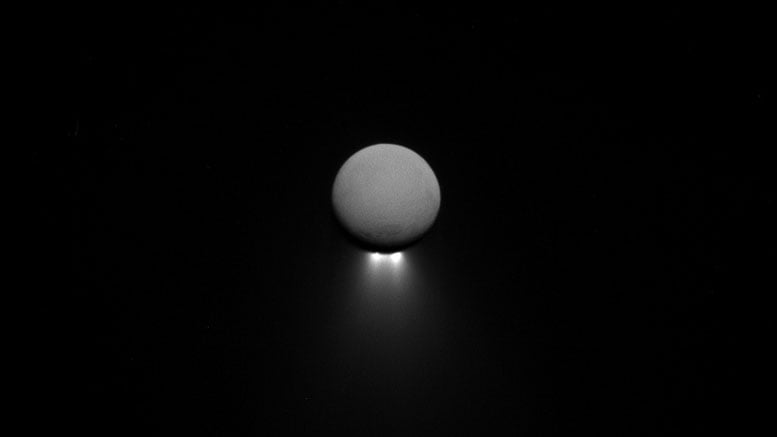
    Cassini Views Enceladus' Intriguing South-Polar Jets from Afar
    The south-polar jets of Enceladus were illuminated by the sun as the moon softly radiates in the reflected light of Saturn. Credit: NASA/JPL-Caltech/Space Science Institute

    NASA’s Cassini Spacecraft views Enceladus’ intriguing south-polar jets from afar, backlit by sunlight while the moon itself glows softly in reflected Saturn-shine.

    Observations of the jets taken from various viewing geometries provide different insights into these remarkable features. Cassini has gathered a wealth of information in the hopes of unraveling the mysteries of the subsurface ocean that lurks beneath the moon’s icy crust.

    This view looks toward the Saturn-facing hemisphere of Enceladus (313 miles or 504 kilometers across). North is up. The image was taken in visible light with the Cassini spacecraft narrow-angle camera on April 13, 2017.

    The view was acquired at a distance of approximately 502,000 miles (808,000 kilometers) from Enceladus and at a sun-Enceladus-spacecraft, or phase, angle of 176 degrees. Image scale is 3 miles (5 kilometers) per pixel.

    The Cassini mission is a cooperative project of NASA, ESA (the European Space Agency) and the Italian Space Agency. The Jet Propulsion Laboratory, a division of the California Institute of Technology in Pasadena, manages the mission for NASA’s Science Mission Directorate, Washington. The Cassini orbiter and its two onboard cameras were designed, developed and assembled at JPL. The imaging operations center is based at the Space Science Institute in Boulder, Colorado.

    Never miss a breakthrough: Join the SciTechDaily newsletter.
    Follow us on Google and Google News.

    Astronomy Cassini-Huygens Mission Enceladus Planetary Science
    Share. Facebook Twitter Pinterest LinkedIn Email Reddit

    Related Articles

    ScienceCasts Video: Close Encounter with Enceladus

    Cassini’s Deepest-Ever Dive Through the Enceladus Plume

    NASA Prepares for Historic Flyby of Icy Saturn Moon Enceladus

    NASA’s Cassini Reveals New Views of Saturn’s Moon Enceladus

    Cassini Spacecraft to Begin Flyby of Saturn’s Moon Enceladus

    Cassini Reveals Global Ocean in Saturn’s Moon Enceladus

    Activity on Enceladus Could Be ‘Curtain Eruptions’

    Astronomers Track Icy Tendrils Reaching into Saturn’s E Ring

    NASA Detects Ocean Inside Saturn’s Moon Enceladus

    Leave A Reply Cancel Reply

    • Facebook
    • Twitter
    • Pinterest
    • YouTube

    Don't Miss a Discovery

    Subscribe for the Latest in Science & Tech!

    Trending News

    Invisible Black Holes Could Be Triggering Supernovae

    Scientists Discover the First Contagious Cancer in a Freshwater Animal

    THC-CBD Treatment Dramatically Reduces Agitation in Dementia Trial

    Scientists Say Love Follows Mathematical Patterns

    “Zombie Cells” Reveal a Hidden Weakness That Could Help Fight Aging

    Alien Signals May Be Hiding in a Radio Band SETI Has Barely Explored

    Earth’s Hidden Thermostat Has Regulated Climate for 60 Million Years

    This 518-Million-Year-Old Creature Reveals How Spiders Got Their Bite

    Follow SciTechDaily
    • Facebook
    • Twitter
    • YouTube
    • Pinterest
    • Newsletter
    • RSS
    SciTech News
    • Biology News
    • Chemistry News
    • Earth News
    • Health News
    • Physics News
    • Science News
    • Space News
    • Technology News
    Recent Posts
    • 30-Year-Old Museum Rock May Hide a New Mosasaur Species
    • Unzipping the Code of Life: Scientists Pinpoint Where DNA First Opens
    • Loneliness Is Making People Sick – but Medicine Can’t Fix It Alone
    • American Heart Association Reveals How Much Coffee Is Safe for Your Heart
    • Europa’s Hidden Ocean May Be Locked Beneath a Frozen Wall
    Copyright © 1998 - 2026 SciTechDaily. All Rights Reserved.
    • Science News
    • About
    • Contact
    • Editorial Board
    • Privacy Policy
    • Terms of Use

    Type above and press Enter to search. Press Esc to cancel.