
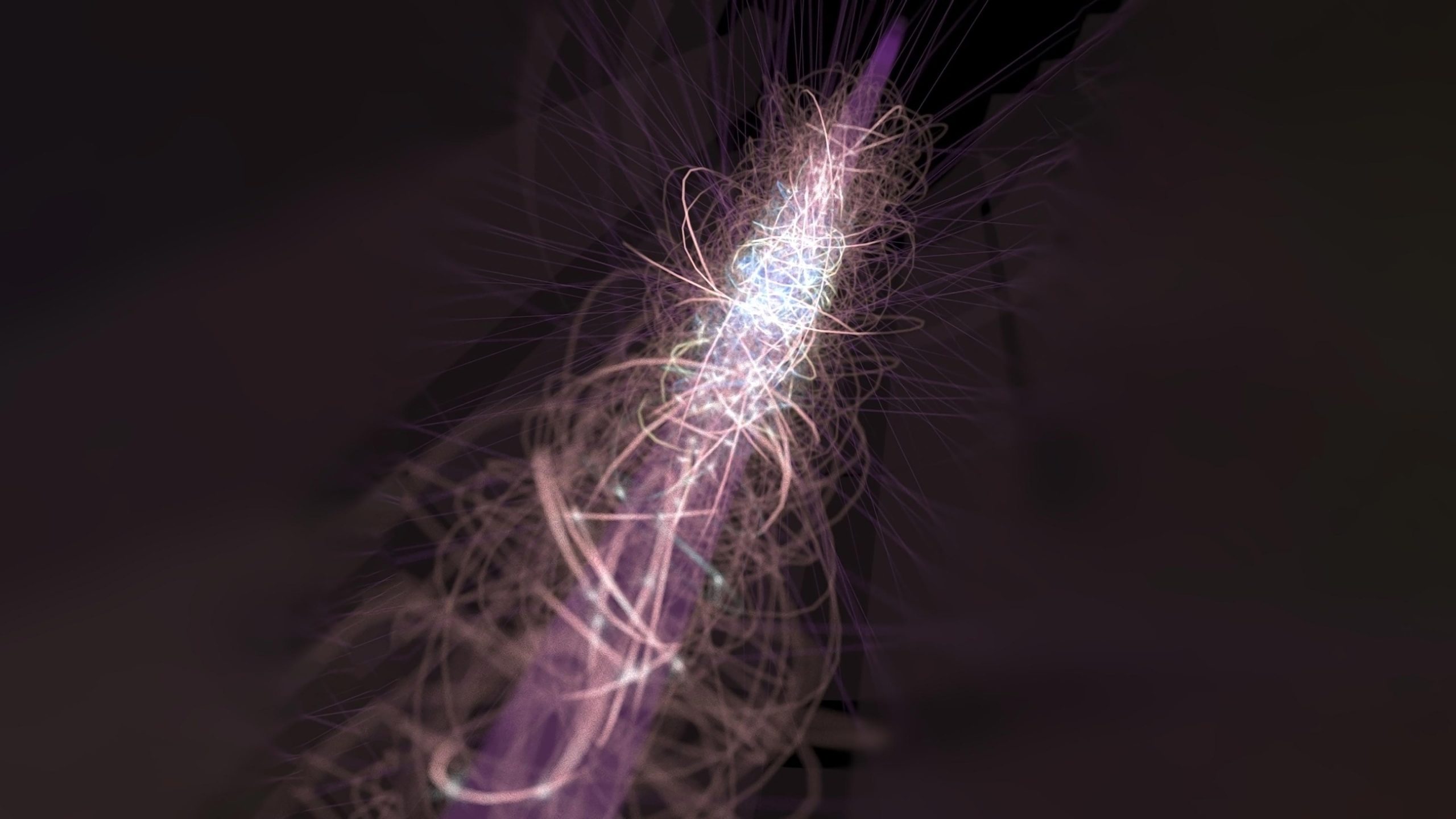
Physicists have laser-cooled antihydrogen atoms for the first time, dramatically improving the precision of experiments that probe antimatter.
The result opens the door to considerably more precise studies of the response of antimatter to light and how it behaves under the influence of gravity.
Swansea University physicists, as leading members of the ALPHA collaboration at CERN, have demonstrated laser cooling of antihydrogen atoms for the first time. The groundbreaking achievement produces colder antimatter than ever before and enables an entirely new class of experiments, helping scientists learn more about antimatter in the future.
In a paper published on March 31, 2021, in Nature, the collaboration reports that the temperature of antihydrogen atoms trapped inside a magnetic bottle is reduced when the atoms scatter light from an ultraviolet laser beam, slowing the atoms down and reducing the space they occupy in the bottle — both vital aspects of future more detailed studies of the properties of antimatter.
Spectral Line Narrowing Enhances Precision
In addition to showing that the energy of the antihydrogen atoms was decreased, the physicists also found a reduction in the range of wavelengths that the cold atoms can absorb or emit light on, so the spectral line (or color band) is narrowed due to the reduced motion.
This latter effect is of particular interest, as it will allow a more precise determination of the spectrum which in turn reveals the internal structure of the antihydrogen atoms.
Antimatter is a necessity in the most successful quantum mechanical models of particle physics. It became available in the laboratory nearly a century ago with the discovery of the positively charged positron, the antimatter counterpart of the negatively charged electron.
Annihilation, Asymmetry, and a Cosmic Mystery
When matter and antimatter come together annihilation occurs; a striking effect wherein the original particles disappear. Annihilation can be observed in the laboratory and is even used in medical diagnostic techniques such as positron emission tomography (PET) scans. However, antimatter presents a conundrum. An equal amount of antimatter and matter formed in the Big Bang, but this symmetry is not preserved today as antimatter seems to be virtually absent from the visible universe.
Swansea University’s Professor Niels Madsen, who was responsible for the experimental run, said: “Since there is no antihydrogen around, we have to make it in the lab at CERN. It’s a remarkable feat that we can now also laser-cool antihydrogen and make a very precise spectroscopic measurement, all in less than a single day. Only two years ago, the spectroscopy alone would take ten weeks. Our goal is to investigate if the properties of our antihydrogen match those of ordinary hydrogen as expected by symmetry. A difference, however small, could help explain some of the deep questions surrounding antimatter.”
Professor Eriksson, who was responsible for the spectroscopy lasers involved in the study, said: “This spectacular result takes antihydrogen research to the next level, as the improved precision that laser cooling brings puts us in contention with experiments on normal matter. This is a tall order since the spectrum of hydrogen that we compare with has been measured with a staggering precision of fifteen digits. We are already upgrading our experiment to meet the challenge!”
Read World’s First Laser-Based Manipulation of Antimatter for more on this research.
Reference: “Laser cooling of antihydrogen atoms” by C. J. Baker, W. Bertsche, A. Capra, C. Carruth, C. L. Cesar, M. Charlton, A. Christensen, R. Collister, A. Cridland Mathad, S. Eriksson, A. Evans, N. Evetts, J. Fajans, T. Friesen, M. C. Fujiwara, D. R. Gill, P. Grandemange, P. Granum, J. S. Hangst, W. N. Hardy, M. E. Hayden, D. Hodgkinson, E. Hunter, C. A. Isaac, M. A. Johnson, J. M. Jones, S. A. Jones, S. Jonsell, A. Khramov, P. Knapp, L. Kurchaninov, N. Madsen, D. Maxwell, J. T. K. McKenna, S. Menary, J. M. Michan, T. Momose, P. S. Mullan, J. J. Munich, K. Olchanski, A. Olin, J. Peszka, A. Powell, P. Pusa, C. Ø. Rasmussen, F. Robicheaux, R. L. Sacramento, M. Sameed, E. Sarid, D. M. Silveira, D. M. Starko, C. So, G. Stutter, T. D. Tharp, A. Thibeault, R. I. Thompson, D. P. van der Werf and J. S. Wurtele, 31 March 2021, Nature.
DOI: 10.1038/s41586-021-03289-6
Never miss a breakthrough: Join the SciTechDaily newsletter.
Follow us on Google and Google News.