

Scientists one step closer to understanding the mystery of matter in the universe.
- Neutron’s ‘electric dipole moment’ smaller than ever predicted
- New international standard for detail and sensitivity has been set
- Scientists one step closer to understanding the mystery of matter in the Universe
Scientists at the University of Sussex have measured a property of the neutron – a fundamental particle in the universe — more precisely than ever before. Their research is part of an investigation into why there is matter left over in the universe, that is, why all the antimatter created in the Big Bang didn’t just cancel out the matter.
The team – which included the Science and Technology Facilities Council’s (STFC) Rutherford Appleton Laboratory in the UK, the Paul Scherrer Institute (PSI) in Switzerland, and a number of other institutions – was looking into whether or not the neutron acts like an “electric compass”. Neutrons are believed to be slightly asymmetrical in shape, being slightly positive at one end and slightly negative at the other — a bit like the electrical equivalent of a bar magnet. This is the so-called “electric dipole moment” (EDM), and is what the team was looking for.
This is an important piece of the puzzle in the mystery of why matter remains in the Universe, because scientific theories about why there is matter left over also predict that neutrons have the “electric compass” property, to a greater or lesser extent. Measuring it then it helps scientists to get closer to the truth about why matter remains.

The team of physicists found that the neutron has a significantly smaller EDM than predicted by various theories about why matter remains in the universe; this makes these theories less likely to be correct, so they have to be altered, or new theories found. In fact, it’s been said in the literature that over the years, these EDM measurements, considered as a set, have probably disproved more theories than any other experiment in the history of physics. The results are reported today, Friday February 28, 2020, in the journal Physical Review Letters.
Professor Philip Harris, Head of the School of Mathematical and Physical Sciences and leader of the EDM group at the University of Sussex, said:
“After more than two decades of work by researchers at the University of Sussex and elsewhere, a final result has emerged from an experiment designed to address one of the most profound problems in cosmology for the last fifty years: namely, the question of why the Universe contains so much more matter than antimatter, and, indeed, why it now contains any matter at all. Why didn’t the antimatter cancel out all the matter? Why is there any matter left?
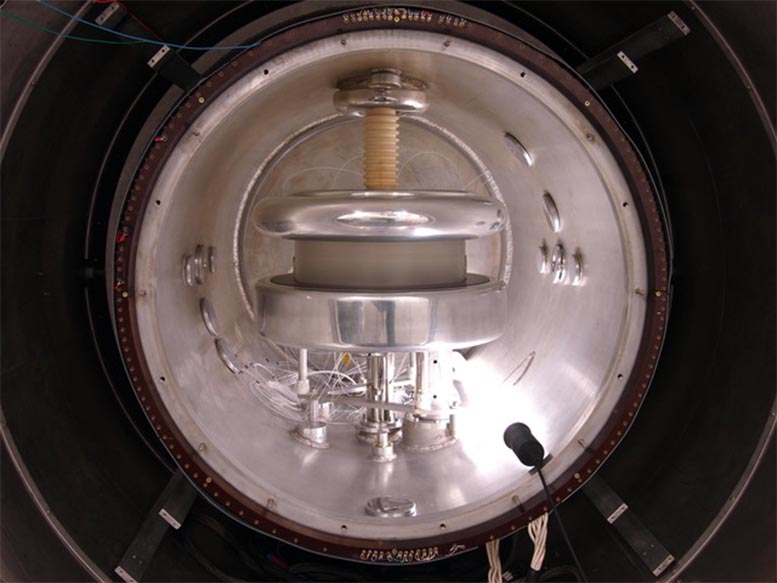
“The answer relates to a structural asymmetry that should appear in fundamental particles like neutrons. This is what we’ve been looking for. We’ve found that the “electric dipole moment” is smaller than previously believed. This helps us to rule out theories about why there is matter left over — because the theories governing the two things are linked.
“We have set a new international standard for the sensitivity of this experiment. What we’re searching for in the neutron — the asymmetry which shows that it is positive at one end and negative at the other – is incredibly tiny. Our experiment was able to measure this in such detail that if the asymmetry could be scaled up to the size of a football, then a football scaled up by the same amount would fill the visible Universe”.
The experiment is an upgraded version of apparatus originally designed by researchers at the University of Sussex and the Rutherford Appleton Laboratory (RAL), and which has held the world sensitivity record continuously from 1999 until now.
Dr. Maurits van der Grinten, from the neutron EDM group at the Rutherford Appleton Laboratory (RAL), said:
“The experiment combines various state-of-the-art technologies that all need to perform simultaneously. We’re pleased that the equipment, technology, and expertise developed by scientists from RAL has contributed to the work to push the limit on this important parameter”
Dr. Clark Griffith, Lecturer in Physics from the School of Mathematical and Physical Sciences at the University of Sussex, said:
“This experiment brings together techniques from atomic and low energy nuclear physics, including laser-based optical magnetometry and quantum-spin manipulation. By using these multi-disciplinary tools to measure the properties of the neutron extremely precisely, we are able to probe questions relevant to high-energy particle physics and the fundamental nature of the symmetries underlying the universe. “
50,000 measurements
Any electric dipole moment that a neutron may have is tiny, and so is extremely difficult to measure. Previous measurements by other researchers have borne this out. In particular, the team had to go to great lengths to keep the local magnetic field very constant during their latest measurement. For example, every truck that drove by on the road next to the institute disturbed the magnetic field on a scale that would have been significant for the experiment, so this effect had to be compensated for during the measurement.
Also, the number of neutrons observed needed to be large enough to provide a chance to measure the electric dipole moment. The measurements ran over a period of two years. So-called ultracold neutrons, that is, neutrons with a comparatively slow speed, were measured. Every 300 seconds, a bunch of more than 10,000 neutrons was directed to the experiment and examined in detail. The researchers measured a total of 50,000 such bunches.
A new international standard is set
The researchers’ latest results supported and enhanced those of their predecessors: a new international standard has been set. The size of the EDM is still too small to measure with the instruments that have been used up until now, so some theories that attempted to explain the excess of matter have become less likely. The mystery therefore remains, for the time being.
The next, more precise, measurement is already being constructed at PSI. The PSI collaboration expects to start their next series of measurements by 2021.
Search for “new physics”
The new result was determined by a group of researchers at 18 institutes and universities in Europe and the USA on the basis of data collected at PSI’s ultracold neutron source. The researchers collected measurement data there over a period of two years, evaluated it very carefully in two separate teams, and were then able to obtain a more accurate result than ever before.
The research project is part of the search for “new physics” that would go beyond the so-called Standard Model of Physics, which sets out the properties of all known particles. This is also a major goal of experiments at larger facilities such as the Large Hadron Collider (LHC) at CERN.
The techniques originally developed for the first EDM measurement in the 1950s led to world-changing developments such as atomic clocks and MRI scanners, and to this day it retains its huge and ongoing impact in the field of particle physics.
Reference: “Measurement of the Permanent Electric Dipole Moment of the Neutron” by C. Abel1, S. Afach, N. J. Ayres, C. A. Baker, G. Ban, G. Bison, K. Bodek, V. Bondar, M. Burghoff, E. Chane, Z. Chowdhuri, P.-J. Chiu, B. Clement, C. B. Crawford, M. Daum, S. Emmenegger, L. Ferraris-Bouchez, M. Fertl, P. Flaux B. Franke, A. Fratangelo, P. Geltenbort, K. Green, W. C. Griffith, M. van der Grinten, Z. D. Grujić, P. G. Harris, L. Hayen, W. Heil, R. Henneck, V. Hélaine, N. Hild, Z. Hodge, M. Horras, P. Iaydjiev, S. N. Ivanov, M. Kasprzak, Y. Kermaidic, K. Kirch, A. Knecht, P. Knowles, H.-C. Koch, P. A. Koss, S. Komposch, A. Kozela, A. Kraft, J. Krempe, M. Kuźniak, B. Lauss, T. Lefort, Y. Lemière, A. Leredde, P. Mohanmurthy, A. Mtchedlishvili, M. Musgrave, O. Naviliat-Cuncic, D. Pais, F. M. Piegsa, E. Pierre, G. Pignol, C. Plonka-Spehr, P. N. Prashanth, G. Quéméner, M. Rawlik, D. Rebreyend, I. Rienäcker, D. Ries, S. Roccia, G. Rogel, D. Rozpedzik, A. Schnabe, P. Schmidt-Wellenburg, N. Severijns, D. Shiers, R. Tavakoli Dinani, J. A. Thorne, R. Virot, J. Voigt, A. Weis, E. Wursten, G. Wyszynski, J. Zejma, J. Zenner and G. Zsigmond, 28 February 2020, Physical Review Letters.
DOI: 10.1103/PhysRevLett.124.081803
Never miss a breakthrough: Join the SciTechDaily newsletter.
Follow us on Google and Google News.