
A Caltech team has developed a new tabletop tool using radioactive radium molecules to detect symmetry violations that may explain the matter-antimatter imbalance in the universe.
Stars, galaxies, and everything in the universe, including our own bodies, are comprised of so-called regular matter. Regular matter includes atoms and molecules, which are made up of tiny particles, such as electrons, protons, and neutrons. These particles dominate our universe, vastly outnumbering their lesser-known counterparts: antimatter particles. First experimentally discovered in 1932 by the late Nobel laureate and longtime Caltech professor Carl Anderson (BS ’27, PhD ’30), antimatter particles have the opposite charges to their matter counterparts. The antimatter particle to the negatively charged electron, for example, is the positively charged positron.
How did matter come to overshadow antimatter? Scientists believe that something happened early in the history of our cosmos to tip the balance of particles to matter, causing antimatter to largely disappear. How this occurred is still a mystery.
Probing Symmetry to Solve a Cosmic Puzzle
In a new study in the journal Physical Review Letters, Nick Hutzler (BS ’07), assistant professor of physics at Caltech, and his graduate student Phelan Yu, propose a new tabletop-based tool to search for answers to the antimatter riddle. Like other physicists studying the problem, the researchers’ main idea is to look for asymmetries in how regular matter interacts with electromagnetic fields. This is related to a type of symmetry commonly seen in particles called charge parity, or CP. Any deviations from the expected CP symmetry might explain how matter ultimately edged out antimatter in our universe.
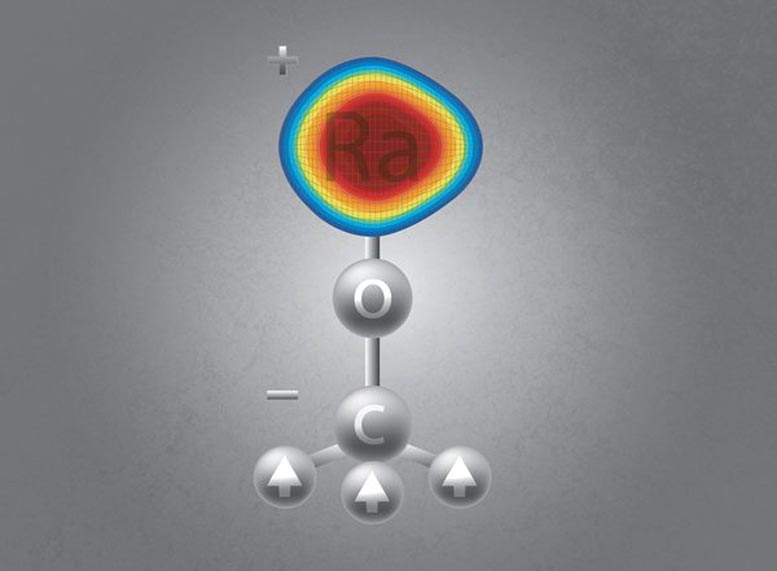
Hutzler and his colleagues theoretically worked out a new way to probe these symmetry violations using a radioactive molecule called a radium monomethoxide ion, or RaOCH3+. Their partners at UC Santa Barbara, led by Andrew Jayich, then created these molecules for the first time and published the results in a companion article in Physical Review Letters.
The joint studies demonstrate that radioactive molecules have the potential to be even more sensitive probes of fundamental particle symmetries than the non-radioactive atoms commonly used today.

“The state-of-the-art method for this type of study uses atoms,” explains Hutzler. “But molecules can be even better probes because they have baked-in asymmetry. They are lumpy and lopsided to begin with. The radium nucleus is even lumpier since it has a very uneven charge distribution, and this also helps. The result is a 100,000 to 1,000,000 larger amplification of symmetry violations, if any are present, compared to what has been state of the art.”
To look for symmetry violations in particles, researchers generally observe how particles behave in electric fields. They search for abnormal behaviors that break the known symmetry rules; for instance, physicists have predicted that symmetry violations might cause an electron to precess, or wobble around like a spinning top, in an electric field. Molecules have electromagnetic fields inside them, due to their asymmetrical nature, so they make ideal targets for this kind of work.
Hutzler says he had thought about using radium-based molecules for this purpose before, even calling himself a “radium fanboy,” but explained that the isotope they need is extremely radioactive with a half-life of two weeks (half of a lump of radium will decay into other nuclei in just two weeks).
“This radium isotope is very radioactive and very scarce, which makes working with it difficult,” explains Hutzler. “But the unique properties of the RaOCH3+ molecule overcome many of these challenges, and, when combined with the experimental technique demonstrated at UC Santa Barbara, will enable modern, quantum, highly sensitive methods to search for these symmetry violations.”
Complementary Approaches to the Antimatter Puzzle
The new tabletop method is complementary to other techniques that search for clues to the antimatter mystery, including related experiments performed in the Hutzler lab as well as the neutron Electric Dipole Moment, or nEDM experiment, which is being built in part at Caltech by Brad Filippone, the Francis L. Moseley Professor of Physics, and his team. In fact, Hutzler worked with Filippone on this experiment as an undergraduate at Caltech. The nEDM experiment, which will ultimately take place at the Oak Ridge National Laboratory in about five years, will look for CP symmetry violations specifically in neutrons.
“This new approach is not as clean and direct as nEDM, but by using a whole molecule, we have the advantage of being able to sense symmetry violations in a range of particles,” says Hutzler.
The radioactive-molecule approach may take years more to fully develop but Hutzler says that he has been enjoying focusing on the theoretical aspect of the work.
“We’ve been starting to dabble more in theory partly due to the pandemic and having more time at home,” he says. “We probably would not have done this theory work otherwise.”
Reference: “Probing Fundamental Symmetries of Deformed Nuclei in Symmetric Top Molecules” by Phelan Yu and Nicholas R. Hutzler, 11 January 2021, Physical Review Letters.
DOI: 10.1103/PhysRevLett.126.023003
The study, titled “Probing Fundamental Symmetries of Deformed Nuclei in Symmetric Top Molecules,” was funded by the National Institute of Standards and Technology, the Gordon and Betty Moore Foundation, and the Alfred P. Sloan Foundation.
A more in-depth summary of the research can be found on the American Physical Society’s website.
Never miss a breakthrough: Join the SciTechDaily newsletter.
Follow us on Google and Google News.
2 Comments
“comprised of” …jeeze… Composed of is correct.
Checkout my book on antimatter for free https://www.fuion.net