
Close Menu
    Facebook X (Twitter) Instagram
    SciTechDaily
    • Biology
    • Chemistry
    • Earth
    • Health
    • Physics
    • Science
    • Space
    • Technology
    Facebook X (Twitter) Pinterest YouTube RSS
    SciTechDaily
    Home»Biology»Certain Proteins – Such As Bacterial Toxins and the COVID Vaccine – Pass Through Cell Walls “Like a Magic Trick”
    Biology

    Certain Proteins – Such As Bacterial Toxins and the COVID Vaccine – Pass Through Cell Walls “Like a Magic Trick”

    By Laura Arenschield, Ohio State UniversityOctober 27, 2021No Comments4 Mins Read
    Facebook Twitter Pinterest Telegram LinkedIn WhatsApp Email Reddit
    Share
    Facebook Twitter LinkedIn Pinterest Telegram Email Reddit
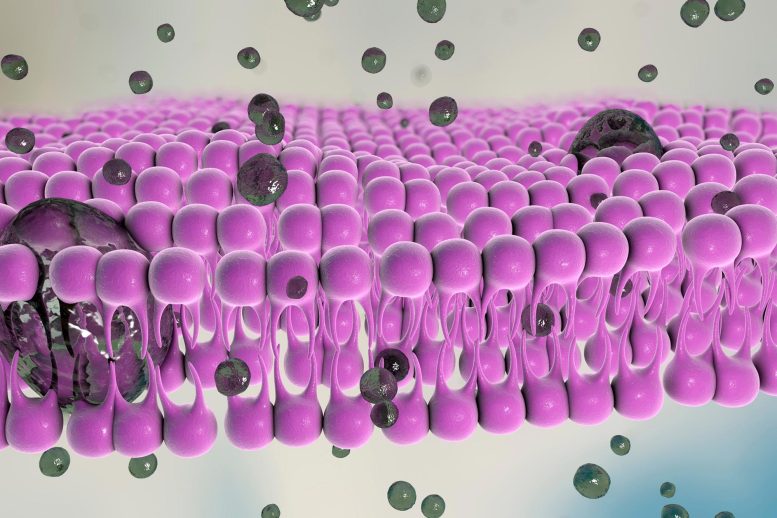
    Cell Plasma Membrane
    A recent study identified how proteins traverse a cell membrane, laying the groundwork for improved drug delivery into cells or treating illnesses caused by bacterial toxins in the future.

    Study First To Show How Some Toxins and Drugs Enter Cells

    For decades, scientists have wondered how large molecules such as proteins pass through cell walls, also known as plasma membranes, without leaving a trace. That ability is part of what makes certain drugs ­­­­– including some cancer treatments and the COVID-19 vaccine – work. And it is also how bacterial toxins enter human cells and wreak havoc.

    Peptides Cell Walls
    The researchers noticed that some peptides cross membranes by pushing against them. The peptides deformed the membrane into small circular buds. The buds then detach as small bubbles, which eventually “pop,” allowing the peptides to be released inside the cell. Credit: Ashweta Sahni

    Diphtheria Toxin as a Case Study

    One such example is diphtheria toxin, which is produced by Corynebacterium diphtheriae and causes diphtheria, a serious and potentially fatal bacterial infection of the nose and throat. But the mechanics of how these proteins enter human cells were a scientific mystery.

    Dehua Pei
    Dehua Pei. Credit: OSU

    A recent study, published in the journal ACS Chemical Biology, answers that mystery. The study identified the ways in which proteins cross a cell membrane, a finding that could create a scientific foundation for better ways of delivering drugs into cells in the future, or for treating illnesses caused by bacterial toxins.

    “It is almost like a magic trick, the way the membrane encapsulates these toxins,” said Dehua Pei, senior author of the study and a professor of chemistry and biochemistry at The Ohio State University.

    Pei’s research team at Ohio State has spent years trying to understand how biomolecules such as bacterial toxins get inside a human cell, with the goal of finding ways to get medications into those cells. It was through that work that the researchers discovered how some toxins were getting across the cell membranes, said Ashweta Sahni, lead author of the study and a graduate student in Pei’s lab at Ohio State.

    Researchers have known how small molecules penetrate cell membranes, typically by binding to the membrane and then diffusing through it. But they knew that proteins do not have that ability because they are too big. Until now, the most popular hypothesis was that proteins pass through small holes, known as pores, in the membrane, akin to the Parisian statue, Le Passe-Muraille, of a man passing through a wall. But Pei’s previous work did not support that hypothesis.

    Ashweta Sahni
    Ashweta Sahni. Credit: OSU

    The Budding-and-Collapse Mechanism in Action

    While working on the team’s other projects, Sahni noticed that some fragments of proteins, known as peptides, cross membranes by pushing against them. The peptides deformed the membrane into small circular buds. The buds then detach as small bubbles, known as vesicles, which eventually “pop,” allowing the peptides to be released inside the cell. The team subsequently observed that two structurally different bacterial toxins also employed this same mechanism. This discovery led them to conclude that this budding-and-collapse mechanism is a common mechanism employed by many large biomolecules.

    “This budding-and-collapse phenomenon was previously unknown, but we were able to witness it because we had the equipment, training and experience to know what we were looking at,” Sahni said.

    The team witnessed the budding-and-collapse in live cells through confocal microscopy, an imaging technique that allowed them to focus in on what was happening inside the cells, and on the cell membranes, with these specific proteins.

    Pei said the discovery could potentially open the door for new drug therapies that use this finding to manipulate the ways drugs enter a cell.

    Reference: “Bacterial Toxins Escape the Endosome by Inducing Vesicle Budding and Collapse” by Ashweta Sahni and Dehua Pei, 23 September 2021, ACS Chemical Biology.
    DOI: 10.1021/acschembio.1c00540

    This work was funded by the National Institutes of Health.

    Never miss a breakthrough: Join the SciTechDaily newsletter.
    Follow us on Google and Google News.

    Biochemistry Cell Biology Ohio State University Popular
    Share. Facebook Twitter Pinterest LinkedIn Email Reddit

    Related Articles

    Biology Textbooks Wrong? New Research Reveals the Secret Behind a Key Cellular Process

    “Symphony of Cellular Activities” Revealed by Fluorescent Imaging Technique

    Scientists Find Neurochemicals – Dopamine and Serotonin – Have Unexpectedly Profound Roles in the Human Brain

    Alien Microorganism Research Shows Humans and Other Mammals Could Struggle to Fight Space Germs

    Quadruple Helix DNA Formation Tracked in Live Human Cells for the First Time

    Beneath the Ocean’s Surface, a Virus Is Hijacking the Most Abundant Organism on Earth

    Breakthrough in Understanding Evolution – Mitochondrial Division Conserved Across Species

    ‘Butterfly Effect’ in a Protein Molecule – Changing Just 3 Atoms Causes Big Effect

    Researchers Decode Root Structure of Muscular Disease

    Leave A Reply Cancel Reply

    • Facebook
    • Twitter
    • Pinterest
    • YouTube

    Don't Miss a Discovery

    Subscribe for the Latest in Science & Tech!

    Trending News

    Mezcal “Worm” in a Bottle Mystery: DNA Testing Reveals a Surprise

    New Research Reveals That Your Morning Coffee Activates an Ancient Longevity Switch

    This Is What Makes You Irresistible to Mosquitoes

    Shockingly Powerful Giant Octopuses Ruled the Seas 100 Million Years Ago

    Scientists Stunned by New Organic Molecules Found on Mars

    Rewriting Dinosaur Evolution: Scientists Unearth Remarkable 150-Million-Year-Old Stegosaur Skull

    Omega-3 Supplements Linked to Cognitive Decline in Surprising New Study

    First-of-Its-Kind Discovery: Homer’s Iliad Found Embedded in a 1,600-Year-Old Egyptian Mummy

    Follow SciTechDaily
    • Facebook
    • Twitter
    • YouTube
    • Pinterest
    • Newsletter
    • RSS
    SciTech News
    • Biology News
    • Chemistry News
    • Earth News
    • Health News
    • Physics News
    • Science News
    • Space News
    • Technology News
    Recent Posts
    • Male Birth Control Breakthrough: Scientists Find Way To Turn Sperm Production Off and Back On
    • A Common Vitamin Could Hold the Key to Treating Fatty Liver Disease
    • New Research Shows Vitamin B12 May Hold the Key to Healthy Aging
    • Scientists Map Thousands of Brain Connections With RNA Barcodes
    • This Gene Tweak Turns Strawberries Into Healthier, Tastier Superfruit
    Copyright © 1998 - 2026 SciTechDaily. All Rights Reserved.
    • Science News
    • About
    • Contact
    • Editorial Board
    • Privacy Policy
    • Terms of Use

    Type above and press Enter to search. Press Esc to cancel.